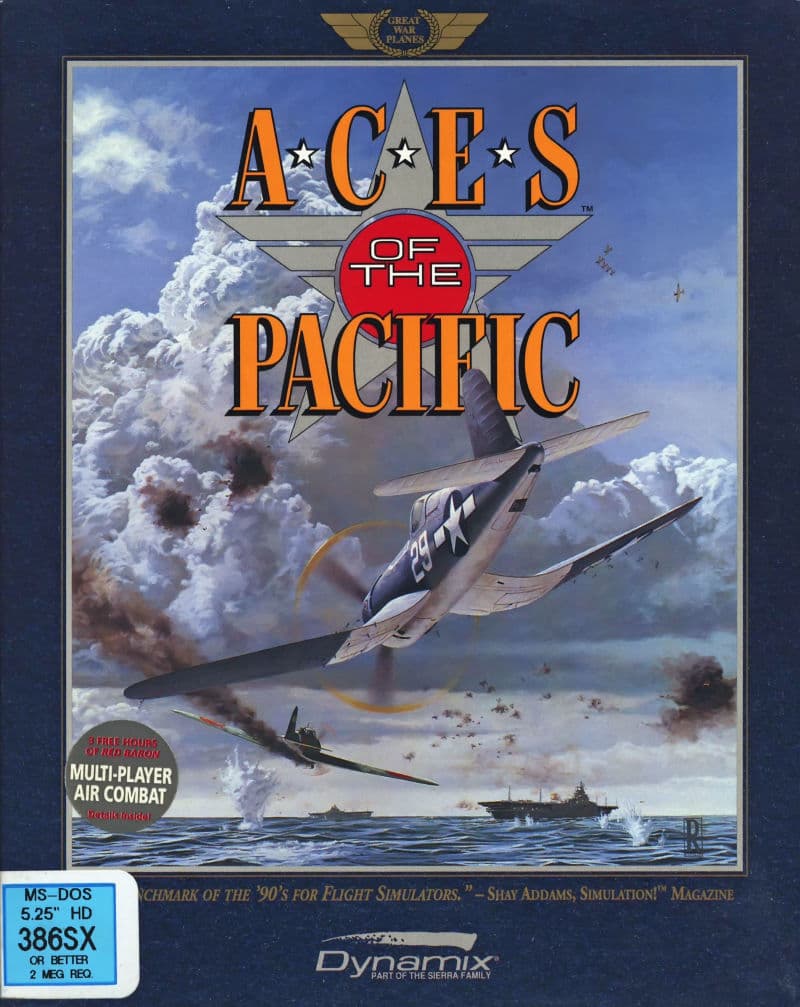
Aces of the Pacific
When Damon Slye's team built Aces of the Pacific, they moved away from World War I biplanes to construct a WWII combat simulator defined by unforgiving momentum and massive tactical variety.
Why Aces of the Pacific set the bar for flight models in 1992
Most flight simulators from this era pushed players into strict, linear dogfights, but this design opened up the entire Pacific theater. Designed by Damon Slye at Dynamix and published by Sierra On-Line, it expanded on what the studio learned from Red Baron by taking on naval operations and carrier strikes alongside land-based battles. You can hop into quick instant missions, build custom scenarios, or start a full war career flying for either the United States or Imperial Japanese forces.
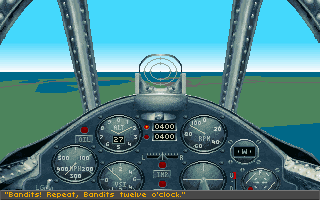
The 256-color VGA polygon engine handles realistic pilot physics, cockpit instrumentation, and flight controls with surprising precision. Flight dynamics punish sloppy maneuvers instantly: pull up too hard while pulling g-force and your vision fades to pitch black, while diving too aggressively forces a redout. You are forced to track speed, adjust landing flaps, and monitor fuel levels during long return trips over open ocean. Choosing a top-down tactical map view before entering a strike zone gives you a clear sense of enemy formations, but once you sit inside the cockpit, situational awareness relies entirely on checking your mirrors and craning your neck.
The control balance changes drastically depending on which of the included aircraft you decide to pilot:
- F6F Hellcat and Wildcat: Heavy armor and solid firepower that reward high-altitude diving strikes rather than sharp turning maneuvers.
- A6M Zero: Nimble turn rates that dominate early-war dogfights, offset by total lack of armor protection against heavy machine guns.
- P-38 Lightning and P-51 Mustang: High speed and long range ideal for escorting heavy bombers like the B-17 or B-24 deep into hostile territory.
- P-39 Airacobra: Features a massive 37mm nose cannon that destroys ground targets with a single hit, though its slow fire rate makes air-to-air hits tough.
Slogging through historical sorties and deadly cannon shells
Career mode spans the major clashes of WWII, including the Attack on Pearl Harbor, Battle of Midway, Coral Sea, and Leyte Gulf. You can also fly the famous high-priority interception mission targeting Admiral Isoroku Yamamoto. Missions span far beyond standard dogfighting: torpedo runs against aircraft carriers, low-level bombing passes against land bases, supply reconnaissance, and defensive escorts all demand distinct tactics.
In this simulation game, ammunition management becomes a constant anxiety. Firing off long bursts from machine guns or wing-mounted cannons drains your reserves in seconds, leaving you helpless when surprise interceptors appear on your tail. Enemy aces like Hiroyoshi Nishizawa, Saburo Sakai, Dick Bong, and Pappy Boyington fly with aggressive, historical AI behaviors. If you spot a veteran enemy squad leader on your tail, attempting to out-climb them without an altitude advantage usually ends in a spiraling fireball.
A single mistake during a carrier landing will wreck your plane completely. If you touch down too fast without catching the arrestor cable, you skip across the deck straight into the ocean. The damage model does not forgive poor judgment: taking hits to your oil line will slowly seize your engine mid-flight, while hydraulic failure jams your landing gear right when you need to land on a short jungle airstrip.
The Japanese campaign is an exercise in surviving against history
Choosing to play through the Japanese career path delivers a starkly different experience from the American side. Early in the conflict, the Zero lets you run rings around opposing Wildcat pilots, making early sorties feel manageable. As the calendar advances toward 1944 and 1945, however, the late-war technological shift hits hard. Facing endless waves of heavily armored US fighters while flying fragile aircraft turns late-game sorties into brutal battles for survival.
One of the best design inclusions in this 1992 release is the flight recorder feature. After finishing a tense mission, you can rewatch your entire flight from external angles, track enemy movements you missed in the heat of combat, or take control of the airplane mid-replay to try a different combat maneuver. It works as an analytical tool to see why your wingman went down and gives you a safety net for practicing tough approaches.
Massive manuals and high hardware costs defined the launch
When the original box hit store shelves, it contained a printed 233-page manual packed with tactics diagrams, aircraft specifications, and pilot biographies. Running the game smoothly on release was notoriously demanding on hardware. Reviewers loved the detailed graphics, though PC magazines noted that older processors struggled under heavy dogfights, making 386 setups essential for acceptable frame rates.
Audio support varied widely across sound cards of the time. Hearing the rumble of radial engines through a Sound Blaster card or an AdLib board brought the airfield to life, while a Roland MT-32 added rich orchestral atmosphere to menu screens. On launch, allocating enough conventional RAM in MS-DOS configuration files was a huge hurdle for players, as the executable pushed early system memory limits to its boundaries.
Dynamix later released an expansion pack titled WWII: 1946, exploring an alternate historical scenario involving a direct invasion of the Japanese mainland. That release introduced jet-powered prototypes like the American P-80 and Japanese aircraft like the J7W Shinden and Kikka. The original core game went on to sell over 350,000 copies, earning top review ratings from publications like Dragon Magazine and PC Gamer.
How to play Aces of the Pacific free in your browser right now
You can run this Sierra On-Line classic directly in your browser without dealing with base memory configurations or disk mounting tricks. You do not need to install software or tweak old system files to get into the air. If you want to sample classic flight mechanics with dozens of detailed aircraft and historical missions, it takes one click to jump right into the cockpit.
Launch the session below to experience the original Aces of the Pacific MS-DOS game instantly. You can test your gunnery skills against hostile fighters, practice difficult carrier trap landings, or experiment with the interactive camera replay tool right here in your browser window.