
aka Across
In Action SuperCross, single-handedly created by Balázs Rózsa, you ride a dirt bike across absurdly jagged geometry to pick up bright red apples before touching a target flower to exit.
In the late 1990s, simulating weight and momentum in two dimensions usually meant simple arcade gravity where a sprite dropped at a fixed speed. Hungarian programmer Balázs Rózsa took a far more ambitious route by writing an elastic motor-physics engine that calculated spring tension, inertia, and tire grip in real time. The outcome was a totally fresh take on racing and driving games, where managing your bike's center of mass mattered far more than holding down an accelerate key.
Instead of relying on standard terrain heightmaps, the game rendered levels out of raw geometric polygons across high VESA display modes, supporting both 320x200 and 640x480 resolutions. Underneath those minimalist visual shapes ran a continuous calculations loop that translated every keyboard input into suspension compression. Leaning back pulled the front wheel off the ground to clear low hurdles, while leaning forward slammed the chassis down to prevent flipping backward on steep inclines.
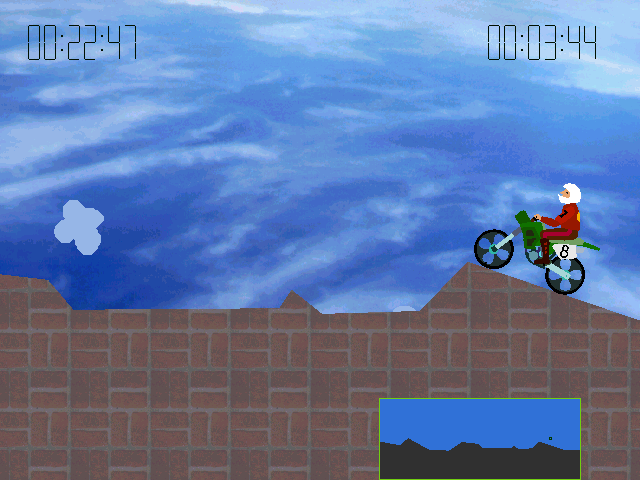
The rules of engagement are brutally straightforward. You must steer your dirt bike through a track, touch every single apple suspended in mid-air, and finally reach the exit flower to register a valid time. There are no enemies shooting at you, no dynamic lap timers counting down to an instant game over, and no boss fights waiting at the end of a stage.
The danger comes entirely from the environment and your driver's fragile neck. If the rider's helmet touches a ceiling, a wall, or the bare dirt floor at any speed, the round ends instantly and forces a complete restart. The levels are also littered with spiky rotating metal blades that shred the rider on contact. One misjudged bounce against an awkward slope sends you tumbling upside down into danger, turning early attempts into endless trial and error.
To keep players from quitting in sheer frustration, the full game includes 47 internal tracks and allows you to skip up to 5 levels whenever a single obstacle course feels completely insurmountable. That flexibility proved essential for survival, as the difficulty spike halfway through the level list leaves virtually no margin for error.
Because the spring physics model was built on flexible mechanical simulations rather than strict real-world constraints, clever players quickly discovered weird engine glitches. By rapidly rocking the rider back and forth while applying throttle at precise angles, you could load potential energy into the suspension and launch the motorcycle straight up into the sky. These strange airborne maneuvers allowed dedicated drivers to bypass entire caverns filled with spikes.
Sharing those crazy solutions became half the fun thanks to a built-in recording system. Balázs Rózsa added a feature that saved tiny .rec telemetry files after every successful run. Players swapped these tiny replay files over early internet forums and email lists to prove their record times or show off bizarre, physics-defying shortcuts.

The inclusion of a full track creator extended the game's lifespan infinitely beyond its original internal level set. Finnish gaming magazine MikroBitti awarded it shareware game of the month in 1997, recognizing that the clever toolset and engine depth set it far apart from typical budget releases. That exact design foundation would later lead directly into Rózsa's year 2000 sequel, Elasto Mania.
If you look purely at the presentation, the game shows its age instantly. The rider sprite looks basic, the terrain uses flat color fills, and the background environment is a plain black void. It lacks the engine polish or smooth texture work seen in commercial big-budget titles from the same year.
Yet the mechanical execution is sharp. Every movement of the motorcycle responds instantly to your keypresses, and the weight transfer feels logical once you understand how the wheels absorb impact. Success demands deep concentration, muscle memory, and a firm grasp of how energy moves through a virtual coil spring.
The graphics are plain, but the core drive to shave half a second off your best run makes this classic MS-DOS title deeply satisfying to revisit. Learning how to stretch the bike's front wheel across a wide gap without cracking your driver's helmet against a low ceiling is still a fantastic challenge.
You can experience this DOS version directly in your browser without downloading extra files or tweaking software options. You can play Action SuperCross online free right now, jump into the built-in level editor, or test your balance on the initial tracks in just a few quick button presses.
In Action SuperCross, single-handedly created by Balázs Rózsa, you ride a dirt bike across absurdly jagged geometry to pick up bright red apples before touching a target flower to exit.
In the late 1990s, simulating weight and momentum in two dimensions usually meant simple arcade gravity where a sprite dropped at a fixed speed. Hungarian programmer Balázs Rózsa took a far more ambitious route by writing an elastic motor-physics engine that calculated spring tension, inertia, and tire grip in real time. The outcome was a totally fresh take on racing and driving games, where managing your bike's center of mass mattered far more than holding down an accelerate key.
Instead of relying on standard terrain heightmaps, the game rendered levels out of raw geometric polygons across high VESA display modes, supporting both 320x200 and 640x480 resolutions. Underneath those minimalist visual shapes ran a continuous calculations loop that translated every keyboard input into suspension compression. Leaning back pulled the front wheel off the ground to clear low hurdles, while leaning forward slammed the chassis down to prevent flipping backward on steep inclines.
The rules of engagement are brutally straightforward. You must steer your dirt bike through a track, touch every single apple suspended in mid-air, and finally reach the exit flower to register a valid time. There are no enemies shooting at you, no dynamic lap timers counting down to an instant game over, and no boss fights waiting at the end of a stage.
The danger comes entirely from the environment and your driver's fragile neck. If the rider's helmet touches a ceiling, a wall, or the bare dirt floor at any speed, the round ends instantly and forces a complete restart. The levels are also littered with spiky rotating metal blades that shred the rider on contact. One misjudged bounce against an awkward slope sends you tumbling upside down into danger, turning early attempts into endless trial and error.
To keep players from quitting in sheer frustration, the full game includes 47 internal tracks and allows you to skip up to 5 levels whenever a single obstacle course feels completely insurmountable. That flexibility proved essential for survival, as the difficulty spike halfway through the level list leaves virtually no margin for error.
Because the spring physics model was built on flexible mechanical simulations rather than strict real-world constraints, clever players quickly discovered weird engine glitches. By rapidly rocking the rider back and forth while applying throttle at precise angles, you could load potential energy into the suspension and launch the motorcycle straight up into the sky. These strange airborne maneuvers allowed dedicated drivers to bypass entire caverns filled with spikes.
Sharing those crazy solutions became half the fun thanks to a built-in recording system. Balázs Rózsa added a feature that saved tiny .rec telemetry files after every successful run. Players swapped these tiny replay files over early internet forums and email lists to prove their record times or show off bizarre, physics-defying shortcuts.
The inclusion of a full track creator extended the game's lifespan infinitely beyond its original internal level set. Finnish gaming magazine MikroBitti awarded it shareware game of the month in 1997, recognizing that the clever toolset and engine depth set it far apart from typical budget releases. That exact design foundation would later lead directly into Rózsa's year 2000 sequel, Elasto Mania.
If you look purely at the presentation, the game shows its age instantly. The rider sprite looks basic, the terrain uses flat color fills, and the background environment is a plain black void. It lacks the engine polish or smooth texture work seen in commercial big-budget titles from the same year.
Yet the mechanical execution is sharp. Every movement of the motorcycle responds instantly to your keypresses, and the weight transfer feels logical once you understand how the wheels absorb impact. Success demands deep concentration, muscle memory, and a firm grasp of how energy moves through a virtual coil spring.
The graphics are plain, but the core drive to shave half a second off your best run makes this classic MS-DOS title deeply satisfying to revisit. Learning how to stretch the bike's front wheel across a wide gap without cracking your driver's helmet against a low ceiling is still a fantastic challenge.
You can experience this DOS version directly in your browser without downloading extra files or tweaking software options. You can play Action SuperCross online free right now, jump into the built-in level editor, or test your balance on the initial tracks in just a few quick button presses.
How Action SuperCross is played — the keys the game listens to, grouped by what they do.
Highlighted keys are mapped — hover or tap one to see what it does.
Key mapping sourced strictly from provided research notes; menu navigation and editor controls were not documented in the source text.
The on-screen keyboard and gamepad mapping the browser player uses on a phone, a tablet or a controller, as opposed to the real keys above. $PRO members make their own in the player and share them here; anyone can pick one to play with.
Cheat codes, console commands and memory pokes for Action SuperCross — each one verified and attributed.
Sign in to submitHow Action SuperCross is played — the keys the game listens to, grouped by what they do.
Highlighted keys are mapped — hover or tap one to see what it does.
Key mapping sourced strictly from provided research notes; menu navigation and editor controls were not documented in the source text.
The on-screen keyboard and gamepad mapping the browser player uses on a phone, a tablet or a controller, as opposed to the real keys above. $PRO members make their own in the player and share them here; anyone can pick one to play with.
Cheat codes, console commands and memory pokes for Action SuperCross — each one verified and attributed.
Sign in to submit