
Robin C. Johnson's 1989 text parser Alice in Wonderland strips away graphical flourishes to test whether you can navigate Lewis Carroll's surreal world and get your pet cat home safely. It is a merciless piece of shareware design where one wrong swallow or dropped item permanently ruins your entire run.
Down the rabbit hole with a custom cat
You start your journey on a quiet riverbank beside Alice's sister, passing a local hay barn before plummeting down the famous rabbit hole. Before that plunge occurs, the game asks you for a personal touch: naming Alice's pet cat, the very animal you spend the rest of the game trying to rescue. Once you touch down in Wonderland, this parser adventure presents you with a stark text interface driven by commands outlined in the included documentation file, AIW.DOC.
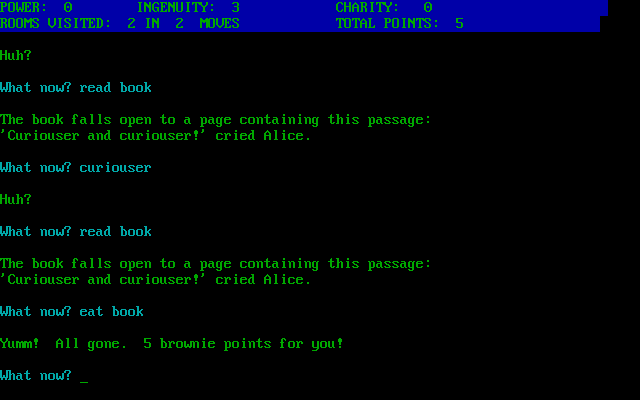
The premise sounds simple enough, but the mechanical realities hit you immediately. The game incorporates sixteen interactable objects alongside ten distinct creatures pulled straight from Carroll's text. You spend your time typing out commands to look around, inspect surroundings, pick up items, and interact with the strange inhabitants of the realm. However, this is not a friendly walk through a storybook, as every room holds the potential for an instant game-over screen if you miscalculate your actions.
Inventory management based on physical size in Alice in Wonderland
The defining mechanic here is how inventory weight interacts with Alice's changing physical stature. Picking up items like a tiny key or a bottle labeled "drink me" alters your options depending on your current scale. When Alice drinks from a potion or nibbles a cake to shrink or grow, her carrying capacity scales along with her dimensions. If you grow too small while lugging heavy gear, you will suddenly find yourself crushed under the weight of your own pocket inventory.
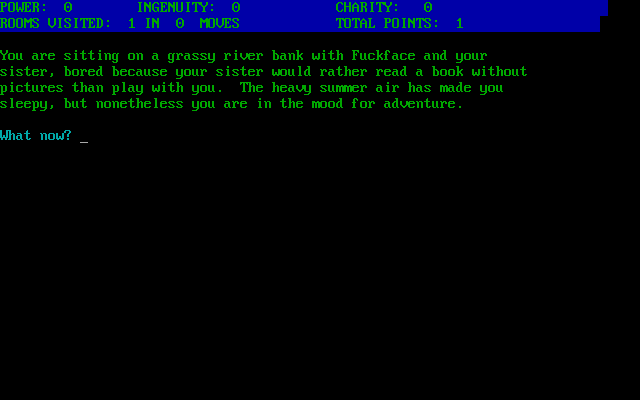
This dynamic forces you to calculate every single item movement before eating or drinking anything in the room. Dropping an essential item on the wrong side of a small door means you might never be big enough to pick it up again, or too small to reach it. It creates a structural tension that text games rarely achieve through simple parser mechanics alone, even if that tension often translates into sheer frustration when you realize you locked yourself out of a victory three rooms back.
Unfair deaths and missing clues in shareware design
Let's not mince words: this game is viciously unforgiving by modern standards, and retrospective critics routinely slam its trial-and-error structure. A review on Let's play oldies! slapped it with a harsh 2/10 rating, pointing out that puzzles lack clear clues, writing is sparse, and softlocks happen constantly. If you drop a vital quest item in a room you cannot re-enter, the game will happily let you keep walking around for another twenty minutes before you hit an invisible wall.
The modular layout of the executable code reveals how the developer assembled this experience for home computers. The entire package was distributed across several files, including AIW.EXE, WELCOME.COM, WONDER1.EXE, and WONDER2.EXE. Designed by Robin C. Johnson (credited in the files as R.C. Johnson), it was released under Freeware and shareware banners, asking players to mail a ten-dollar registration contribution to an address in Stockton, California. For that price, players in 1989 received a surprisingly strict text challenge.
Why text parser puzzles in Alice in Wonderland still demand patience
Navigating through the ten creatures in Wonderland requires memorizing the exact commands the parser expects. The creatures act similarly to their book counterparts, but their logic in-game is cold and uncompromising. You can attempt to talk to them or present objects from your inventory, but one incorrect interaction can cause a creature to vanish or leave you trapped in an unwinnable state. Without any in-game hint system, solving these encounters relies heavily on trial and error or exhaustive reading of Carroll's original chapters for thematic clues.
That level of strictness was common enough for a text adventure, but Johnson's design takes it further by offering zero room for error. When you compare it to mainstream commercial parser games from the late eighties, the sparse prose offers little ambient padding to soften the blow of constant deaths. You are essentially playing a punishing logic puzzle dressed up in fairytale attire.

How to play Alice in Wonderland online today
If you enjoy mapping out brutal text parsers and testing your patience against classic shareware design, this title is a curious piece of history worth attempting. You can play Alice in Wonderland free in your browser without worrying about setting up ancient executables or digging through text files. It offers a raw look at how independent developers tackled interactive fiction before graphical interfaces completely dominated DOS screens.
You can launch this classic Alice in Wonderland MS-DOS game directly on this page with no extra setup required. When you start your run, make sure to save your place frequently and keep a notepad nearby to track object weights before you take a bite of anything suspicious. Name your cat, step off the riverbank, and see if you can navigate the rabbit hole without getting softlocked forever.
Players' controls
Touch and gamepad controls
The on-screen keyboard and gamepad mapping the browser player uses on a phone, a tablet or a controller, as opposed to the real keys above. $PRO members make their own in the player and share them here; anyone can pick one to play with.
Make your own touch controlsPRO
- 1Open the editorSign in below, then pick what to make. The game starts with the editor open over it.
- 2Place your keysAdd keys and drag them where your thumbs rest, or map a controller's buttons. Test plays the game with them; Save keeps them, and you play with them from then on.
- 3Share themShare them right after saving in the game, or name and share them here. Players vote, and the best become this game's controls for everyone.
Go PROSee how it worksSign in+20 XP for sharing · +50 XP if yours become the game's own
- The game's own controlsNone yet: played with a real keyboard only.In use
3 screenshots
From the archive
No gameplay video yet
No gameplay video for Alice in Wonderland yet. Sign in to add one.
No reviews yet
Tell the community what you think of Alice in Wonderland. Reviews are public and tied to your username.
No archived manuals for Alice in Wonderland yet
No manuals archived for this title yet. Sign in to upload the first scan.
Cheat codes, console commands and memory pokes for Alice in Wonderland — each one verified and attributed.
Sign in to submitNo cheats yet for this title
Know a working cheat, poke or trainer? Add it with the button above. Moderators check every entry before it goes live.
No archived soundtrack for Alice in Wonderland yet
No soundtrack archived for this title yet. Sign in to upload the first rip.
No save states for Alice in Wonderland yet
No save states for this title yet. Sign in to share one.
Discussions
Sign in to post- Threads0
- Total posts0
- Online now6
Community · Alice in Wonderland
Who's contributing, and what's new
- Reviews0
- Threads0
- Uploadsapproved0
- Contributors0
Recent activity
Nothing here yet
Reviews, discussion threads and approved uploads appear here as members add them.