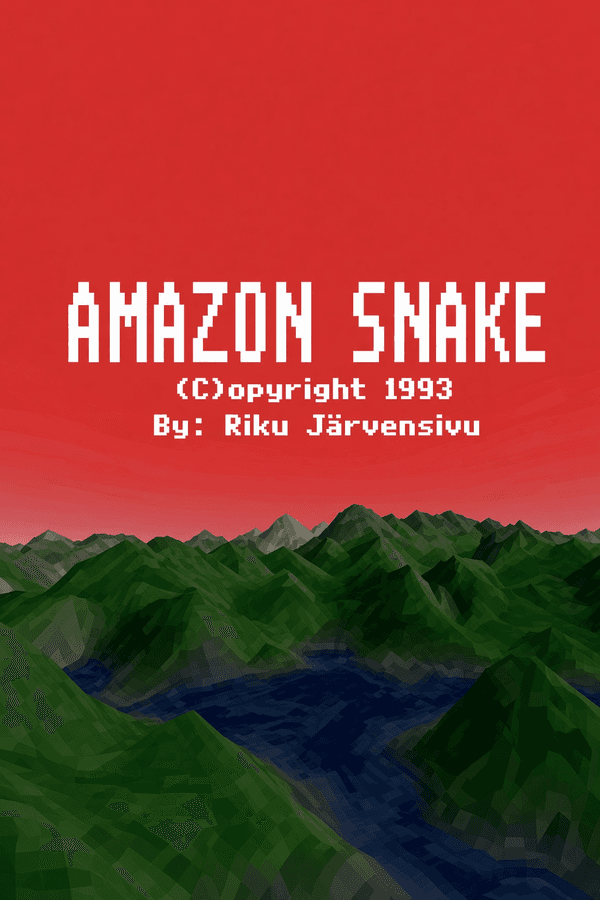
In Amazon Snake, a public domain MS-DOS game from 1995, you control an ever-growing serpent that speeds across a single screen in search of its next meal.
Created by Finnish developer Riku Järvensivu (who also went by the handle "Fisherman"), Riku Järvensivu released this minimalist title straight into the public domain as version 1.00. Rather than building a commercial package with sprawling menus or complex backstories, Järvensivu focused entirely on the basic core of the standard arcade formula. Built to run in standard 320x200 256-color VGA graphics resolution, the visual presentation stays simple, using crisp pixel art that gets the job done without bogging down low-end machines of the era.
By keeping the scope intentionally small, the game eliminates any startup delay. You boot it up, grab the keyboard, and immediately face the core loop without wading through introductory cinematic sequences or dense instruction cards. It is an uncomplicated action layout designed to be played in rapid, short sessions.
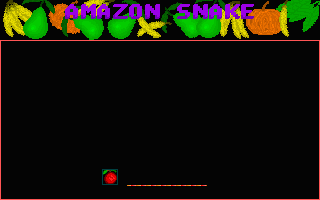
The mechanics take inspiration from classic nibbler and arcade serpent games, but they demand your undivided focus the second a round starts. Your snake moves continuously across the screen, forcing you to use the keyboard arrow keys to steer left, right, up, or down. Every piece of food you guide your snake toward adds to your total score, but it also increases your length. Eating a pumpkin, for example, grants you 1 point, but that tiny reward instantly makes your tail longer and your path much tighter.
Because your body stretches with every successful meal, the open playing area shrinks quickly. The challenge comes entirely from spatial management: you must map out your turns several moves in advance so you do not pin yourself against a wall or cross your own body. One wrong keypress or a moment of hesitation sends you crashing into an obstacle, ending the run instantly.
What gives this title its specific personality is also its main point of friction. There are no level transitions, no power-ups to clear the screen, and no secondary items to change your speed. Every round takes place on the exact same board, meaning the difficulty relies entirely on your own growth rate rather than evolving stage hazards. Reviewers at the time pointed out that the visual presentation holds up well enough, but the total lack of stage variation means long sessions can feel repetitive quickly.
That lack of variety puts it in stark contrast with larger arcade-style PC releases from 1995, which often included multiple worlds or power-up systems to keep players hooked. Here, the difficulty curve relies exclusively on your speed and reflexes. If you make a mistake ten minutes into a run, there are no checkpoints or extra lives to save you; you simply restart from zero and try to outmaneuver your previous high score.
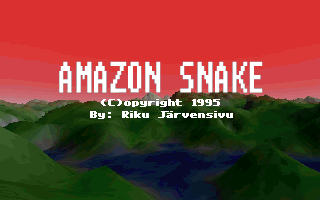
As a quick distraction, the game holds up because its controls react without lag, which is mandatory when your tail takes up three-quarters of the display. The clean pixel art keeps your target fruits and the snake's body easy to track against the background, so you never lose your head in the middle of a sharp hairpin turn. It delivers precisely what it advertises: an unpretentious, fast-paced challenge that tests how cleanly you can turn under pressure.
However, anyone looking for deep progression, unlockable stages, or secret cheat codes will find the experience paper-thin. It is a single mechanics puzzle stripped down to its bare essentials. It works best as a five-minute test of your spatial memory and keyboard reflexes rather than a full afternoon campaign.
If you want to experience this piece of Finnish public domain software, you can play Amazon Snake online directly on this page. You can jump into the MS-DOS game straight from your web browser without installing old software, configuring system files, or hunting down disk images. Load up the board, grab the arrow keys, and see how many pumpkins you can collect before your own tail boxes you into a corner.
In Amazon Snake, a public domain MS-DOS game from 1995, you control an ever-growing serpent that speeds across a single screen in search of its next meal.
Created by Finnish developer Riku Järvensivu (who also went by the handle "Fisherman"), Riku Järvensivu released this minimalist title straight into the public domain as version 1.00. Rather than building a commercial package with sprawling menus or complex backstories, Järvensivu focused entirely on the basic core of the standard arcade formula. Built to run in standard 320x200 256-color VGA graphics resolution, the visual presentation stays simple, using crisp pixel art that gets the job done without bogging down low-end machines of the era.
By keeping the scope intentionally small, the game eliminates any startup delay. You boot it up, grab the keyboard, and immediately face the core loop without wading through introductory cinematic sequences or dense instruction cards. It is an uncomplicated action layout designed to be played in rapid, short sessions.

The mechanics take inspiration from classic nibbler and arcade serpent games, but they demand your undivided focus the second a round starts. Your snake moves continuously across the screen, forcing you to use the keyboard arrow keys to steer left, right, up, or down. Every piece of food you guide your snake toward adds to your total score, but it also increases your length. Eating a pumpkin, for example, grants you 1 point, but that tiny reward instantly makes your tail longer and your path much tighter.
Because your body stretches with every successful meal, the open playing area shrinks quickly. The challenge comes entirely from spatial management: you must map out your turns several moves in advance so you do not pin yourself against a wall or cross your own body. One wrong keypress or a moment of hesitation sends you crashing into an obstacle, ending the run instantly.
What gives this title its specific personality is also its main point of friction. There are no level transitions, no power-ups to clear the screen, and no secondary items to change your speed. Every round takes place on the exact same board, meaning the difficulty relies entirely on your own growth rate rather than evolving stage hazards. Reviewers at the time pointed out that the visual presentation holds up well enough, but the total lack of stage variation means long sessions can feel repetitive quickly.
That lack of variety puts it in stark contrast with larger arcade-style PC releases from 1995, which often included multiple worlds or power-up systems to keep players hooked. Here, the difficulty curve relies exclusively on your speed and reflexes. If you make a mistake ten minutes into a run, there are no checkpoints or extra lives to save you; you simply restart from zero and try to outmaneuver your previous high score.

As a quick distraction, the game holds up because its controls react without lag, which is mandatory when your tail takes up three-quarters of the display. The clean pixel art keeps your target fruits and the snake's body easy to track against the background, so you never lose your head in the middle of a sharp hairpin turn. It delivers precisely what it advertises: an unpretentious, fast-paced challenge that tests how cleanly you can turn under pressure.
However, anyone looking for deep progression, unlockable stages, or secret cheat codes will find the experience paper-thin. It is a single mechanics puzzle stripped down to its bare essentials. It works best as a five-minute test of your spatial memory and keyboard reflexes rather than a full afternoon campaign.
If you want to experience this piece of Finnish public domain software, you can play Amazon Snake online directly on this page. You can jump into the MS-DOS game straight from your web browser without installing old software, configuring system files, or hunting down disk images. Load up the board, grab the arrow keys, and see how many pumpkins you can collect before your own tail boxes you into a corner.
How Amazon Snake is played — the keys the game listens to, grouped by what they do.
Highlighted keys are mapped — hover or tap one to see what it does.
The on-screen keyboard and gamepad mapping the browser player uses on a phone, a tablet or a controller, as opposed to the real keys above. $PRO members make their own in the player and share them here; anyone can pick one to play with.
Cheat codes, console commands and memory pokes for Amazon Snake — each one verified and attributed.
Sign in to submitHow Amazon Snake is played — the keys the game listens to, grouped by what they do.
Highlighted keys are mapped — hover or tap one to see what it does.
The on-screen keyboard and gamepad mapping the browser player uses on a phone, a tablet or a controller, as opposed to the real keys above. $PRO members make their own in the player and share them here; anyone can pick one to play with.
Cheat codes, console commands and memory pokes for Amazon Snake — each one verified and attributed.
Sign in to submit