

In Baldies, designer David Wightman set out to combine the structural depth of Populous with the Lemmings-style chaos of managing dozens of clueless, round-headed oafs.
You can see the traces of a long, strange development path the moment you boot up the 1996 DOS release. Creative Edge Software began work on the title back in 1993 targeting the Amiga, but publishing delays and shifting hardware markets eventually pushed the completed game onto the Atari Jaguar CD in late 1995 before it finally reached PC monitors. Published in North America by Panasonic Interactive Media, it arrived right as top-down strategy was shifting toward fast, military-focused combat. Yet Creative Edge Software stuck to an older European design ethos: macro-management mixed with slapstick cruelty.
The core setup places you in the role of an unseen deity directing a tribe of pale, hairless figures against their arch-rivals, the Hairies. Over 80 levels spanning five distinct environments, from green pastures to frozen ice sheets and volcanic hellscapes, your objective is absolute extermination. Instead of giving direct orders to individual soldiers, you allocate your population into four color-coded roles: red Workers who stay indoors to breed, blue Builders who erect and expand housing, white Scientists who invent gadgets, and grey Soldiers who fight. Combat gets absurd fast, relying heavily on inventions like landmines, skunks, exploding cows, and localized firestorms.
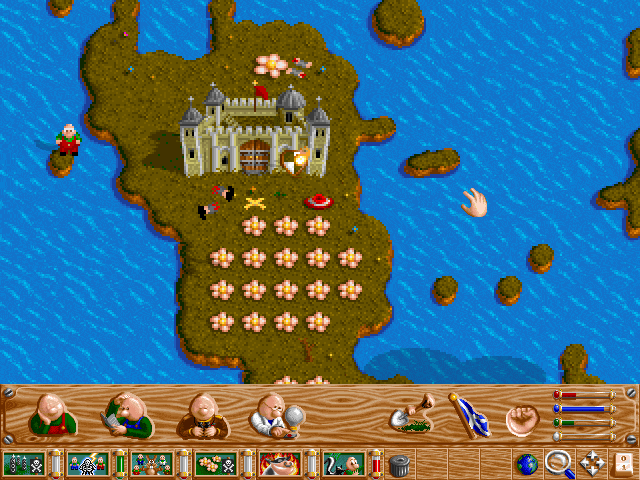
While the premise sounds like a breezy twist on real-time tactics, the actual decision loop is constantly hamstrung by its controls. To get anything done, you either pick up individual units with a mouse hand and drop them where they need to be, or drop a shield icon to set a central rally point. In theory, units near the shield gather together and move as a group. In practice, the shield's sphere of influence is tiny, forcing you to pick up dozens of little men one by one when you want to mount a serious invasion.
The result is a game where the UI becomes a bigger threat than the enemy army. Your soldiers wander off, get stuck behind environmental obstacles, or completely ignore nearby enemy strongholds while being cut down. Magazines like PC Zone praised the game's novel visual style but scored it a mediocre 61%, pointing directly to its clunky controls and steep learning curve. GameSpot similarly noted that unit pathing issues took the punch out of its tactical battles. When an enemy house is full of Hairies, sending ten soldiers into the fight often results in six of them taking a walk into a nearby lake because you did not manually steer every single step.
For players who want to skip the deliberate grind of pop-cap management, a quick keyboard trick offers an immediate out. By holding `F8` and clicking anywhere on the map, you can spawn infinite units on demand. There is even an elaborate secret level sequence that involves dropping a single sheep into a lake on level 4, piling ten dolphins on top of your Science Lab, and completing the stage to unlock hidden bonus maps.
Evaluating this 1996 release today comes down to how much patience you have for chaotic god-game mechanics. The lighthearted tone and inventive arsenal of traps still hold a genuine oddball charm that standard real-time strategy games lacked. Watching a well-placed skunk clear out a bunker full of Hairies remains genuinely funny, and balancing your lab output against your breeding rate forces a genuine strategic trade-off.
However, the micro-management demands simply do not respect your time. Levels on larger desert or ice maps drag on endlessly as you spend ten minutes hunting down scattered wandering units just to finish off the final enemy building. If you enjoy classic sandbox strategies like Populous or the goofy hazard-avoidance of Lemmings, there is plenty of creative design to appreciate, but anyone expecting the crisp unit control of Command & Conquer will find themselves fighting the mouse cursor more than the computer.
If you want to experience this piece of mid-nineties PC strategy, you can play Baldies online free in your browser right here. There is no software to install or setup to troubleshoot, letting you jump straight into the action in seconds. Launch level 1, drop a couple of scientists into a lab to cook up an exploding cow, and see how long your patience lasts against the chaotic pathfinding of the nineties.
In Baldies, designer David Wightman set out to combine the structural depth of Populous with the Lemmings-style chaos of managing dozens of clueless, round-headed oafs.
You can see the traces of a long, strange development path the moment you boot up the 1996 DOS release. Creative Edge Software began work on the title back in 1993 targeting the Amiga, but publishing delays and shifting hardware markets eventually pushed the completed game onto the Atari Jaguar CD in late 1995 before it finally reached PC monitors. Published in North America by Panasonic Interactive Media, it arrived right as top-down strategy was shifting toward fast, military-focused combat. Yet Creative Edge Software stuck to an older European design ethos: macro-management mixed with slapstick cruelty.
The core setup places you in the role of an unseen deity directing a tribe of pale, hairless figures against their arch-rivals, the Hairies. Over 80 levels spanning five distinct environments, from green pastures to frozen ice sheets and volcanic hellscapes, your objective is absolute extermination. Instead of giving direct orders to individual soldiers, you allocate your population into four color-coded roles: red Workers who stay indoors to breed, blue Builders who erect and expand housing, white Scientists who invent gadgets, and grey Soldiers who fight. Combat gets absurd fast, relying heavily on inventions like landmines, skunks, exploding cows, and localized firestorms.

While the premise sounds like a breezy twist on real-time tactics, the actual decision loop is constantly hamstrung by its controls. To get anything done, you either pick up individual units with a mouse hand and drop them where they need to be, or drop a shield icon to set a central rally point. In theory, units near the shield gather together and move as a group. In practice, the shield's sphere of influence is tiny, forcing you to pick up dozens of little men one by one when you want to mount a serious invasion.
The result is a game where the UI becomes a bigger threat than the enemy army. Your soldiers wander off, get stuck behind environmental obstacles, or completely ignore nearby enemy strongholds while being cut down. Magazines like PC Zone praised the game's novel visual style but scored it a mediocre 61%, pointing directly to its clunky controls and steep learning curve. GameSpot similarly noted that unit pathing issues took the punch out of its tactical battles. When an enemy house is full of Hairies, sending ten soldiers into the fight often results in six of them taking a walk into a nearby lake because you did not manually steer every single step.
For players who want to skip the deliberate grind of pop-cap management, a quick keyboard trick offers an immediate out. By holding `F8` and clicking anywhere on the map, you can spawn infinite units on demand. There is even an elaborate secret level sequence that involves dropping a single sheep into a lake on level 4, piling ten dolphins on top of your Science Lab, and completing the stage to unlock hidden bonus maps.

Evaluating this 1996 release today comes down to how much patience you have for chaotic god-game mechanics. The lighthearted tone and inventive arsenal of traps still hold a genuine oddball charm that standard real-time strategy games lacked. Watching a well-placed skunk clear out a bunker full of Hairies remains genuinely funny, and balancing your lab output against your breeding rate forces a genuine strategic trade-off.
However, the micro-management demands simply do not respect your time. Levels on larger desert or ice maps drag on endlessly as you spend ten minutes hunting down scattered wandering units just to finish off the final enemy building. If you enjoy classic sandbox strategies like Populous or the goofy hazard-avoidance of Lemmings, there is plenty of creative design to appreciate, but anyone expecting the crisp unit control of Command & Conquer will find themselves fighting the mouse cursor more than the computer.
If you want to experience this piece of mid-nineties PC strategy, you can play Baldies online free in your browser right here. There is no software to install or setup to troubleshoot, letting you jump straight into the action in seconds. Launch level 1, drop a couple of scientists into a lab to cook up an exploding cow, and see how long your patience lasts against the chaotic pathfinding of the nineties.
How Baldies is played — the keys the game listens to, grouped by what they do.
Highlighted keys are mapped — hover or tap one to see what it does.
Camera scrolling keyboard shortcuts are not documented in the manual sources.
The on-screen keyboard and gamepad mapping the browser player uses on a phone, a tablet or a controller, as opposed to the real keys above. $PRO members make their own in the player and share them here; anyone can pick one to play with.
Cheat codes, console commands and memory pokes for Baldies — each one verified and attributed.
Sign in to submitHow Baldies is played — the keys the game listens to, grouped by what they do.
Highlighted keys are mapped — hover or tap one to see what it does.
Camera scrolling keyboard shortcuts are not documented in the manual sources.
The on-screen keyboard and gamepad mapping the browser player uses on a phone, a tablet or a controller, as opposed to the real keys above. $PRO members make their own in the player and share them here; anyone can pick one to play with.
Cheat codes, console commands and memory pokes for Baldies — each one verified and attributed.
Sign in to submit