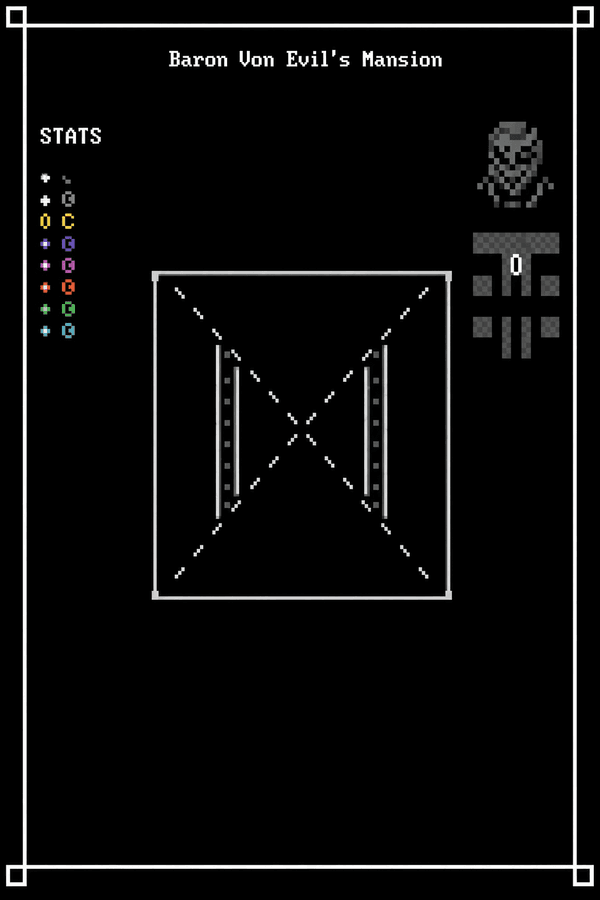
Baron Von Evil's Mansion
Rate this game
- Played
- Rarely
Navigating the character-drawn corridors of Baron Von Evil's Mansion feels like stepping directly into a late-nineties home computer project. Written using pure text characters to mimic a first-person perspective, it turns grid navigation into a stark, minimalist labyrinth puzzle.
Building a pseudo-3D dungeon out of raw text characters
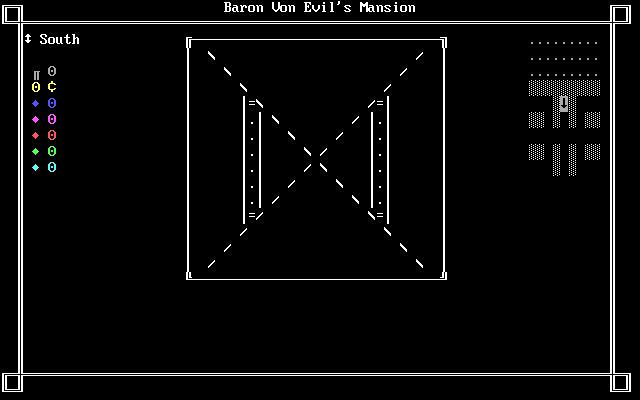
Back when high-end graphical engines demanded expensive video cards, amateur programmers had to find clever workarounds to render three-dimensional space. The solution here was to take standard text mode graphics in QBasic 1.1 and draw wall boundaries using plain keyboard characters.
Developer Ben McLean originally put this concept together in the late 1990s during his middle school years. Rather than pulling from sprite libraries or plotting complex pixel bitmapped math, the code calculates visible wall distances and draws text columns to signal corners, open doorways, and dead ends. It creates a distinct sense of depth out of simple screen characters, asking your brain to fill in the atmospheric details of a dark fortress.
That visual restraint changes how you move through a space. Without dynamic lighting or smooth texture filtering, every step relies entirely on reading wall lines and keeping a tight mental map of where you have turned. It belongs to the broader history of puzzle games that prioritize mechanical logic over graphical flair.
Exploring the grid in Baron Von Evil's Mansion
Movement inside the mansion follows strict turn-based rules. Pressing an arrow key steps you forward into the next grid square or turns your perspective ninety degrees, instantly redrawing the character frame to show your new line of sight.
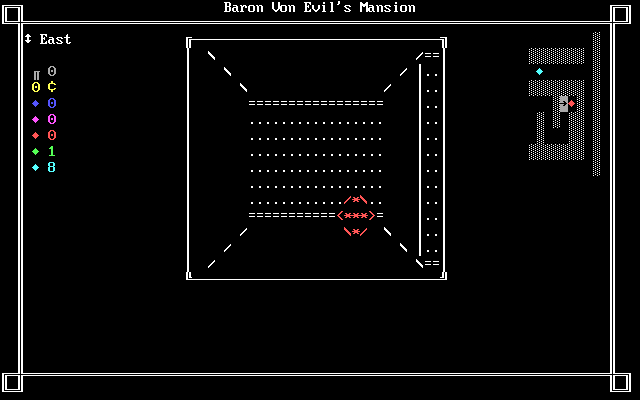
Your main objective revolves around systematic exploration. You march through identical-looking halls, investigate rooms, and collect key items scattered throughout the layout. The core interactive loop stays lean and direct:
- Step through grid corridors using the standard direction keys to map out unseen rooms.
- Examine layout dead ends and floor corners to locate hidden items required for progress.
- Answer prompt choices by pressing Y or N followed by Enter when the game poses a decision.
- Hit the Escape key at any point to exit the session immediately back to the command line.
The lack of a persistent mini-map is where the actual difficulty lives. If you get turned around after a series of quick turns, every hall begins to look identical. Taking manual notes on scratch paper is practically required if you want to avoid pacing down the same empty hallway three times in a row.
From forgotten QBasic code to open source re-release
For years, projects built in QBasic spent their lives on local floppy disks or lost personal web pages. In 2012, long after the original code was drafted, McLean revisited his schoolwork, cleaned up the source syntax, and put the program online for anyone to examine.
That 2012 release made the title available as open source software on modern code repositories. Anyone curious about how to construct a functioning pseudo-3D viewport in BASIC can open the uncompiled code directly and see every array calculation and text print loop laid out in clear, human-readable lines. You can find more work credited to Ben McLean across early PC gaming archives, alongside other software published under the Ben McLean name.
Revisiting this 2012 distribution reveals a neat slice of hobbyist programming logic. It shows how much spatial tension a designer can extract from strict hardware boundaries, basic control inputs, and a handful of screen strings.
Step into Baron Von Evil's Mansion in your browser
This is a focused, stripped-down maze trial that respects your time. It relies on sharp spatial awareness rather than flashy visual effects, making it a great pick for anyone who enjoys old-school grid navigation and early programming craft. If you want to check out this classic Baron Von Evil's Mansion MS-DOS game, you do not need to hunt down ancient BASIC interpreters or fiddle with system configurations.
You can play Baron Von Evil's Mansion free in your browser right on this page, with nothing to install and no setup required. The text-mode walls render instantly inside your window, letting you test your mapping skills and take on the maze right now. Once it loads, keep a piece of paper handy for mapping out your turns, and remember that hit of the Escape key if you ever need to make a quick exit.
How Baron Von Evil's Mansion is played — the keys the game listens to, grouped by what they do.
- Movement
- Interface
Highlighted keys are mapped — hover or tap one to see what it does.
The key map is incomplete. Operates as a text-mode pseudo-3D maze game.
Players' controls
Touch and gamepad controls
The on-screen keyboard and gamepad mapping the browser player uses on a phone, a tablet or a controller, as opposed to the real keys above. $PRO members make their own in the player and share them here; anyone can pick one to play with.
Make your own touch controlsPRO
- 1Open the editorSign in below, then pick what to make. The game starts with the editor open over it.
- 2Place your keysAdd keys and drag them where your thumbs rest, or map a controller's buttons. Test plays the game with them; Save keeps them, and you play with them from then on.
- 3Share themShare them right after saving in the game, or name and share them here. Players vote, and the best become this game's controls for everyone.
Go PROSee how it worksSign in+20 XP for sharing · +50 XP if yours become the game's own
- The game's own controlsKeyboardGamepadWhat every player starts with.In use
2 screenshots
From the archive
No gameplay video yet
No gameplay video for Baron Von Evil's Mansion yet. Sign in to add one.
No reviews yet
Tell the community what you think of Baron Von Evil's Mansion. Reviews are public and tied to your username.
No archived manuals for Baron Von Evil's Mansion yet
No manuals archived for this title yet. Sign in to upload the first scan.
Cheat codes, console commands and memory pokes for Baron Von Evil's Mansion — each one verified and attributed.
Sign in to submitNo cheats yet for this title
Know a working cheat, poke or trainer? Add it with the button above. Moderators check every entry before it goes live.
No archived soundtrack for Baron Von Evil's Mansion yet
No soundtrack archived for this title yet. Sign in to upload the first rip.
No save states for Baron Von Evil's Mansion yet
No save states for this title yet. Sign in to share one.
Discussions
Sign in to post- Threads0
- Total posts0
- Online now6
Community · Baron Von Evil's Mansion
Who's contributing, and what's new
- Reviews0
- Threads0
- Uploadsapproved0
- Contributors0
Recent activity
Nothing here yet
Reviews, discussion threads and approved uploads appear here as members add them.