
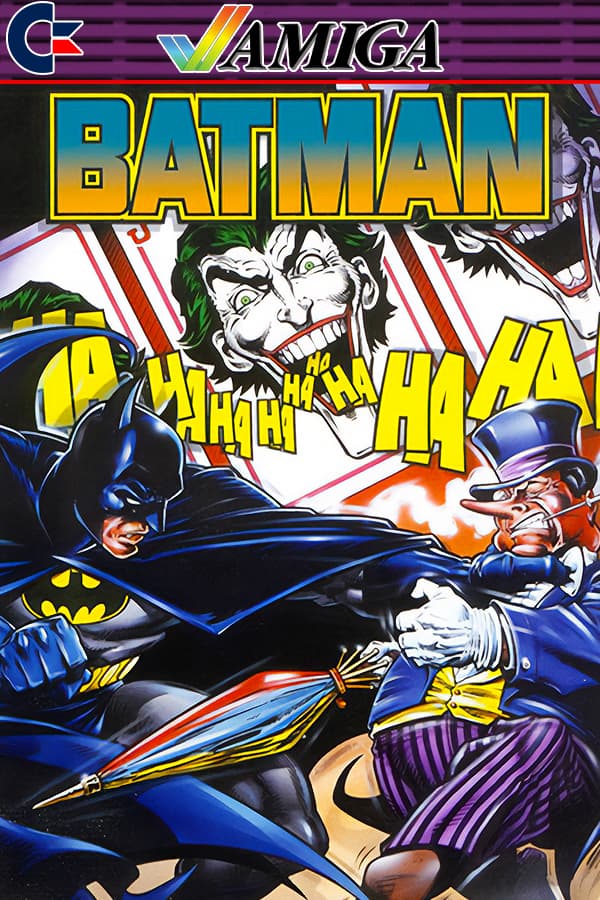
In 1989, Batman: The Caped Crusader attempted to translate the visual pacing of comic books directly to PC monitors through an overlapping panel display. Instead of a simple brawler, Special FX Software created a maze of inventory puzzles where taking a single step backward meant fighting the exact same goon all over again.
By the late eighties, licensed superhero games were almost universally straight-ahead arcade side-scrollers. You walked right, punched a line of nameless thugs, and fought a boss at the end of the stage. Special FX Software tried something fundamentally different when building this game for publisher Data East Corporation. They built the layout around comic book frames, where entering a new doorway or climbing a ladder draws a fresh graphic panel right over the old one, which then greys out in the background.
The visual trick was genuinely clever for 1989, but the core engine underneath is less of an action title and more of an adventure game dressed in a cowl. You navigate screens, collect key items, and try to deduce which object opens the next path while manageably kicking henchmen along the way. Instead of a linear campaign, the game splits into two self-contained scenarios available from the main menu in any order:
You punch, kick, and throw batarangs, but fighting is secondary to spatial memory. Progress rests entirely on finding keys, tools, and gadgetry, then carrying them to the correct screen without dying to endless waves of basic henchmen.
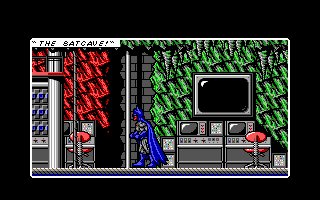
If you launch the MS-DOS version expecting smooth movement, the physics will shock you immediately. Batman moves at a jarring, slippery speed that makes precise positioning a constant battle. Stopping on a specific tile to pick up an item or line up a punch takes deliberate effort, because Batman tends to slide past his target before the input registers.
The inventory system compounds this awkwardness. Opening the menu requires specific key combinations, and once inside, you have to manage drop and use commands through a cluttered interface. Figuring out which item solves a specific block in the level is purely a process of trial and error. You carry an object across four panels, realise it does nothing, backtrack to swap it for another, and hope you do not get worn down by attrition on the return trip.
The attrition is constant because of how enemies spawn. The moment Batman leaves a panel and steps into a new frame, the room behind him resets. If you knock out a thug, step one panel to the left, and immediately step back to the right, that same thug is standing there at full health. This design choice turns basic backtracking into a grinding test of patience rather than an exciting crime-fighting run.
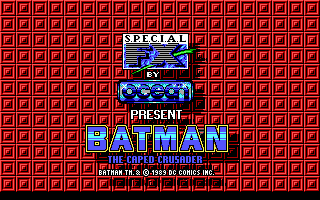
When the game first landed on British 8-bit computers like the ZX Spectrum, magazine reviewers celebrated its visual presentation. Outfits like Crash and Your Sinclair handed out high scores, pointing to the distinctive comic-book frame technology and bright character art as proof that movie and comic tie-ins were finally evolving. To players on those platforms, having two complete, separate adventures in one package felt generous.
The reception turned sour as the game reached American desktop computers and reviewers evaluated it strictly as an action game. Computer Gaming World noted that the heavy emphasis on maze navigation and inventory puzzles alienated players who wanted a pure beat-em-up. Years later in 1996, the same publication went so far as to put the title on its list of the worst games of all time, largely driven by frustration over its repetitive puzzles, strict backtracking, and fiddly interface.
That split in reputation makes sense once you play it. If you treat it as a slow, deliberate micro-adventure with fight mechanics attached, the design holds together better than if you jump in expecting an intense combat title. The ideas developed by Special FX Software Ltd were ambitious, but the execution suffered from the technical constraints and pacing habits of late-eighties PC ports.
You can play Batman: The Caped Crusader online free in your browser right now, with nothing to install and no complex setup required. The panel-based visual layout is an intriguing piece of late-eighties screen design that is worth seeing in motion, even if the instant enemy respawns and stiff movement demand some patience. Start with the Joker scenario in Hyde Park, learn how the inventory keys function, and see how long you survive against Gotham's respawning henchmen.
In 1989, Batman: The Caped Crusader attempted to translate the visual pacing of comic books directly to PC monitors through an overlapping panel display. Instead of a simple brawler, Special FX Software created a maze of inventory puzzles where taking a single step backward meant fighting the exact same goon all over again.
By the late eighties, licensed superhero games were almost universally straight-ahead arcade side-scrollers. You walked right, punched a line of nameless thugs, and fought a boss at the end of the stage. Special FX Software tried something fundamentally different when building this game for publisher Data East Corporation. They built the layout around comic book frames, where entering a new doorway or climbing a ladder draws a fresh graphic panel right over the old one, which then greys out in the background.
The visual trick was genuinely clever for 1989, but the core engine underneath is less of an action title and more of an adventure game dressed in a cowl. You navigate screens, collect key items, and try to deduce which object opens the next path while manageably kicking henchmen along the way. Instead of a linear campaign, the game splits into two self-contained scenarios available from the main menu in any order:
You punch, kick, and throw batarangs, but fighting is secondary to spatial memory. Progress rests entirely on finding keys, tools, and gadgetry, then carrying them to the correct screen without dying to endless waves of basic henchmen.
If you launch the MS-DOS version expecting smooth movement, the physics will shock you immediately. Batman moves at a jarring, slippery speed that makes precise positioning a constant battle. Stopping on a specific tile to pick up an item or line up a punch takes deliberate effort, because Batman tends to slide past his target before the input registers.
The inventory system compounds this awkwardness. Opening the menu requires specific key combinations, and once inside, you have to manage drop and use commands through a cluttered interface. Figuring out which item solves a specific block in the level is purely a process of trial and error. You carry an object across four panels, realise it does nothing, backtrack to swap it for another, and hope you do not get worn down by attrition on the return trip.
The attrition is constant because of how enemies spawn. The moment Batman leaves a panel and steps into a new frame, the room behind him resets. If you knock out a thug, step one panel to the left, and immediately step back to the right, that same thug is standing there at full health. This design choice turns basic backtracking into a grinding test of patience rather than an exciting crime-fighting run.
When the game first landed on British 8-bit computers like the ZX Spectrum, magazine reviewers celebrated its visual presentation. Outfits like Crash and Your Sinclair handed out high scores, pointing to the distinctive comic-book frame technology and bright character art as proof that movie and comic tie-ins were finally evolving. To players on those platforms, having two complete, separate adventures in one package felt generous.
The reception turned sour as the game reached American desktop computers and reviewers evaluated it strictly as an action game. Computer Gaming World noted that the heavy emphasis on maze navigation and inventory puzzles alienated players who wanted a pure beat-em-up. Years later in 1996, the same publication went so far as to put the title on its list of the worst games of all time, largely driven by frustration over its repetitive puzzles, strict backtracking, and fiddly interface.
That split in reputation makes sense once you play it. If you treat it as a slow, deliberate micro-adventure with fight mechanics attached, the design holds together better than if you jump in expecting an intense combat title. The ideas developed by Special FX Software Ltd were ambitious, but the execution suffered from the technical constraints and pacing habits of late-eighties PC ports.
You can play Batman: The Caped Crusader online free in your browser right now, with nothing to install and no complex setup required. The panel-based visual layout is an intriguing piece of late-eighties screen design that is worth seeing in motion, even if the instant enemy respawns and stiff movement demand some patience. Start with the Joker scenario in Hyde Park, learn how the inventory keys function, and see how long you survive against Gotham's respawning henchmen.
How Batman: The Caped Crusader is played — the keys the game listens to, grouped by what they do.
Highlighted keys are mapped — hover or tap one to see what it does.
Specific default keyboard letter/arrow key aliases for joystick controls were not fully detailed in the primary manual excerpt. Spacebar acts as the fire/attack button modifier.
The on-screen keyboard and gamepad mapping the browser player uses on a phone, a tablet or a controller, as opposed to the real keys above. $PRO members make their own in the player and share them here; anyone can pick one to play with.
Cheat codes, console commands and memory pokes for Batman: The Caped Crusader — each one verified and attributed.
Sign in to submitHow Batman: The Caped Crusader is played — the keys the game listens to, grouped by what they do.
Highlighted keys are mapped — hover or tap one to see what it does.
Specific default keyboard letter/arrow key aliases for joystick controls were not fully detailed in the primary manual excerpt. Spacebar acts as the fire/attack button modifier.
The on-screen keyboard and gamepad mapping the browser player uses on a phone, a tablet or a controller, as opposed to the real keys above. $PRO members make their own in the player and share them here; anyone can pick one to play with.
Cheat codes, console commands and memory pokes for Batman: The Caped Crusader — each one verified and attributed.
Sign in to submit