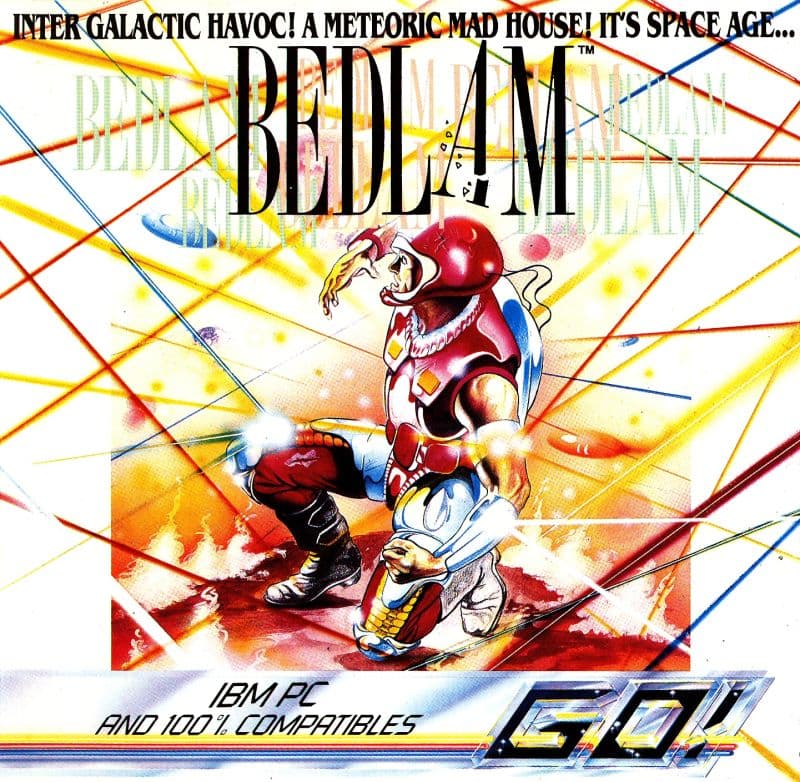
Bedlam drops you into an over-caffeinated vertical shooter where surviving means reading dense formations of swirling alien craft while picking off stationary turrets anchored to floating enemy starbases.
On paper, this 1988 top-down shooter presents itself as a military simulation called the X12 fighter simulator, built to test green cadets at the Stellar Imperium academy against biomechanical threats across infested colonies. The second you press fire, that lore vanishes into pure arcade panic. You push your ship up a vertically scrolling corridor, carving through tight waves of spinning alien fighters that drop into sweeping pattern attacks. The challenge does not come from bullet-hell salvos, but from spatial congestion: enemies loop down the screen in fast, interlocking tracks while deck-mounted cannons snap off shots from fixed positions, forcing you to constantly choose between hunting high-value ground targets or dodging incoming traffic.
For players diving into this action game today, the controls are brutally direct. Your fighter moves across the entire screen area as the background scrolls beneath you, picking up power-ups to widen your shot pattern or boost your forward firepower. Boss ships sit at the end of the runs, acting as massive damage sponges that test how well you preserved your ship's upgraded weaponry through the preceding swarm. With a second player along for the ride, the screen becomes twice as chaotic, though sharing space in narrow flight corridors usually leads to accidental collisions and missed power-ups rather than smooth tactical coordination.
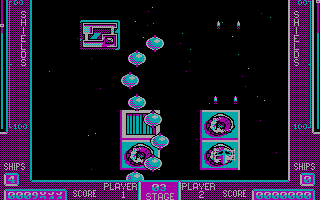
If you played Bedlam on home micros like the ZX Spectrum, you remember a fast shooter that picked up top scores in the magazines. Developers Bill McIntosh, Steven Taylor, Rob Howard, and Raymond Bradley packed detailed multi-scrolling backgrounds, changing level themes, and even playable pinball mini-games straight into the main code. It moved fast and gave you plenty of visual variety across a long run of stages.
The translation to PC DOS by Beam Software Pty., Ltd. tells a very different story. Released alongside Commodore 64 and Amstrad CPC ports by GO! Media Holdings Ltd., the MS-DOS build strips out the rich environmental art in favor of sparse, black-sky arenas that feel much closer to Galaga than an expanded late-80s shmup. Worse, PC players were locked into a harsh 4-color CGA visual palette dominated by magenta and cyan, paired with total silence where PC speaker audio should have been. The underlying movement speed and collision detection survive intact, but the visual flair that defined the Spectrum version was largely left on the cutting room floor.
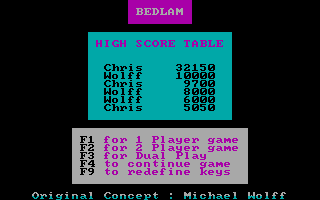
Even if you forgive the washed-out CGA graphics, the level design hits a hard ceiling early on. The core problem is variety. While the flight physics feel responsive, the 16 short stages reuse enemy wave geometries until every cluster of alien craft feels identical to the one three levels prior. Home of the Underdogs rightly pointed out in a retrospective review that while the game remains fast, fun, and highly playable, the enemy ships look far too much alike and the stage environments offer little visual progression to keep you hooked.
Compared to other 1988 releases that were experimenting with complex weapon loadouts and parallax scrolling, this conversion relies entirely on basic twitch reflexes. It lacks a midpoint checkpoint system, meaning a single misjudged turn into a swarming formation sends you straight back to the bottom of the level sequence. It is an unyielding, straightforward design that appeals strictly to high-score chasers who want zero friction between boot-up and blasting.
Despite its visual drawbacks on PC, the fundamental flight-and-fire loop retains a distinct late-80s punch. It demands quick instincts, instant target selection, and complete memorization of dive patterns if you hope to survive past the initial colony stages.
You can test your own piloting reflexes and play Bedlam online free in your browser right here. Running directly in your window with no setups required, this version lets you test whether you have what it takes to clear the Stellar Imperium academy trials or succumb to the alien swarm.
Bedlam drops you into an over-caffeinated vertical shooter where surviving means reading dense formations of swirling alien craft while picking off stationary turrets anchored to floating enemy starbases.
On paper, this 1988 top-down shooter presents itself as a military simulation called the X12 fighter simulator, built to test green cadets at the Stellar Imperium academy against biomechanical threats across infested colonies. The second you press fire, that lore vanishes into pure arcade panic. You push your ship up a vertically scrolling corridor, carving through tight waves of spinning alien fighters that drop into sweeping pattern attacks. The challenge does not come from bullet-hell salvos, but from spatial congestion: enemies loop down the screen in fast, interlocking tracks while deck-mounted cannons snap off shots from fixed positions, forcing you to constantly choose between hunting high-value ground targets or dodging incoming traffic.
For players diving into this action game today, the controls are brutally direct. Your fighter moves across the entire screen area as the background scrolls beneath you, picking up power-ups to widen your shot pattern or boost your forward firepower. Boss ships sit at the end of the runs, acting as massive damage sponges that test how well you preserved your ship's upgraded weaponry through the preceding swarm. With a second player along for the ride, the screen becomes twice as chaotic, though sharing space in narrow flight corridors usually leads to accidental collisions and missed power-ups rather than smooth tactical coordination.

If you played Bedlam on home micros like the ZX Spectrum, you remember a fast shooter that picked up top scores in the magazines. Developers Bill McIntosh, Steven Taylor, Rob Howard, and Raymond Bradley packed detailed multi-scrolling backgrounds, changing level themes, and even playable pinball mini-games straight into the main code. It moved fast and gave you plenty of visual variety across a long run of stages.
The translation to PC DOS by Beam Software Pty., Ltd. tells a very different story. Released alongside Commodore 64 and Amstrad CPC ports by GO! Media Holdings Ltd., the MS-DOS build strips out the rich environmental art in favor of sparse, black-sky arenas that feel much closer to Galaga than an expanded late-80s shmup. Worse, PC players were locked into a harsh 4-color CGA visual palette dominated by magenta and cyan, paired with total silence where PC speaker audio should have been. The underlying movement speed and collision detection survive intact, but the visual flair that defined the Spectrum version was largely left on the cutting room floor.

Even if you forgive the washed-out CGA graphics, the level design hits a hard ceiling early on. The core problem is variety. While the flight physics feel responsive, the 16 short stages reuse enemy wave geometries until every cluster of alien craft feels identical to the one three levels prior. Home of the Underdogs rightly pointed out in a retrospective review that while the game remains fast, fun, and highly playable, the enemy ships look far too much alike and the stage environments offer little visual progression to keep you hooked.
Compared to other 1988 releases that were experimenting with complex weapon loadouts and parallax scrolling, this conversion relies entirely on basic twitch reflexes. It lacks a midpoint checkpoint system, meaning a single misjudged turn into a swarming formation sends you straight back to the bottom of the level sequence. It is an unyielding, straightforward design that appeals strictly to high-score chasers who want zero friction between boot-up and blasting.
Despite its visual drawbacks on PC, the fundamental flight-and-fire loop retains a distinct late-80s punch. It demands quick instincts, instant target selection, and complete memorization of dive patterns if you hope to survive past the initial colony stages.
You can test your own piloting reflexes and play Bedlam online free in your browser right here. Running directly in your window with no setups required, this version lets you test whether you have what it takes to clear the Stellar Imperium academy trials or succumb to the alien swarm.
The on-screen keyboard and gamepad mapping the browser player uses on a phone, a tablet or a controller, as opposed to the real keys above. $PRO members make their own in the player and share them here; anyone can pick one to play with.
Cheat codes, console commands and memory pokes for Bedlam (1988) — each one verified and attributed.
Sign in to submitThe on-screen keyboard and gamepad mapping the browser player uses on a phone, a tablet or a controller, as opposed to the real keys above. $PRO members make their own in the player and share them here; anyone can pick one to play with.
Cheat codes, console commands and memory pokes for Bedlam (1988) — each one verified and attributed.
Sign in to submit