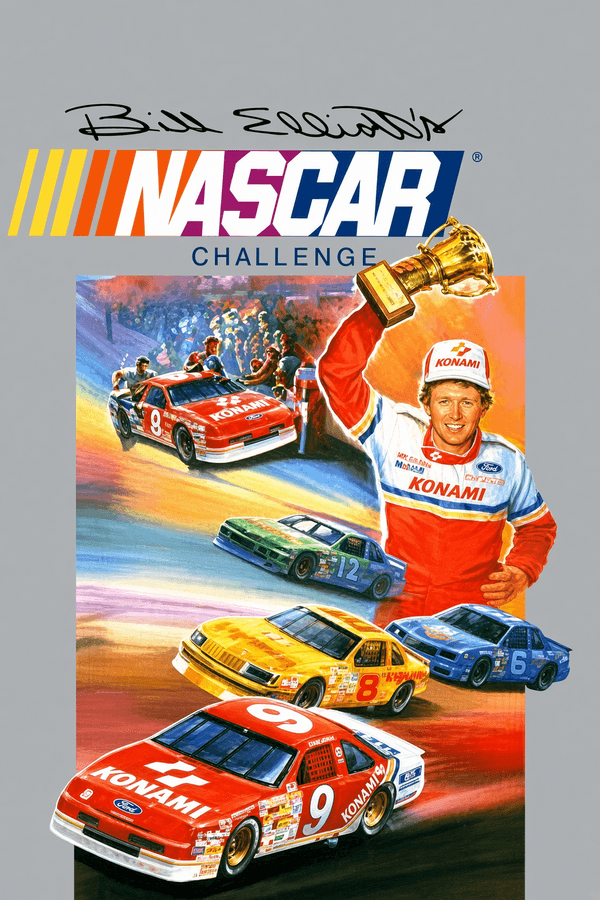
The moment Bill Elliott's NASCAR Challenge clicks is when you stop trying to wrestle the steering wheel on an oval and finally let the car drift up toward the wall to catch the slipstream off a lead driver.
Before this 1990 release, computer stock car games mostly treated round tracks like wide arcade lanes where holding down the accelerator key guaranteed a win. Designers Don Mattrick, Stanley Chow, and Amory Wong at Distinctive Software, Inc. took a different approach, turning drafting and car setup into the core loop. By pulling up directly behind an opponent, you punch a hole through the air resistance, pick up a few extra miles per hour on the straightaways, and slingshot past them into the turn.
That mechanical focus extends right into the garage before you ever turn a lap. You pick from three distinct bodies - a Ford Thunderbird, Chevrolet Lumina, or Pontiac Grand Prix - and tune your vehicle for specific track profiles. If you leave your spoiler angled for maximum downforce on a long oval like Talladega, you will watch the pack walk away from you down the back straight. Adjusting gear ratios, tire stagger, and engine setups isn't decorative flair here; it dictates whether you survive a full Winston Cup Championship Season or blow out your engine halfway through.
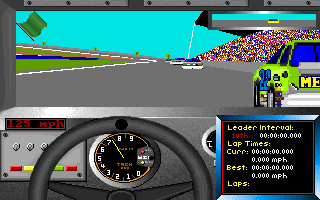
The track lineup features eight real-world locations: Daytona, Talladega, Atlanta, Darlington, Charlotte, Michigan, Watkins Glen, and Sears Point. On high-speed ovals, the game feels fluid, as flat-shaded 3D polygon environments zip past your windshield in a surprisingly clean fashion for a 1990 PC title. Watching your gauges from the cockpit while managing pit stops creates a steady rhythm that feels surprisingly close to actual motorsport strategy.
Everything changes when you load into the road courses. Taking on the tight, twisting turns of Sears Point exposes the hardest edge of the game's handling model. Keyboard and joystick controls that feel responsive on gentle bankings suddenly feel twitchy and punishing through chicane turns. It is where many players bounced off, as a single missed braking point sends your stock car skittering off course, wrecking your suspension and ending your championship hopes in a matter of seconds.
Published by Konami, Inc., this was the first video game to secure an official NASCAR license and the first on PC to put a real driver's name on the box. Konami even leaned into the competition by running a real-world mail-in contest, offering top players who mailed in high-score screenshots a chance to win a real 1992 Ford Thunderbird Super Coupe and a trip to meet Bill Elliott at the Daytona 500. Period reviews in publications like Computer Gaming World noted that while its handling leaned slightly more arcade than hardcore, its overall responsiveness set a benchmark for racing games in 1990.
Retrospectively, long multi-lap season races can turn monotonous once you master the drafting AI on the ovals, and the visual engine lacks the fine trackside detail that later simulations introduced. Yet, the inclusion of a VCR-style replay system with multiple camera angles was exceptionally forward-thinking, letting you rewatch your best overtakes long before that feature became standard in the genre.
If you want to experience early polygon simulation history, you can play Bill Elliott's NASCAR Challenge free in your browser right now. You do not need an old Sound Blaster setup or a vintage joystick to get onto the grid. Just launch the game, dial back your spoiler angle in the garage, and remember to ease into the brakes early when you hit the road courses.
The moment Bill Elliott's NASCAR Challenge clicks is when you stop trying to wrestle the steering wheel on an oval and finally let the car drift up toward the wall to catch the slipstream off a lead driver.
Before this 1990 release, computer stock car games mostly treated round tracks like wide arcade lanes where holding down the accelerator key guaranteed a win. Designers Don Mattrick, Stanley Chow, and Amory Wong at Distinctive Software, Inc. took a different approach, turning drafting and car setup into the core loop. By pulling up directly behind an opponent, you punch a hole through the air resistance, pick up a few extra miles per hour on the straightaways, and slingshot past them into the turn.
That mechanical focus extends right into the garage before you ever turn a lap. You pick from three distinct bodies - a Ford Thunderbird, Chevrolet Lumina, or Pontiac Grand Prix - and tune your vehicle for specific track profiles. If you leave your spoiler angled for maximum downforce on a long oval like Talladega, you will watch the pack walk away from you down the back straight. Adjusting gear ratios, tire stagger, and engine setups isn't decorative flair here; it dictates whether you survive a full Winston Cup Championship Season or blow out your engine halfway through.

The track lineup features eight real-world locations: Daytona, Talladega, Atlanta, Darlington, Charlotte, Michigan, Watkins Glen, and Sears Point. On high-speed ovals, the game feels fluid, as flat-shaded 3D polygon environments zip past your windshield in a surprisingly clean fashion for a 1990 PC title. Watching your gauges from the cockpit while managing pit stops creates a steady rhythm that feels surprisingly close to actual motorsport strategy.
Everything changes when you load into the road courses. Taking on the tight, twisting turns of Sears Point exposes the hardest edge of the game's handling model. Keyboard and joystick controls that feel responsive on gentle bankings suddenly feel twitchy and punishing through chicane turns. It is where many players bounced off, as a single missed braking point sends your stock car skittering off course, wrecking your suspension and ending your championship hopes in a matter of seconds.

Published by Konami, Inc., this was the first video game to secure an official NASCAR license and the first on PC to put a real driver's name on the box. Konami even leaned into the competition by running a real-world mail-in contest, offering top players who mailed in high-score screenshots a chance to win a real 1992 Ford Thunderbird Super Coupe and a trip to meet Bill Elliott at the Daytona 500. Period reviews in publications like Computer Gaming World noted that while its handling leaned slightly more arcade than hardcore, its overall responsiveness set a benchmark for racing games in 1990.
Retrospectively, long multi-lap season races can turn monotonous once you master the drafting AI on the ovals, and the visual engine lacks the fine trackside detail that later simulations introduced. Yet, the inclusion of a VCR-style replay system with multiple camera angles was exceptionally forward-thinking, letting you rewatch your best overtakes long before that feature became standard in the genre.
If you want to experience early polygon simulation history, you can play Bill Elliott's NASCAR Challenge free in your browser right now. You do not need an old Sound Blaster setup or a vintage joystick to get onto the grid. Just launch the game, dial back your spoiler angle in the garage, and remember to ease into the brakes early when you hit the road courses.
The on-screen keyboard and gamepad mapping the browser player uses on a phone, a tablet or a controller, as opposed to the real keys above. $PRO members make their own in the player and share them here; anyone can pick one to play with.
Cheat codes, console commands and memory pokes for Bill Elliott's NASCAR Challenge — each one verified and attributed.
Sign in to submitaka האתגר האמיתי :NASCAR מירוץ
The on-screen keyboard and gamepad mapping the browser player uses on a phone, a tablet or a controller, as opposed to the real keys above. $PRO members make their own in the player and share them here; anyone can pick one to play with.
Cheat codes, console commands and memory pokes for Bill Elliott's NASCAR Challenge — each one verified and attributed.
Sign in to submit