
Boston Bomb Club
Rate this game
- Played
- Rarely
Playing Boston Bomb Club means guiding lit explosives through a Victorian gentlemen's club before their fuses burn out and set the carpets on fire.
Steering explosives through a Victorian gentlemen's club in Boston Bomb Club
Most puzzle games from 1991 gave you time to pause, plan, and lay down pieces at your leisure. Silmarils went a different route by throwing you into a room full of eccentric gentlemen, lit fuses, and rolling iron spheres. You play an unseen overseer in an 1890s Boston club where the local mad scientists have turned the place into a oversized test bed. Instead of moving a hero around, your job is to alter the floor layout in real-time so that rolling bombs land safely into a bucket of water.
The perspective is strictly top-down, showing a tile-based grid framed by plush rugs, wooden panelling, and club members who look up from their morning papers just to get in your way. When you run `BOSTON.EXE` on MS-DOS, you are instantly hit with a high-pressure real-time flow. There are 30 levels in total, each starting with a bomb emerging on a fixed trajectory. If a lit fuse reaches the end before the casing hits water, the board blows up and you lose a life.
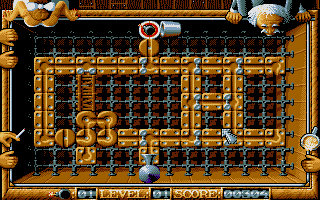
The tile-based mechanics of Boston Bomb Club make every split second count
The core layout borrows heavily from track-building classics like Pipe Mania, but the moving physics change the entire tension. Your main tools are clickable tile pieces scattered across the floor. You can rotate L-bend tiles to redirect a bomb around a dead end, flip movable gates along tile edges, or guide bombs across single-use collapsible bridges that disappear the moment weight touches them. Fixed directional gates add another wrinkle: they force a bomb to turn and then rotate clockwise on their own, meaning you cannot send two bombs down the exact same path without manual intervention.
Then comes the mechanic that split reviewers right down the middle when the game debuted. Trampolines marked with numbers bounce bombs across several tiles, skipping sections of the grid entirely. While it sounds helpful on paper, calculating where a high-velocity explosive will land while managing two other rolling bombs on the ground is where the system gets chaotic. French magazine Obligement singled out these bouncing sections as the absolute low point of the design, calling them the main drawback in an otherwise crisp puzzle package.
- Rotatable L-bends to turn rolling explosives around tight corners
- Movable edge gates to switch track paths on the fly
- Collapsible bridges that crumble after a single pass
- Clockwise auto-rotating gates that alter the circuit after every impact
- Numbered trampolines that launch bombs across the board
Why the chaotic difficulty spikes turn Boston Bomb Club into a fever dream
The design by Pascal Einsweiler and Michel Pernot works fine when you are dealing with a single bomb, but levels quickly start spawning secondary explosives only seconds after the first. This is where timing becomes your worst enemy. If two bombs collide on the same tile, they instantly detonate, wiping out your run without giving you a chance to repair the track. Mechanical arms intermittently drop bonus items onto the grid to tempt you, but going out of your way to collect them usually ends in catastrophe.
Opponent sprites move around the board, reading newspapers or manually flipping switches you just spent three seconds setting up. It gives the game the manic, unpredictable feel of a Rube Goldberg machine gone wrong. Magazines like ASM handed out middle-of-the-road scores like 50%, largely because the line between clever pathfinding and pure visual noise gets blurry by the mid-game stages. Yet the presentation carries plenty of dry visual humor, right down to the animated game over screen where the text politely tips its top hat to your failure.

How the MS-DOS version stands up today
If you play the 1991 Silmarils release today, the plain interface is what strikes you first. Period reviewers at Home of the Underdogs correctly noted that the game suffered from an unhelpful control layout. Clicking small tile edges while a lit fuse is five frames away from blowing up leads to plenty of misclicks. The round bombs themselves are drawn with tiny cartoon faces that smirk at you, a neat graphical touch that contrasts nicely with the stress of the actual puzzle solving.
Audio is functional rather than flashy, relying on standard PC speaker chirps or simple Sound Blaster effects to signal turns, bounces, and explosions. While the music composed by Fabrice Hautecloque gave the Amiga version a slight edge in atmosphere, the core logic on DOS remains identical. It is a harsh, fast-paced entry in the puzzle genre that relies more on fast mouse reflexes than long-term strategic plotting.
Ready to extinguish a few fuses? Play Boston Bomb Club online now
If you want to test your reaction speed against these Victorian mad scientists, you can play Boston Bomb Club free in your browser right on this page. There are no ancient config menus to navigate or files to extract; the game launches directly in your browser window with full mouse control enabled.
New players usually make the mistake of focusing entirely on the lead bomb while ignoring the spawn points at the edges of the screen. Keep an eye on where the next explosive is set to drop, set your L-bends early, and try not to panic when the trampolines start bouncing iron balls across your carefully planned routes. Jump in below and see how many buckets you can fill before the club room goes up in smoke.
How Boston Bomb Club is played — the keys the game listens to, grouped by what they do.
- Movement
- Action
- Left click — Change bomb route / Interact
Highlighted keys are mapped — hover or tap one to see what it does.
Players' controls
Touch and gamepad controls
The on-screen keyboard and gamepad mapping the browser player uses on a phone, a tablet or a controller, as opposed to the real keys above. $PRO members make their own in the player and share them here; anyone can pick one to play with.
Make your own touch controlsPRO
- 1Open the editorSign in below, then pick what to make. The game starts with the editor open over it.
- 2Place your keysAdd keys and drag them where your thumbs rest, or map a controller's buttons. Test plays the game with them; Save keeps them, and you play with them from then on.
- 3Share themShare them right after saving in the game, or name and share them here. Players vote, and the best become this game's controls for everyone.
Go PROSee how it worksSign in+20 XP for sharing · +50 XP if yours become the game's own
- The game's own controlsKeyboardGamepadWhat every player starts with.In use
2 screenshots
From the archive
No gameplay video yet
No gameplay video for Boston Bomb Club yet. Sign in to add one.
No reviews yet
Tell the community what you think of Boston Bomb Club. Reviews are public and tied to your username.
No archived manuals for Boston Bomb Club yet
No manuals archived for this title yet. Sign in to upload the first scan.
Cheat codes, console commands and memory pokes for Boston Bomb Club — each one verified and attributed.
Sign in to submitNo cheats yet for this title
Know a working cheat, poke or trainer? Add it with the button above. Moderators check every entry before it goes live.
No archived soundtrack for Boston Bomb Club yet
No soundtrack archived for this title yet. Sign in to upload the first rip.
No save states for Boston Bomb Club yet
No save states for this title yet. Sign in to share one.
Discussions
Sign in to post- Threads0
- Total posts0
- Online now6
Community · Boston Bomb Club
Who's contributing, and what's new
- Reviews0
- Threads0
- Uploadsapproved0
- Contributors0
Recent activity
Nothing here yet
Reviews, discussion threads and approved uploads appear here as members add them.