
Breakout !
Rate this game
- Played
- Rarely
Hal Strausberg's 1986 MS-DOS title Breakout ! took the fundamental arcade template of a moving paddle and a bouncing ball, stripping away fancy powerups to focus purely on clearing brick walls ten points at a time.
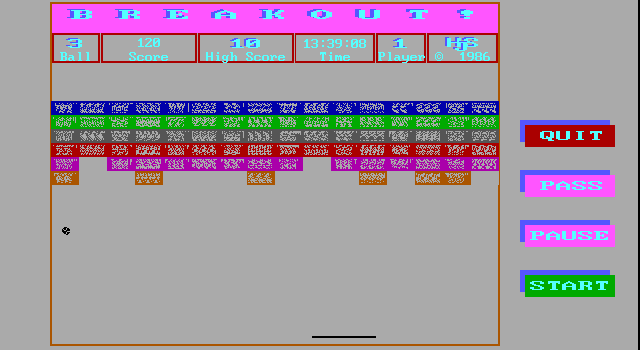
Clearing the wall five balls at a time in Breakout !
When you boot up this 1986 MS-DOS title, there are no narrative cutscenes, level select menus, or weapon upgrades waiting for you. You step right into a clean field with five balls in reserve, a paddle resting at the bottom of the display, and a solid wall of targets stacked overhead. Your single objective is to keep that ball active by placing your paddle directly beneath its descent, bouncing it back upward to destroy as many target blocks as possible.
Every single block you eliminate earns you 10 points. Without modern falling powerups, laser modifications, or multi-ball chaos, the tension comes down to simple geometry and reaction timing. Missing the ball costs you one of your precious lives immediately, resetting the field momentum and forcing you to launch your next attempt carefully. It is an unadorned take on real-time action mechanics where a single miscalculated bounce ends your run fast.
How Hal Strausberg adapted arcade fundamentals for MS-DOS
During the mid-1980s, bringing arcade-style real-time movement to home computers required keeping code light and efficient. Developed and published by Hal Strausberg as a software release distributed through freeware and shareware channels, the game was built to run cleanly across early PC hardware setups without demanding specialized graphics cards. Players who enjoyed the software were encouraged to register by mailing payment directly to the author.
Because it skips complex sprite animations or heavy audio processing, the game avoids the slowdown that plagued heavier PC conversions of the era. The movement of the ball remains predictable, which is essential when a tiny misstep means losing your last life. While commercial releases were starting to add decorative backdrops, this bare-bones build proved that core gameplay loops could survive on modest office machines.
Shared keyboard competition for up to 99 players
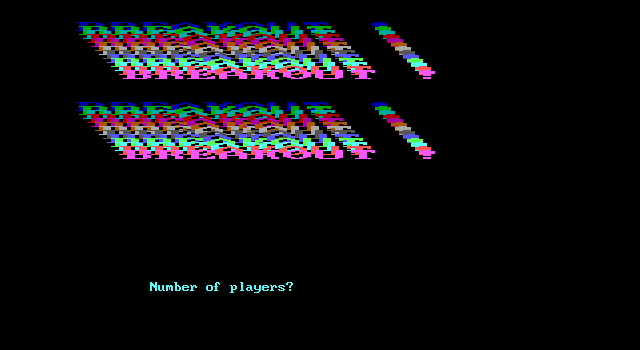
One of the most surprising additions to Breakout ! is its turn-based multiplayer framework. Rather than restricting the fun to a single player sitting at the desktop, the game includes options to support hot-seat competitive play for up to 99 players using a shared keyboard and mouse setup. Everyone takes turns trying to clear the screen or maximize their point totals using their allotted five balls before passing the controls to the next person.
- Five reserve balls per player per round
- Fixed 10-point reward for every brick removed
- Hot-seat rotation supporting up to 99 sequential players
- Direct paddle control via standard MS-DOS input devices
This turn-based competitive format turned what would otherwise be a solitary distraction into a group event for computer clubs and office break rooms. Watching your friends try to clean out the final few awkward corner bricks while holding onto their final ball created plenty of couch-side tension.
Where the minimal design shows its age
The total lack of variety is where this build will test your patience today. Because there are no dynamic powerups, expanding paddles, or changing wall layouts, every single attempt plays out under identical rules. Once you master the basic rebounds and find a comfortable rhythm along the bottom edge, the experience relies entirely on your willingness to chase high scores.
Later commercial iterations on the genre added hazards, enemy ships drifting through the playfield, and distinct stage themes to keep players invested over long sessions. Here, you are doing one job over and over. If you expect evolving puzzle mechanics or boss fights, you will hit a wall quickly, but as a pure test of reflex accuracy, the focus remains intact.
Take your shot at the high score today
It is a neat slice of early PC shareware that shows how independent authors brought popular arcade concepts to home monitors. It skips all modern flash in favor of responsive controls and zero setup fuss. If you want to sample 1980s PC gaming or see how high you can stack your score on a single set of five balls, you can play Breakout ! free in your browser right now with nothing to install, so launch a game and see if you can clear that top row on your very first try.
How Breakout ! is played — the keys the game listens to, grouped by what they do.
- Movement
- Interface
- Move mouse — Move paddle horizontally
- Left click — Suspend game / Select option
- Right click — Suspend game / Select option
Highlighted keys are mapped — hover or tap one to see what it does.
Players' controls
Touch and gamepad controls
The on-screen keyboard and gamepad mapping the browser player uses on a phone, a tablet or a controller, as opposed to the real keys above. $PRO members make their own in the player and share them here; anyone can pick one to play with.
Make your own touch controlsPRO
- 1Open the editorSign in below, then pick what to make. The game starts with the editor open over it.
- 2Place your keysAdd keys and drag them where your thumbs rest, or map a controller's buttons. Test plays the game with them; Save keeps them, and you play with them from then on.
- 3Share themShare them right after saving in the game, or name and share them here. Players vote, and the best become this game's controls for everyone.
Go PROSee how it worksSign in+20 XP for sharing · +50 XP if yours become the game's own
- The game's own controlsKeyboardGamepadWhat every player starts with.In use
2 screenshots
From the archive
No reviews yet
Tell the community what you think of Breakout !. Reviews are public and tied to your username.
No archived manuals for Breakout ! yet
No manuals archived for this title yet. Sign in to upload the first scan.
Cheat codes, console commands and memory pokes for Breakout ! — each one verified and attributed.
Sign in to submitNo cheats yet for this title
Know a working cheat, poke or trainer? Add it with the button above. Moderators check every entry before it goes live.
No archived soundtrack for Breakout ! yet
No soundtrack archived for this title yet. Sign in to upload the first rip.
No save states for Breakout ! yet
No save states for this title yet. Sign in to share one.
Discussions
Sign in to post- Threads0
- Total posts0
- Online now6
Community · Breakout !
Who's contributing, and what's new
- Reviews0
- Threads0
- Uploadsapproved0
- Contributors0
Recent activity