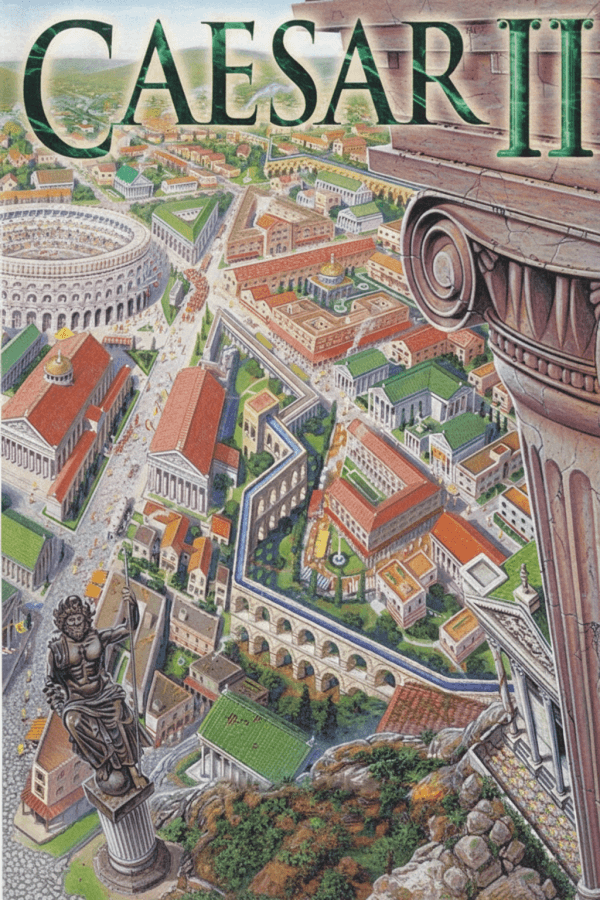

Caesar II turned a modest tile-laying strategy exercise into a demanding, three-tiered empire simulator that punished poor road planning as severely as a barbarian invasion.
Three layers of Roman bureaucracy in Caesar II
Most city builders of the era asked you to manage a single grid, but Impressions Games split this 1995 sequel into three distinct theaters. You balance local city housing, provincial resource extraction, and tactical defense across the Roman world. If your mines in the province lack trade routes, your city markets freeze up, and your treasury rapidly empties.
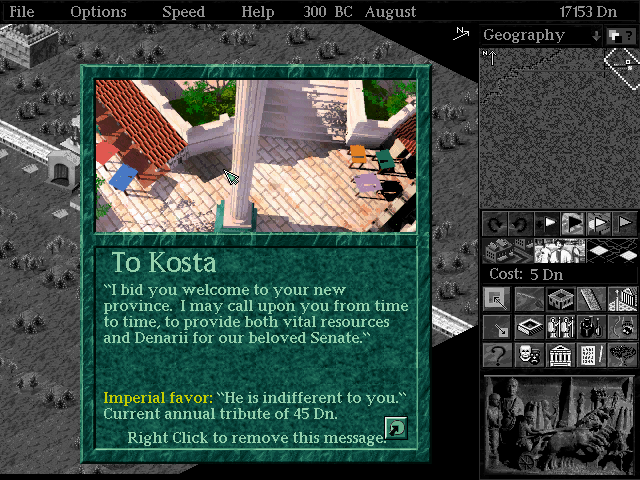
Your ultimate goal is rising from a minor regional governor to Augustus Caesar himself. Progress across the empire map depends on four strict metrics: favor, prosperity, culture, and peace. A digital rival governor works on neighboring territories at the same time, forcing you to expand quickly or fall behind in Caesar's eyes.
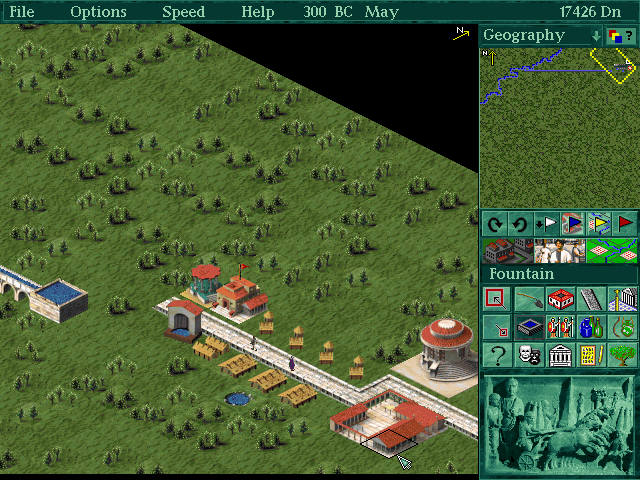
The city map operates like a delicate, temperamental engine. Houses need access to fresh water via reservoirs, clear street access to forums, and protection from fire or riots. Temples protect your tax wealth from theft, but neglect education or baths and your citizens refuse to upgrade their homes.
The eternal labor crisis and the grid logic
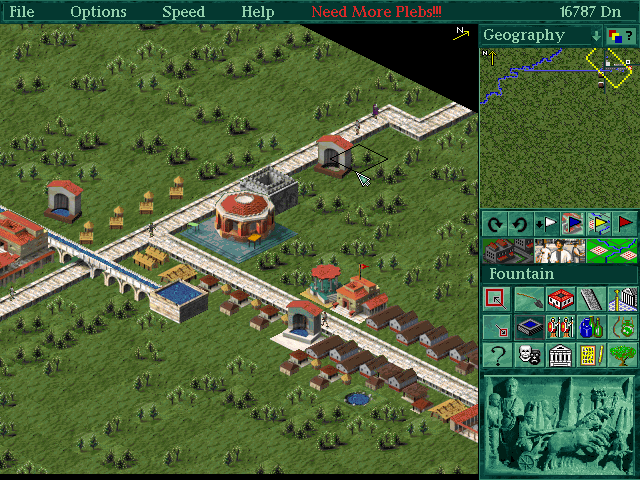
Anyone who spent nights with the 1995 MS-DOS game remembers the endless voice prompts declaring that plebeians were needed. Plebeian labor powers every service in your city, yet worker supply operates on strict, unforgiving pathfinding rules. If a walker reaches a road junction, they choose a direction at random.
To keep services functional, sharp players quickly abandoned realistic city grids in favor of long, unbroken loops. Intersections are your worst enemy because they split market traders and bathhouse attendants away from residential zones. A single misaligned crossroad can starve a thriving neighborhood of food, collapsing property values in minutes.
Here is what a stable governor loop relies on when laying out a new province:
- Primary industry: Mines, farms, and shipyards placed near rural resource nodes on the province map.
- Transport links: Paved provincial roads directly connecting raw materials to your main city gates.
- City processing: Secondary workshops and market stalls positioned along simple, non-branching paved loops.
- Civic protection: Fire houses and prefectures placed near slums to stop riots before arson spreads.
Wall tactics and tactical combat tricks
Barbarian armies regularly spawn from camps inside your province, forcing a shift to the tactical screen. You can command your cohorts directly on battlefield terrain or rely on the automatic battle simulator. Direct control gives you a real shot at beating superior forces if you flank units properly.
Players who lacked military budgets famously relied on an absurd engine exploit. By dropping the simulation speed to a crawl mid-battle, you can open the province build menu and draw stone walls entirely around the incoming invasion force. The trapped army stands helpless inside four walls while your archers pick them off at leisure.
Publisher Sierra On-Line, Inc. shipped the package without standard money cheat codes. Gamers who wanted unlimited funds had to edit their save files directly using hex editors like the popular Denarii Editor. Setting audio card parameters required running the sound setup executable to modify the local RESOURCE.CFG file manually.
Where Impressions Games hit the mark
Designed by David Lester and Christopher J. Foster, the title was a massive success for Impressions Games. Together with its predecessor, combined sales pushed past 400,000 units by early 1996. Computer Gaming World named it a runner-up for strategy game of the year, losing top honors to Command & Conquer.
Art director Chris Beatrice gave the game crisp SVGA visual polish and detailed 3D rendered cutscenes for milestone events. Composers Jeremy A. Bell and Jason P. Rinaldi provided an orchestral audio backdrop that sounded full on a Sound Blaster board. Programmed by Simon Bradbury, the underlying simulation provided a rich, addicting feedback loop despite its strict micromanagement quirks.
The micro-management hit hard when provinces grew massive, but few city builders offered this much scope. Before Caesar III streamlined walker mechanics in 1998, this entry represented the absolute peak of classic early management design.
How to play Caesar II online today
You can play Caesar II online right here in your browser with zero installation headache. Jump straight into the first province campaign, build a tight, loop-based residential district, and make sure you place enough prefectures to keep the plebeians happy. Managing your first self-sustaining Roman economy takes only a few minutes to set up.