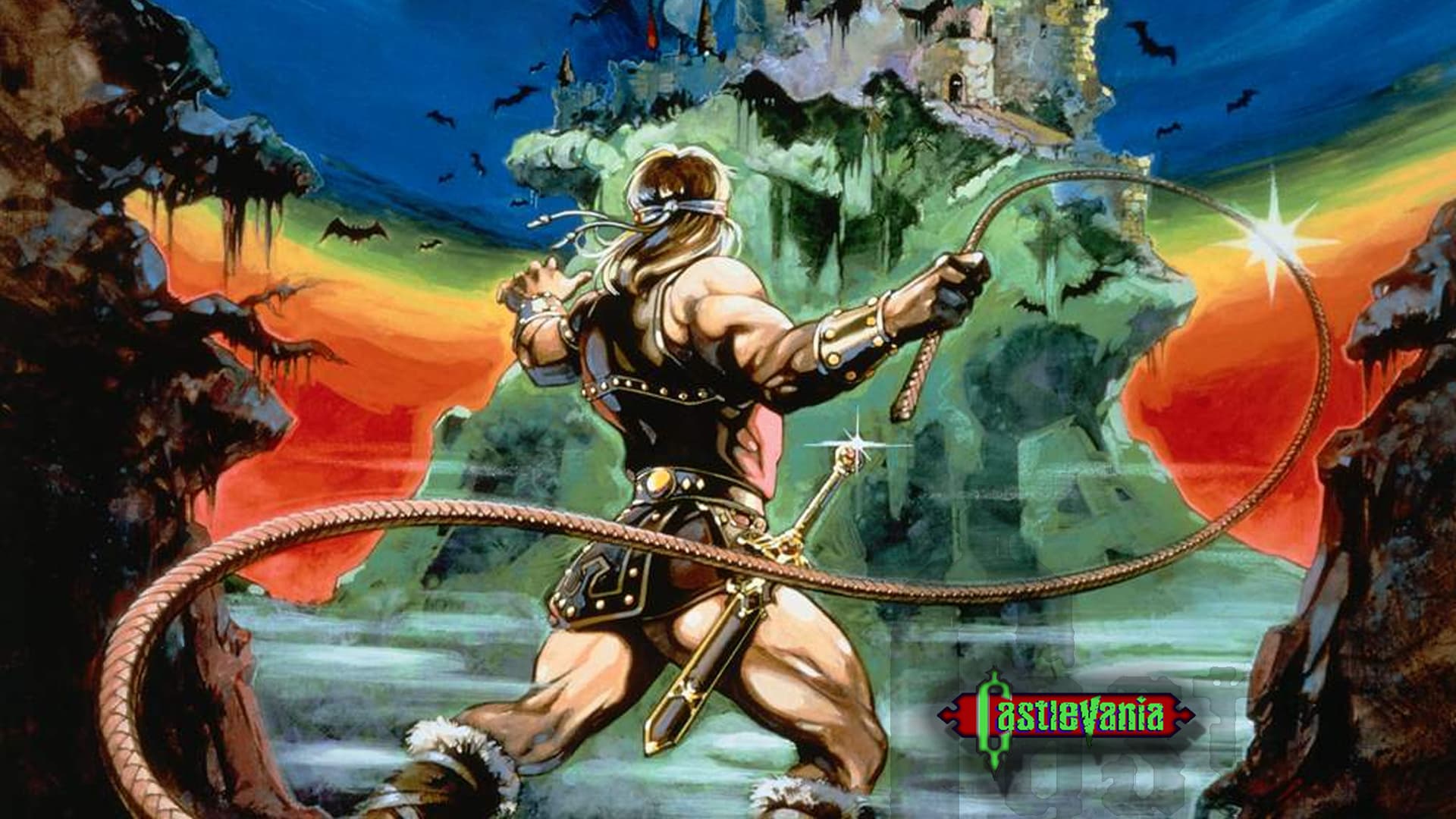
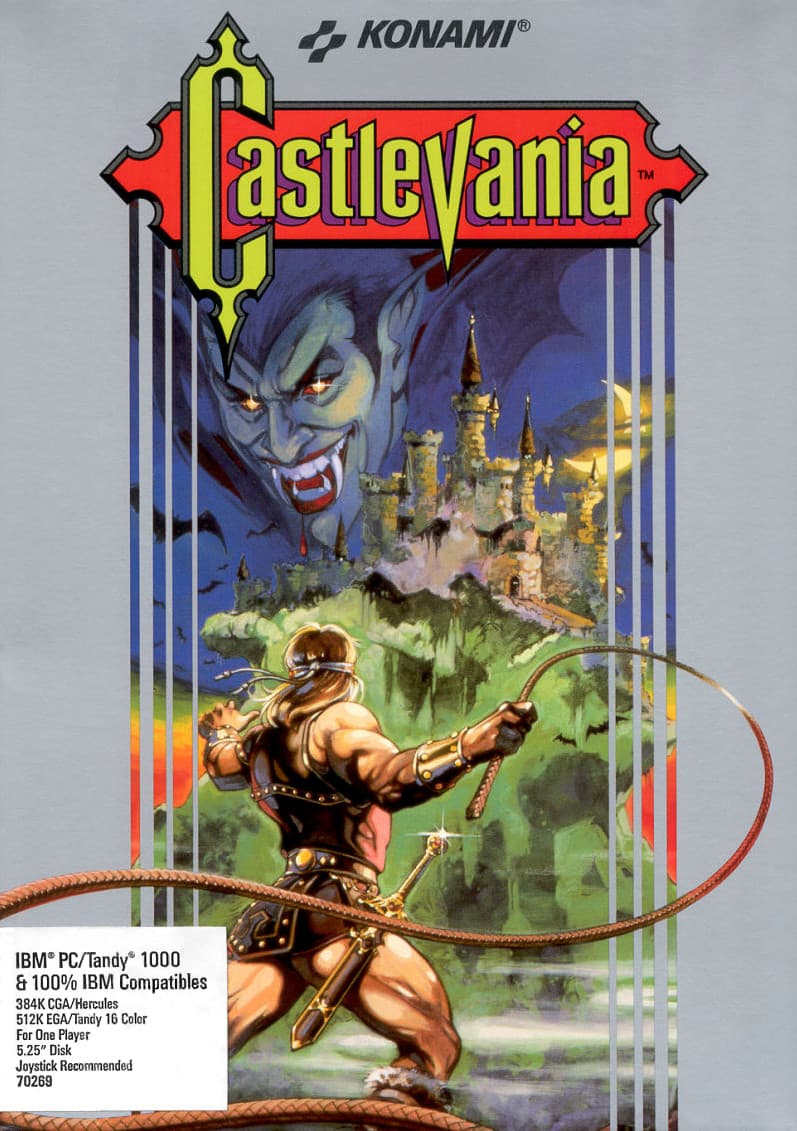
Simon Belmont steps into Dracula's castle carrying an upgradable leather whip and a severe resistance to responsive controls, bringing the side-scrolling hit to PC monitors in the 1990 conversion of Castlevania.
Every step inside Dracula's mansion demands absolute commitment because your movement mechanics give you zero room for error. When you press ENTER to jump, Simon leaps forward in an unyielding arc that cannot be steered in mid-air. If an axe thrower or flying Medusa head hits you while airborne, the resulting knockback immediately knocks you off the platform to your death.
Attacking requires the SPACE bar, but whipping comes with a noticeable delay between swings that will catch you off guard if you spam the key. To throw sub-weapons like the axe, boomerang, dagger, fire bomb, or stop-watch, you must hold the Up Arrow alongside SPACE. Because hearts collected from candles and dead monsters serve directly as ammunition rather than health, wasting a sub-weapon attack on a standard skeleton leaves you empty-handed when a real hazard arrives.
Cracking open breakable walls reveals essential secret items like restorative turkey or double and triple shot upgrades. Finding these hidden items is often the only way to survive a stage, as the default control layout makes basic ducking and whipping much harder than it ever was on console hardware.
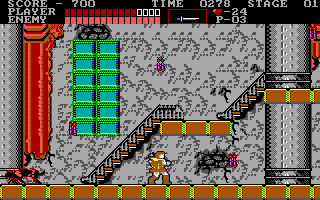
Developer Distinctive Software, Inc. faced a heavy task bringing this action game over to modern PCs for publisher Konami, Inc. back in 1990. The PC port supported CGA, EGA, Tandy, and Hercules display modes, attempting to cover whatever monitor setup a player happened to have on their desk. Depending on your video card, the castle walls ranged from muddy four-color CGA palettes to solid sixteen-color EGA visuals.
The trade-off for multi-card support was screen motion that lacked smooth horizontal scrolling. The background stutters and jerks as the screen shifts along with Simon, making precisely timed jumps past fishmen near water pits feel needlessly perilous. The developers also included built-in disk copy protection that forced players to pass a password prompt before accessing the game menu.
If you managed to clear a stage despite the hardware limitations, your score was recorded on the local leaderboard, titled Drac's Top 10. The PC speaker synth hummed through the familiar melodies, though having a Sound Blaster card delivered far better audio rendering of the castle soundtracks.
The six main stages take you through courtyard dungeons, ruined halls, and clock towers packed with aggressive enemies. Early screens present ravens that dive at sharp angles and bats that flutter at awkward heights, forcing you to memorize enemy spawn points. Skeletons toss bones in erratic paths, while fishmen jump vertically out of bottomless watery chasms.
Boss battles mark huge spikes in difficulty where lazy timing gets punished instantly. Fighting Frankenstein and Igor requires dodging constant leap patterns while trying to squeeze in whip attacks during small windows of safety. Igor dashes around erratically, throwing off your aim while Frankenstein absorbs damage.
The Grim Reaper stage remains notorious for trapping players in a swarm of flying sickles before they can even get close enough to strike. By the time you reach Count Dracula himself, managing your sub-weapon heart count and timing every jump down to the exact frame are mandatory if you want to see the final screen.
Evaluating this conversion today requires acknowledging its awkward keyboard bindings and stiff character handling. While standard action platformers on PC relied on smooth input loops, this version demands that players learn the heavy delay of its whip animation. Modern players often drop the game on the very first stage simply because they expect mid-air trajectory control that does not exist here.
Yet for all its technical quirks and clunky frame updates, it preserves the complete structural layout, item placement, and level progression of the original design. The tactical value of holding onto an axe or stop-watch for a boss fight remains intact, rewarding pure memorization and careful positioning over raw reflexes.
It is a fascinating look at how major Japanese arcade and console properties were translated for early home computers. If you enjoy hard games and want to see how PC players experienced Count Dracula's halls thirty years ago, taking a run through this version is well worth a try.
You can play Castlevania online right now without setting up old system configurations or tweaking vintage display settings. Experiencing this classic Castlevania MS-DOS game today is as simple as launching it and mapping out your keystrokes for Simon's whip commands. You can load Castlevania free in your browser directly on this page, jump straight into Stage 1, and see if you have the patience to whip your way past Dracula's army.
Simon Belmont steps into Dracula's castle carrying an upgradable leather whip and a severe resistance to responsive controls, bringing the side-scrolling hit to PC monitors in the 1990 conversion of Castlevania.
Every step inside Dracula's mansion demands absolute commitment because your movement mechanics give you zero room for error. When you press ENTER to jump, Simon leaps forward in an unyielding arc that cannot be steered in mid-air. If an axe thrower or flying Medusa head hits you while airborne, the resulting knockback immediately knocks you off the platform to your death.
Attacking requires the SPACE bar, but whipping comes with a noticeable delay between swings that will catch you off guard if you spam the key. To throw sub-weapons like the axe, boomerang, dagger, fire bomb, or stop-watch, you must hold the Up Arrow alongside SPACE. Because hearts collected from candles and dead monsters serve directly as ammunition rather than health, wasting a sub-weapon attack on a standard skeleton leaves you empty-handed when a real hazard arrives.
Cracking open breakable walls reveals essential secret items like restorative turkey or double and triple shot upgrades. Finding these hidden items is often the only way to survive a stage, as the default control layout makes basic ducking and whipping much harder than it ever was on console hardware.

Developer Distinctive Software, Inc. faced a heavy task bringing this action game over to modern PCs for publisher Konami, Inc. back in 1990. The PC port supported CGA, EGA, Tandy, and Hercules display modes, attempting to cover whatever monitor setup a player happened to have on their desk. Depending on your video card, the castle walls ranged from muddy four-color CGA palettes to solid sixteen-color EGA visuals.
The trade-off for multi-card support was screen motion that lacked smooth horizontal scrolling. The background stutters and jerks as the screen shifts along with Simon, making precisely timed jumps past fishmen near water pits feel needlessly perilous. The developers also included built-in disk copy protection that forced players to pass a password prompt before accessing the game menu.
If you managed to clear a stage despite the hardware limitations, your score was recorded on the local leaderboard, titled Drac's Top 10. The PC speaker synth hummed through the familiar melodies, though having a Sound Blaster card delivered far better audio rendering of the castle soundtracks.
The six main stages take you through courtyard dungeons, ruined halls, and clock towers packed with aggressive enemies. Early screens present ravens that dive at sharp angles and bats that flutter at awkward heights, forcing you to memorize enemy spawn points. Skeletons toss bones in erratic paths, while fishmen jump vertically out of bottomless watery chasms.
Boss battles mark huge spikes in difficulty where lazy timing gets punished instantly. Fighting Frankenstein and Igor requires dodging constant leap patterns while trying to squeeze in whip attacks during small windows of safety. Igor dashes around erratically, throwing off your aim while Frankenstein absorbs damage.
The Grim Reaper stage remains notorious for trapping players in a swarm of flying sickles before they can even get close enough to strike. By the time you reach Count Dracula himself, managing your sub-weapon heart count and timing every jump down to the exact frame are mandatory if you want to see the final screen.

Evaluating this conversion today requires acknowledging its awkward keyboard bindings and stiff character handling. While standard action platformers on PC relied on smooth input loops, this version demands that players learn the heavy delay of its whip animation. Modern players often drop the game on the very first stage simply because they expect mid-air trajectory control that does not exist here.
Yet for all its technical quirks and clunky frame updates, it preserves the complete structural layout, item placement, and level progression of the original design. The tactical value of holding onto an axe or stop-watch for a boss fight remains intact, rewarding pure memorization and careful positioning over raw reflexes.
It is a fascinating look at how major Japanese arcade and console properties were translated for early home computers. If you enjoy hard games and want to see how PC players experienced Count Dracula's halls thirty years ago, taking a run through this version is well worth a try.
You can play Castlevania online right now without setting up old system configurations or tweaking vintage display settings. Experiencing this classic Castlevania MS-DOS game today is as simple as launching it and mapping out your keystrokes for Simon's whip commands. You can load Castlevania free in your browser directly on this page, jump straight into Stage 1, and see if you have the patience to whip your way past Dracula's army.
How Castlevania is played — the keys the game listens to, grouped by what they do.
Highlighted keys are mapped — hover or tap one to see what it does.
The provided research notes contain an incomplete control scheme, omitting directional movement keys. Password entry is required at startup.
The on-screen keyboard and gamepad mapping the browser player uses on a phone, a tablet or a controller, as opposed to the real keys above. $PRO members make their own in the player and share them here; anyone can pick one to play with.
Cheat codes, console commands and memory pokes for Castlevania — each one verified and attributed.
Sign in to submitHow Castlevania is played — the keys the game listens to, grouped by what they do.
Highlighted keys are mapped — hover or tap one to see what it does.
The provided research notes contain an incomplete control scheme, omitting directional movement keys. Password entry is required at startup.
The on-screen keyboard and gamepad mapping the browser player uses on a phone, a tablet or a controller, as opposed to the real keys above. $PRO members make their own in the player and share them here; anyone can pick one to play with.
Cheat codes, console commands and memory pokes for Castlevania — each one verified and attributed.
Sign in to submit