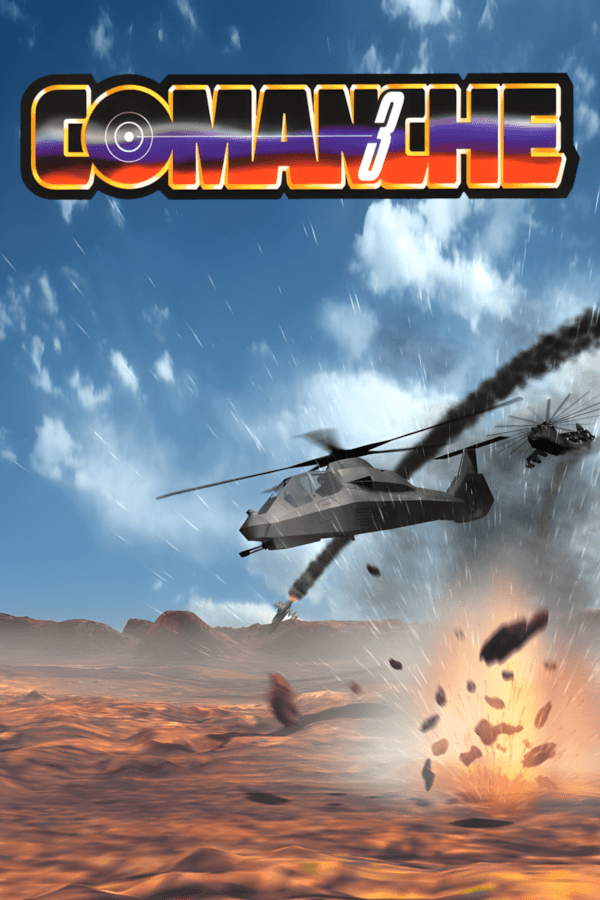

If you lined up PC flight games in 1997, Comanche 3 was the one that looked like reality and ate your CPU alive to prove it.
Most flight simulators of the late nineties traded visual fidelity for expansive skies, but lead programmer Kyle Freeman took NovaLogic in the opposite direction. By upgrading their proprietary technology to Voxel Space 2, the team drew rolling hills, desert dunes, and jagged mountain ridges out of volumetric pixels while pinning crisp 3D polygonal models for ground vehicles and structures directly onto the terrain. Flying low over a jungle canopy or ducking into a ravine gave a sense of velocity that standard polygon grids simply could not match at the time. GameRevolution even awarded the visual presentation a perfect score, and Computer Gaming World praised how believable the environment felt when skimming the treetops.
That visual punch came at a brutal cost to your system hardware. Running the game back then required a monster PC, making it arguably the most resource-heavy MS-DOS game from 1997. If your processor was not up to scratch, frame rates plummeted into a slideshow the moment heavy smoke, ground armor, and artillery strikes hit the display simultaneously. Even today, tweaking cycles to get this demanding engine running smoothly in DOSBox takes patience, though watching the terrain deform and ripple under your rotor wash is still a wild technical trick.
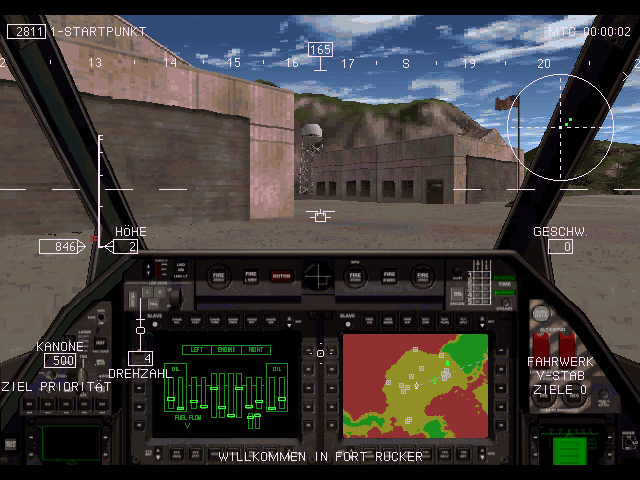
You play as a pilot in Griffin Squadron, sitting in the cockpit of the Boeing-Sikorsky RAH-66 Comanche attack chopper across four distinct campaigns comprising over 30 missions. The game caters to different playstyles by offering both a simplified arcade setup and an advanced flight mode. Turning on the full physics suite introduces real aerodynamics like retreating blade stall, pitch and collective management, ground effect floating, and precise hovering tools like HoverHold and V-Stab. Military advisors including test pilots helped ground these mechanics, forcing you to respect how a low-observable aircraft actually handles under fire.
Mission design forces you to mix stealth tactics with aggressive fire support. Your standard loadout packs a 20mm cannon, heavy Hellfire anti-tank missiles, and heat-seeking Stingers for air threats. You might be tasked with taking down air-defense sites, guiding friendly convoys through narrow passes, or painting targets for off-screen artillery. The tactical loop usually involves popping over a ridge line, locking a target, releasing a Hellfire, and dropping back down before SAM radars lock onto your fuselage.
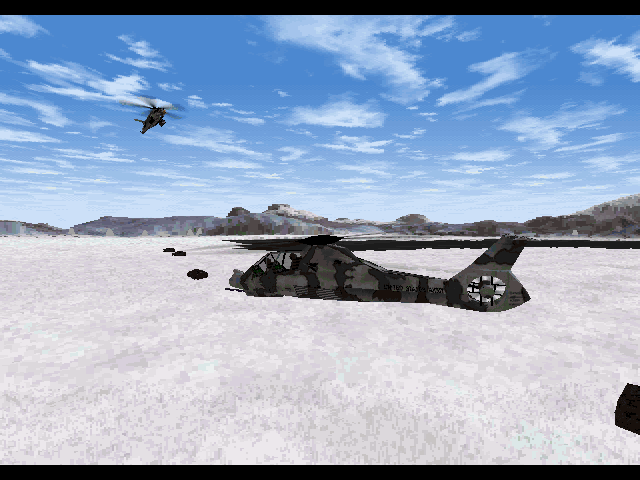
For all its simulation polish, the friendly artificial intelligence is easily the most frustrating part of the package. Your designated wingman has a nasty habit of ignoring direct orders, drifting off course, or trailing so far behind that they fail to support you during ambush encounters. Worse still, their pathfinding often fails in tight terrain, leading them to ram directly into your chopper or open fire straight through your tail rotor to hit a tank on the horizon. Most players quickly learned to treat their squadmate as a secondary decoy rather than a reliable partner.
The sound design is similarly mixed. While the frantic radio chatter from wingmen and enemy command posts adds tension and stays in your head long after a session, the background music features cheesy synthetic MIDI tunes that clash hard with the grim military theme. Turning the music down in the options menu to focus on rotor blade thumps and weapon blasts was practically mandatory for serious sorties.
When a mission fell apart or the frame rates choked under heavy fire, players routinely turned to the built-in single-player cheat console. Tapping the 'R' key brought up a text prompt where you could type codes for full repairs, endless ammunition, or total invisibility. Spawning endless artillery strikes or launching twenty Stingers into the sky at once became a unofficial stress test for hardware, often melting frame rates just to see how many explosions the engine could render before crashing.
Despite stiff competition from sim giants like Jane's Longbow, this release carved out a dedicated following and snagged multiple simulator awards in 1997. Developer NovaLogic later expanded on the concept with Comanche Gold in 1998 before moving the series fully to 3D acceleration with Comanche 4. Yet there is a distinct weight and mechanical bite to this original entry that later iterations never quite duplicated.
If you want a pure slice of late-nineties tactical combat, this chopper sim is a fantastic ride. The combination of easy controls for casual strafing runs and demanding aerodynamics for rotorheads means anyone interested in the action-sim crossover era will find plenty to enjoy. While the wingman pathfinding is broken and the mission count feels concise compared to open-ended survey sims, nothing beats the raw thrill of hugging a voxel valley line to dodge radar.
You can play Comanche 3 online directly in your web browser without installing config files or tweaking system memory settings. Hovering ten feet above a desert valley and dropping laser-guided ordnance onto an enemy convoy is something you have to control yourself to appreciate. Jump into the cockpit, lower your altitude, and see if you can survive the air defense grid without crashing into the terrain.
If you lined up PC flight games in 1997, Comanche 3 was the one that looked like reality and ate your CPU alive to prove it.
Most flight simulators of the late nineties traded visual fidelity for expansive skies, but lead programmer Kyle Freeman took NovaLogic in the opposite direction. By upgrading their proprietary technology to Voxel Space 2, the team drew rolling hills, desert dunes, and jagged mountain ridges out of volumetric pixels while pinning crisp 3D polygonal models for ground vehicles and structures directly onto the terrain. Flying low over a jungle canopy or ducking into a ravine gave a sense of velocity that standard polygon grids simply could not match at the time. GameRevolution even awarded the visual presentation a perfect score, and Computer Gaming World praised how believable the environment felt when skimming the treetops.
That visual punch came at a brutal cost to your system hardware. Running the game back then required a monster PC, making it arguably the most resource-heavy MS-DOS game from 1997. If your processor was not up to scratch, frame rates plummeted into a slideshow the moment heavy smoke, ground armor, and artillery strikes hit the display simultaneously. Even today, tweaking cycles to get this demanding engine running smoothly in DOSBox takes patience, though watching the terrain deform and ripple under your rotor wash is still a wild technical trick.
You play as a pilot in Griffin Squadron, sitting in the cockpit of the Boeing-Sikorsky RAH-66 Comanche attack chopper across four distinct campaigns comprising over 30 missions. The game caters to different playstyles by offering both a simplified arcade setup and an advanced flight mode. Turning on the full physics suite introduces real aerodynamics like retreating blade stall, pitch and collective management, ground effect floating, and precise hovering tools like HoverHold and V-Stab. Military advisors including test pilots helped ground these mechanics, forcing you to respect how a low-observable aircraft actually handles under fire.
Mission design forces you to mix stealth tactics with aggressive fire support. Your standard loadout packs a 20mm cannon, heavy Hellfire anti-tank missiles, and heat-seeking Stingers for air threats. You might be tasked with taking down air-defense sites, guiding friendly convoys through narrow passes, or painting targets for off-screen artillery. The tactical loop usually involves popping over a ridge line, locking a target, releasing a Hellfire, and dropping back down before SAM radars lock onto your fuselage.
For all its simulation polish, the friendly artificial intelligence is easily the most frustrating part of the package. Your designated wingman has a nasty habit of ignoring direct orders, drifting off course, or trailing so far behind that they fail to support you during ambush encounters. Worse still, their pathfinding often fails in tight terrain, leading them to ram directly into your chopper or open fire straight through your tail rotor to hit a tank on the horizon. Most players quickly learned to treat their squadmate as a secondary decoy rather than a reliable partner.
The sound design is similarly mixed. While the frantic radio chatter from wingmen and enemy command posts adds tension and stays in your head long after a session, the background music features cheesy synthetic MIDI tunes that clash hard with the grim military theme. Turning the music down in the options menu to focus on rotor blade thumps and weapon blasts was practically mandatory for serious sorties.
When a mission fell apart or the frame rates choked under heavy fire, players routinely turned to the built-in single-player cheat console. Tapping the 'R' key brought up a text prompt where you could type codes for full repairs, endless ammunition, or total invisibility. Spawning endless artillery strikes or launching twenty Stingers into the sky at once became a unofficial stress test for hardware, often melting frame rates just to see how many explosions the engine could render before crashing.
Despite stiff competition from sim giants like Jane's Longbow, this release carved out a dedicated following and snagged multiple simulator awards in 1997. Developer NovaLogic later expanded on the concept with Comanche Gold in 1998 before moving the series fully to 3D acceleration with Comanche 4. Yet there is a distinct weight and mechanical bite to this original entry that later iterations never quite duplicated.
If you want a pure slice of late-nineties tactical combat, this chopper sim is a fantastic ride. The combination of easy controls for casual strafing runs and demanding aerodynamics for rotorheads means anyone interested in the action-sim crossover era will find plenty to enjoy. While the wingman pathfinding is broken and the mission count feels concise compared to open-ended survey sims, nothing beats the raw thrill of hugging a voxel valley line to dodge radar.
You can play Comanche 3 online directly in your web browser without installing config files or tweaking system memory settings. Hovering ten feet above a desert valley and dropping laser-guided ordnance onto an enemy convoy is something you have to control yourself to appreciate. Jump into the cockpit, lower your altitude, and see if you can survive the air defense grid without crashing into the terrain.
How Comanche 3 is played — the keys the game listens to, grouped by what they do.
Highlighted keys are mapped — hover or tap one to see what it does.
Options and controls can be adjusted through the in-game Options Menu. Joysticks support configurable advanced flight effects.
The on-screen keyboard and gamepad mapping the browser player uses on a phone, a tablet or a controller, as opposed to the real keys above. $PRO members make their own in the player and share them here; anyone can pick one to play with.
Cheat codes, console commands and memory pokes for Comanche 3 — each one verified and attributed.
Sign in to submitHow Comanche 3 is played — the keys the game listens to, grouped by what they do.
Highlighted keys are mapped — hover or tap one to see what it does.
Options and controls can be adjusted through the in-game Options Menu. Joysticks support configurable advanced flight effects.
The on-screen keyboard and gamepad mapping the browser player uses on a phone, a tablet or a controller, as opposed to the real keys above. $PRO members make their own in the player and share them here; anyone can pick one to play with.
Cheat codes, console commands and memory pokes for Comanche 3 — each one verified and attributed.
Sign in to submit