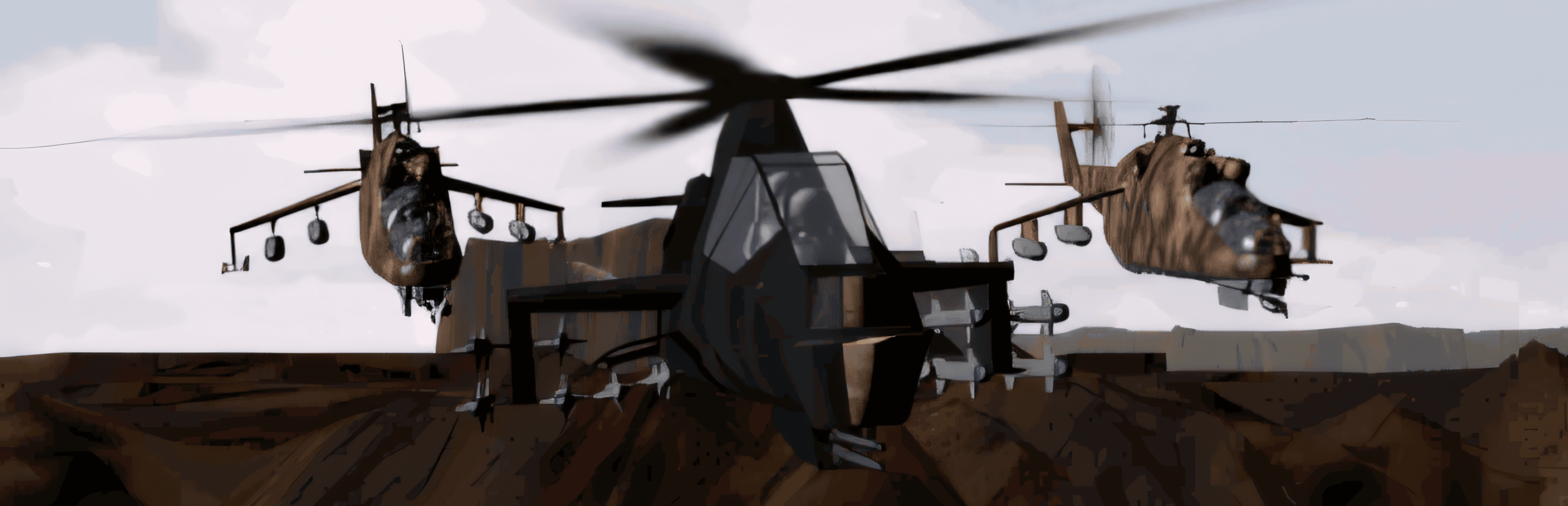
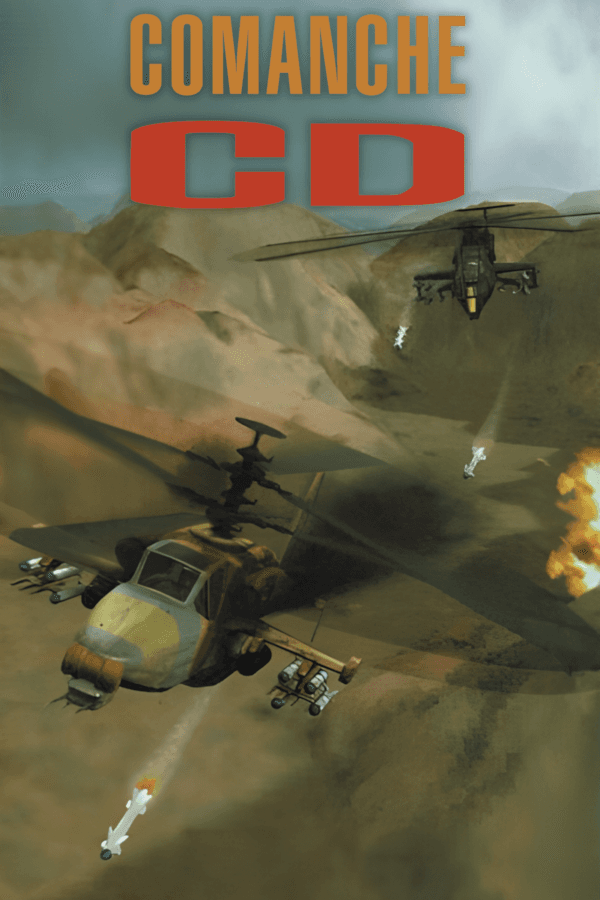

Taking off in Comanche CD means skimming canyons at a hundred feet, masking your rotor blades behind a ridge line while tracking an Mi-24 Hind through the HUD of an RAH-66 stealth attack helicopter.
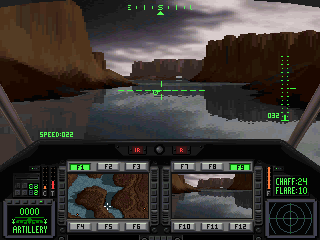
When you sit in the virtual cockpit of NovaLogic's gunship, the horizon does not look like the flat wireframe grids or jagged flat-shaded polygons that dominated combat flight games in the early nineties. You are skimming over rolling clay hills, ducking under tree canopy lines, and hiding inside riverbeds to break line-of-sight with surface-to-air missile batteries. The tactile thrill comes from staying as low as humanly possible, using real geographical contour lines to sneak past radar sweeps before popping up over a ridge line to unleash ordnance.
Your arsenal in this stealth helicopter gives you clear tools for different ranges and threat levels. You carry a chin-mounted cannon for light vehicles, unguided rockets for ground installations, radar-guided Hellfire missiles for heavy armor, and Stinger missiles when enemy air power shows up. Flight physics lean hard toward active tactical combat rather than cold instrument management, letting you focus on altitude control and threat prioritization while managing your finite fuel load and ammunition capacity.
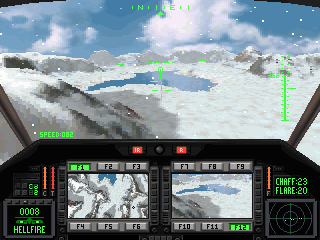
The technology behind the visuals was the proprietary Voxel Space engine, written entirely in raw assembly language by lead programmer Kyle Freeman. Instead of building ground terrain out of connected flat polygons, the system rendered volumetric pixel columns directly from heightmaps and color arrays. The visual result surpassed dedicated military training equipment for ground detail, but it placed heavy demands on period microprocessors, demanding an Intel 386SX at minimum and ideally a fast 486 CPU to maintain fluid framerates at full detail levels.
Setting up the 1994 release on original MS-DOS rigs was notoriously temperamental due to strict system memory demands. The game required extended memory (XMS) and clashed directly with expanded memory managers like EMM386.SYS, forcing players to build dedicated boot disks just to free up lower RAM. If you had the sound cards to match, the audio engine pushed crisp digital radio chatter and deep engine hums through Ad Lib, Sound Blaster, or Roland MT-32 synthesizer hardware.
This release combined the complete contents of the original base release, Comanche: Maximum Overkill, alongside its two expansion packs, Global Challenge and Over the Edge, plus ten extra missions developed specifically for the disc set. The expansion content dramatically widened the roster of military assets you faced across international theaters. Instead of hunting the same recurring truck convoys and static radar sites, missions pitched you directly against formidable real-world combat hardware:
Because the campaign structure drops you into scenarios with dense defensive networks, choosing your path through canyon corridors becomes as vital as your aiming discipline. A reckless climb above the mountain line instantly alerts every enemy SAM battery within five miles, turning a simple sweep into a barrage of incoming fire.
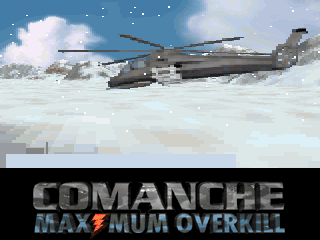
Period gaming press noted the inherent trade-offs built into NovaLogic's design choices. Computer Gaming World highlighted the incredible ground detail and revolutionary terrain modeling while noting that target variety felt limited in the early missions, alongside an overly generous helicopter durability that allowed players to survive hits that would destroy a real airframe. Review scores landed across a broad spectrum: Electronic Games rated the package at 96%, while Power Unlimited gave it an 80% and Finnish publication MikroBitti landed at 76%.
The arcaded flight model keeps actions direct and punchy, but early missions can end in seconds if you lose situational awareness near terrain walls. Crash landings are absolute, and taking heavy fire quickly degrades your system displays and weapon targeting accuracy. Players moving to Windows 95 secondary environments later discovered the original CD-ROM setup would refuse to launch inside a standard 95 DOS prompt window, requiring direct MS-DOS mode reboots until NovaLogic, Inc. updated the installer build for retail budget re-releases years later.
The core design holds up because it cuts straight to the thrill of fast, low-level flight without burdening you with fifty-page startup checklists. While it prioritizes explosive action over strict realistic flight modeling, the tactical balance of terrain masking, managing weapon loads, and dodging counter-fire remains immediately satisfying to master.
You can play Comanche CD online free in your browser right now with no setup needed. If you want a classic simulation that lets you dodge surface-to-air missiles while carving through canyon networks, jump straight into the first campaign mission and keep your nose below the mountain tops.
Taking off in Comanche CD means skimming canyons at a hundred feet, masking your rotor blades behind a ridge line while tracking an Mi-24 Hind through the HUD of an RAH-66 stealth attack helicopter.
When you sit in the virtual cockpit of NovaLogic's gunship, the horizon does not look like the flat wireframe grids or jagged flat-shaded polygons that dominated combat flight games in the early nineties. You are skimming over rolling clay hills, ducking under tree canopy lines, and hiding inside riverbeds to break line-of-sight with surface-to-air missile batteries. The tactile thrill comes from staying as low as humanly possible, using real geographical contour lines to sneak past radar sweeps before popping up over a ridge line to unleash ordnance.
Your arsenal in this stealth helicopter gives you clear tools for different ranges and threat levels. You carry a chin-mounted cannon for light vehicles, unguided rockets for ground installations, radar-guided Hellfire missiles for heavy armor, and Stinger missiles when enemy air power shows up. Flight physics lean hard toward active tactical combat rather than cold instrument management, letting you focus on altitude control and threat prioritization while managing your finite fuel load and ammunition capacity.
The technology behind the visuals was the proprietary Voxel Space engine, written entirely in raw assembly language by lead programmer Kyle Freeman. Instead of building ground terrain out of connected flat polygons, the system rendered volumetric pixel columns directly from heightmaps and color arrays. The visual result surpassed dedicated military training equipment for ground detail, but it placed heavy demands on period microprocessors, demanding an Intel 386SX at minimum and ideally a fast 486 CPU to maintain fluid framerates at full detail levels.
Setting up the 1994 release on original MS-DOS rigs was notoriously temperamental due to strict system memory demands. The game required extended memory (XMS) and clashed directly with expanded memory managers like EMM386.SYS, forcing players to build dedicated boot disks just to free up lower RAM. If you had the sound cards to match, the audio engine pushed crisp digital radio chatter and deep engine hums through Ad Lib, Sound Blaster, or Roland MT-32 synthesizer hardware.
This release combined the complete contents of the original base release, Comanche: Maximum Overkill, alongside its two expansion packs, Global Challenge and Over the Edge, plus ten extra missions developed specifically for the disc set. The expansion content dramatically widened the roster of military assets you faced across international theaters. Instead of hunting the same recurring truck convoys and static radar sites, missions pitched you directly against formidable real-world combat hardware:
Because the campaign structure drops you into scenarios with dense defensive networks, choosing your path through canyon corridors becomes as vital as your aiming discipline. A reckless climb above the mountain line instantly alerts every enemy SAM battery within five miles, turning a simple sweep into a barrage of incoming fire.
Period gaming press noted the inherent trade-offs built into NovaLogic's design choices. Computer Gaming World highlighted the incredible ground detail and revolutionary terrain modeling while noting that target variety felt limited in the early missions, alongside an overly generous helicopter durability that allowed players to survive hits that would destroy a real airframe. Review scores landed across a broad spectrum: Electronic Games rated the package at 96%, while Power Unlimited gave it an 80% and Finnish publication MikroBitti landed at 76%.
The arcaded flight model keeps actions direct and punchy, but early missions can end in seconds if you lose situational awareness near terrain walls. Crash landings are absolute, and taking heavy fire quickly degrades your system displays and weapon targeting accuracy. Players moving to Windows 95 secondary environments later discovered the original CD-ROM setup would refuse to launch inside a standard 95 DOS prompt window, requiring direct MS-DOS mode reboots until NovaLogic, Inc. updated the installer build for retail budget re-releases years later.
The core design holds up because it cuts straight to the thrill of fast, low-level flight without burdening you with fifty-page startup checklists. While it prioritizes explosive action over strict realistic flight modeling, the tactical balance of terrain masking, managing weapon loads, and dodging counter-fire remains immediately satisfying to master.
You can play Comanche CD online free in your browser right now with no setup needed. If you want a classic simulation that lets you dodge surface-to-air missiles while carving through canyon networks, jump straight into the first campaign mission and keep your nose below the mountain tops.
How Comanche CD is played — the keys the game listens to, grouped by what they do.
Highlighted keys are mapped — hover or tap one to see what it does.
Press J to calibrate a connected joystick in-game. Pressing Alt-Q quits the game to DOS at any time.
The on-screen keyboard and gamepad mapping the browser player uses on a phone, a tablet or a controller, as opposed to the real keys above. $PRO members make their own in the player and share them here; anyone can pick one to play with.
Cheat codes, console commands and memory pokes for Comanche CD — each one verified and attributed.
Sign in to submitHow Comanche CD is played — the keys the game listens to, grouped by what they do.
Highlighted keys are mapped — hover or tap one to see what it does.
Press J to calibrate a connected joystick in-game. Pressing Alt-Q quits the game to DOS at any time.
The on-screen keyboard and gamepad mapping the browser player uses on a phone, a tablet or a controller, as opposed to the real keys above. $PRO members make their own in the player and share them here; anyone can pick one to play with.
Cheat codes, console commands and memory pokes for Comanche CD — each one verified and attributed.
Sign in to submit