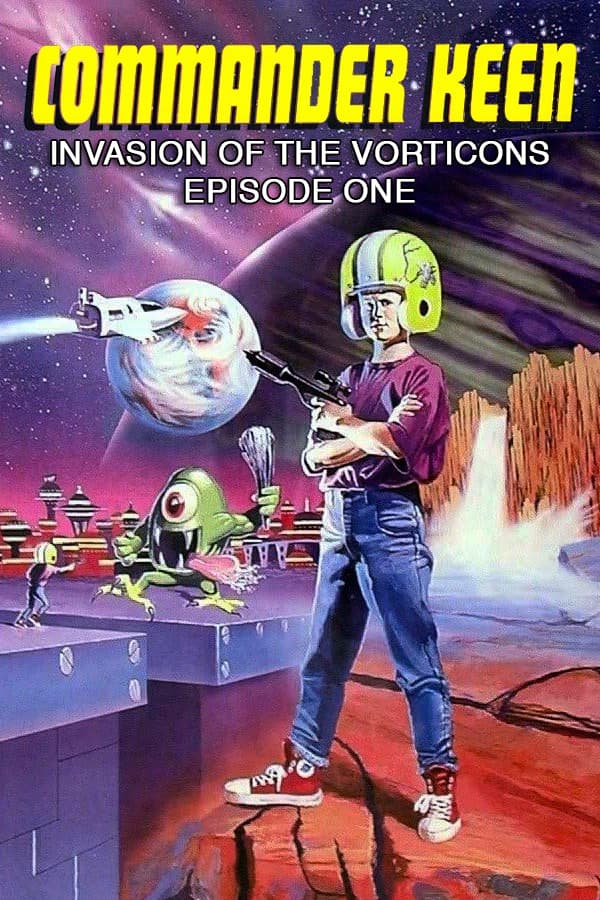
In Commander Keen 1: Marooned on Mars, eight-year-old Billy Blaze equips his brother's football helmet, builds a rocket out of household junk, and sets out across a Martian landscape to reclaim four stolen ship parts. It brought smooth side-scrolling to IBM PCs for the first time, turning standard graphics hardware into a proper platforming system.
Before late 1990, IBM-compatible PCs were notorious for choppy action games. Arcade conversions and early DOS titles redrew entire screens or stuttered through awkward frame updates because PC hardware lacked the hardware-level tile scrolling built into Nintendo consoles. John Carmack solved this while working at Softdisk by inventing Adaptive Tile Refresh, a trick that only redrew the pixels on screen that actually changed position as the character moved.
Carmack, John Romero, and Tom Hall demonstrated this breakthrough by recreating the first level of Super Mario Bros. 3 on PC during a late-night coding session, pitching it to Nintendo as an official port. Nintendo turned them down to protect their console hardware business. Undeterred, the team joined forces with Scott Miller at Apogee Software, Ltd. to build an original platformer around Hall's character concept: an eight-year-old boy genius who fights aliens on weekends.
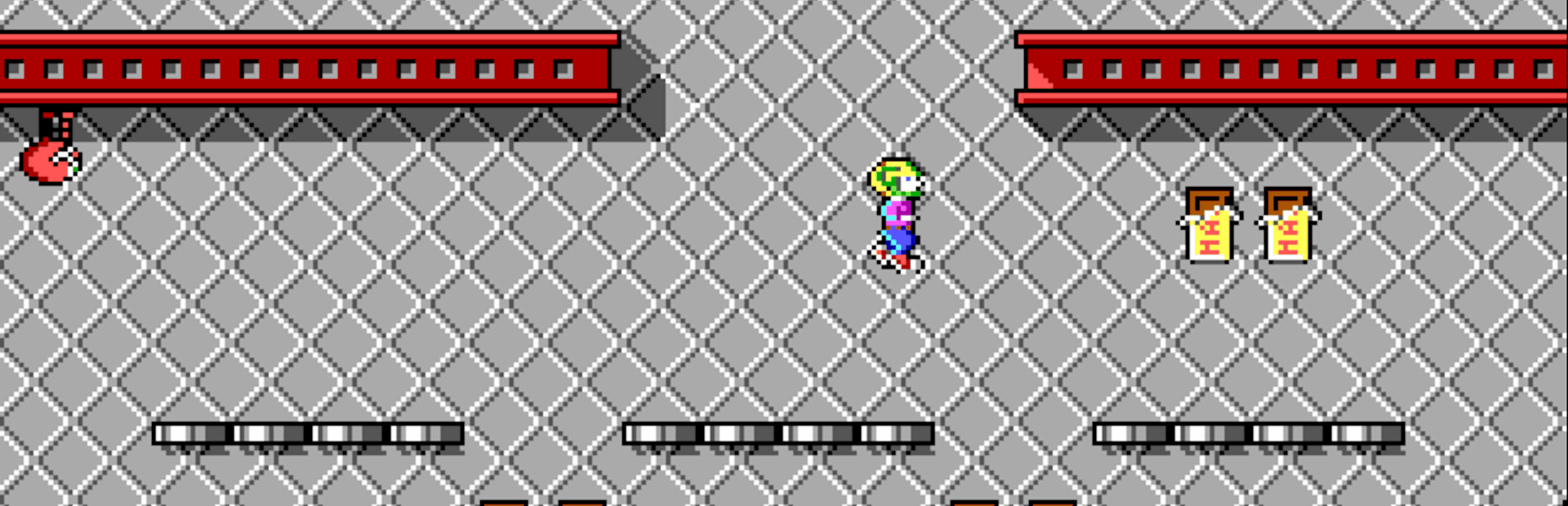
Launching Commander Keen 1: Marooned on Mars places you on an overhead map of Mars where you walk Billy Blaze between dome-shaped cities. Step onto a city node and the viewport locks into a 2D side-scrolling view. Your primary task in each stage is simple: reach the exit door. Along the way, you dodge floor hazards, hunt down color-coded keycards to unlock matching barriers, and collect junk food for score bonuses that award extra lives.
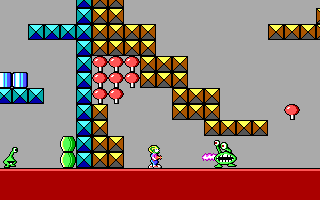
Billy begins with zero defensive tools until you locate two critical items in the early levels. The first is a raygun with strictly limited ammo charges, meaning you cannot afford to shoot blindly at every creature you meet. The second is a pogo stick that completely alters your movement. Holding the jump button while mounted on the pogo propels Billy high into the air, allowing you to reach high platforms and bypass vertical wall hazards that would otherwise block your progress.
The game splits its alien wildlife into a few distinct categories. One-eyed Yorps bounce around harmlessly and can even be used as temporary footstools, though touching them pushes Billy around. Charging Gargs move far faster and demand a quick trigger finger, while the tough Vorticon Commander requires four direct raygun hits to defeat. Because there are only a handful of enemy types throughout the entire episode, the game places heavy reliance on level layout and keycard navigation to maintain challenge.
The main campaign goal requires collecting four components stolen from Billy's Bean-with-Bacon Megarocket: a joystick, a car battery, a vacuum cleaner, and a bottle of Everclear. These parts are scattered across distinct cities, including a hidden Secret City reached through a teleporter tucked away in Red Maze City. However, the game contains a brutal design trap that caught many original players off guard. If you complete the final level and step into the exit without holding the Everclear component, the level vanishes from the map screen forever. Without access to that stage, you cannot retrieve the missing part, leaving Billy permanently stranded and ruining the save file.
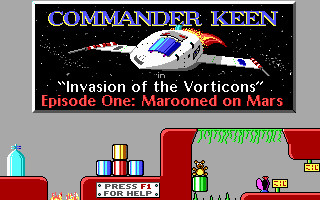
Despite primitive PC speaker audio that squeaked out every jump and laser fire through the internal system horn, the technical execution blew PC gamers away in 1990. Apogee distributed the game under the shareware model, offering the first episode free on dial-up bulletin boards while charging for the remaining two chapters of the trilogy. The strategy succeeded immediately, earning $30,000 in its first two weeks and bringing in tens of thousands per month shortly after.
That sudden revenue allowed Carmack, Romero, Hall, and Adrian Carmack to resign from Softdisk and formally establish id Software, Inc. To make life easier during playtesting, the developers built several key combinations directly into the engine:
The EGA visuals and PC speaker bleeps hold up well because the movement physics feel crisp and predictable. When you press the jump button on a pogo stick, the momentum and height balance give you exact control over every bounce, something no static screenshot or video capture can convey. It is a genuine test of precision movement among classic action games that set up everything id Software built next.
You can play Commander Keen 1: Marooned on Mars online, free, right here in your browser, with nothing to install and no setup. Jump straight onto the overworld map, find your pogo stick, and see how naturally the EGA scrolling feels when you take control yourself.
In Commander Keen 1: Marooned on Mars, eight-year-old Billy Blaze equips his brother's football helmet, builds a rocket out of household junk, and sets out across a Martian landscape to reclaim four stolen ship parts. It brought smooth side-scrolling to IBM PCs for the first time, turning standard graphics hardware into a proper platforming system.
Before late 1990, IBM-compatible PCs were notorious for choppy action games. Arcade conversions and early DOS titles redrew entire screens or stuttered through awkward frame updates because PC hardware lacked the hardware-level tile scrolling built into Nintendo consoles. John Carmack solved this while working at Softdisk by inventing Adaptive Tile Refresh, a trick that only redrew the pixels on screen that actually changed position as the character moved.
Carmack, John Romero, and Tom Hall demonstrated this breakthrough by recreating the first level of Super Mario Bros. 3 on PC during a late-night coding session, pitching it to Nintendo as an official port. Nintendo turned them down to protect their console hardware business. Undeterred, the team joined forces with Scott Miller at Apogee Software, Ltd. to build an original platformer around Hall's character concept: an eight-year-old boy genius who fights aliens on weekends.
Launching Commander Keen 1: Marooned on Mars places you on an overhead map of Mars where you walk Billy Blaze between dome-shaped cities. Step onto a city node and the viewport locks into a 2D side-scrolling view. Your primary task in each stage is simple: reach the exit door. Along the way, you dodge floor hazards, hunt down color-coded keycards to unlock matching barriers, and collect junk food for score bonuses that award extra lives.

Billy begins with zero defensive tools until you locate two critical items in the early levels. The first is a raygun with strictly limited ammo charges, meaning you cannot afford to shoot blindly at every creature you meet. The second is a pogo stick that completely alters your movement. Holding the jump button while mounted on the pogo propels Billy high into the air, allowing you to reach high platforms and bypass vertical wall hazards that would otherwise block your progress.
The game splits its alien wildlife into a few distinct categories. One-eyed Yorps bounce around harmlessly and can even be used as temporary footstools, though touching them pushes Billy around. Charging Gargs move far faster and demand a quick trigger finger, while the tough Vorticon Commander requires four direct raygun hits to defeat. Because there are only a handful of enemy types throughout the entire episode, the game places heavy reliance on level layout and keycard navigation to maintain challenge.
The main campaign goal requires collecting four components stolen from Billy's Bean-with-Bacon Megarocket: a joystick, a car battery, a vacuum cleaner, and a bottle of Everclear. These parts are scattered across distinct cities, including a hidden Secret City reached through a teleporter tucked away in Red Maze City. However, the game contains a brutal design trap that caught many original players off guard. If you complete the final level and step into the exit without holding the Everclear component, the level vanishes from the map screen forever. Without access to that stage, you cannot retrieve the missing part, leaving Billy permanently stranded and ruining the save file.

Despite primitive PC speaker audio that squeaked out every jump and laser fire through the internal system horn, the technical execution blew PC gamers away in 1990. Apogee distributed the game under the shareware model, offering the first episode free on dial-up bulletin boards while charging for the remaining two chapters of the trilogy. The strategy succeeded immediately, earning $30,000 in its first two weeks and bringing in tens of thousands per month shortly after.
That sudden revenue allowed Carmack, Romero, Hall, and Adrian Carmack to resign from Softdisk and formally establish id Software, Inc. To make life easier during playtesting, the developers built several key combinations directly into the engine:
The EGA visuals and PC speaker bleeps hold up well because the movement physics feel crisp and predictable. When you press the jump button on a pogo stick, the momentum and height balance give you exact control over every bounce, something no static screenshot or video capture can convey. It is a genuine test of precision movement among classic action games that set up everything id Software built next.
You can play Commander Keen 1: Marooned on Mars online, free, right here in your browser, with nothing to install and no setup. Jump straight onto the overworld map, find your pogo stick, and see how naturally the EGA scrolling feels when you take control yourself.
How Commander Keen 1: Marooned on Mars is played — the keys the game listens to, grouped by what they do.
Highlighted keys are mapped — hover or tap one to see what it does.
Controls can be redefined in-game by pressing F3. Press F4 to switch to joystick mode.
The on-screen keyboard and gamepad mapping the browser player uses on a phone, a tablet or a controller, as opposed to the real keys above. $PRO members make their own in the player and share them here; anyone can pick one to play with.
Cheat codes, console commands and memory pokes for Commander Keen 1: Marooned on Mars — each one verified and attributed.
Sign in to submitHow Commander Keen 1: Marooned on Mars is played — the keys the game listens to, grouped by what they do.
Highlighted keys are mapped — hover or tap one to see what it does.
Controls can be redefined in-game by pressing F3. Press F4 to switch to joystick mode.
The on-screen keyboard and gamepad mapping the browser player uses on a phone, a tablet or a controller, as opposed to the real keys above. $PRO members make their own in the player and share them here; anyone can pick one to play with.
Cheat codes, console commands and memory pokes for Commander Keen 1: Marooned on Mars — each one verified and attributed.
Sign in to submit