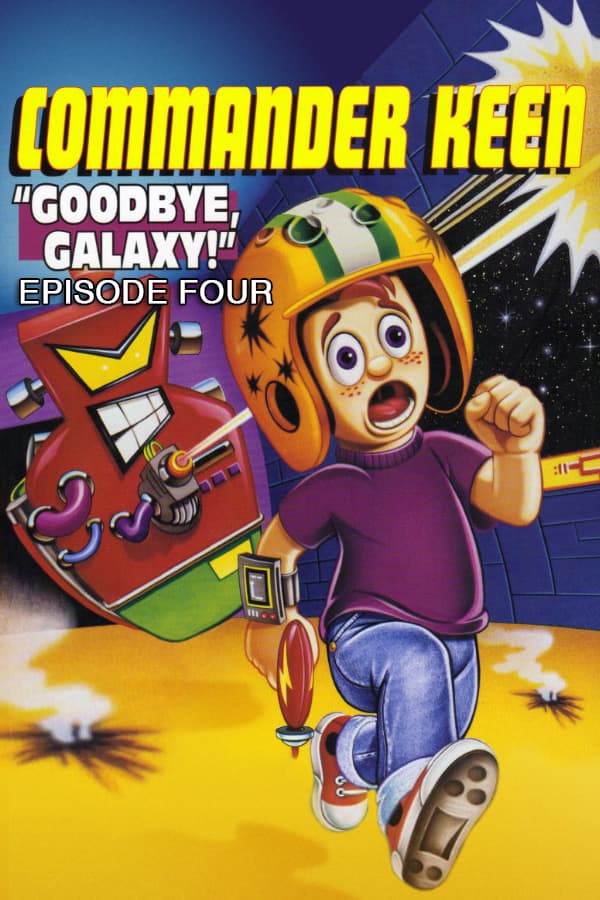

When you strap on an oversized football helmet to bounce across alien spike pits, Commander Keen 4: Secret of the Oracle demonstrates the exact moment PC platformers stopped feeling like sluggish home computer compromises.
Before Billy Blaze bounced into the Shadowlands, DOS side-scrollers were notoriously stiff. Programmer John Carmack changed that by designing an engine trick called Adaptive Tile Refresh. This tech allowed standard EGA graphics cards on modest 286 machines to scroll smoothly in all directions. Suddenly, PC gamers had a side-scroller that felt like a console title, running smoothly on the hardware they already owned.
That hardware engine powers a very distinct rhythm of movement. As eight-year-old child genius Billy "Commander Keen" Blaze, your primary tool is a homemade pogo stick. Tapping the pogo key sends Billy vaulting twice as high as a standard jump. Mastering this bounce is required if you want to clear wide gaps, reach high platforms, or escape incoming monsters.
It also makes precision landing a constant source of stress. The pogo stick adds slippery forward momentum that demands careful air control. If you overshoot a ledge by a few pixels, you drop straight onto a bed of spears or into a pool of burning poison.
The campaign places you on an isometric map of Gnosticus IV. Your mission is to rescue eight kidnapped Gnosticene Council Members so they can consult their Oracle about an invading alien force called the Shikadi. From this map screen, you pick your route through locations like Border Village, Crystalus, and the Chasm of Zzzzt.
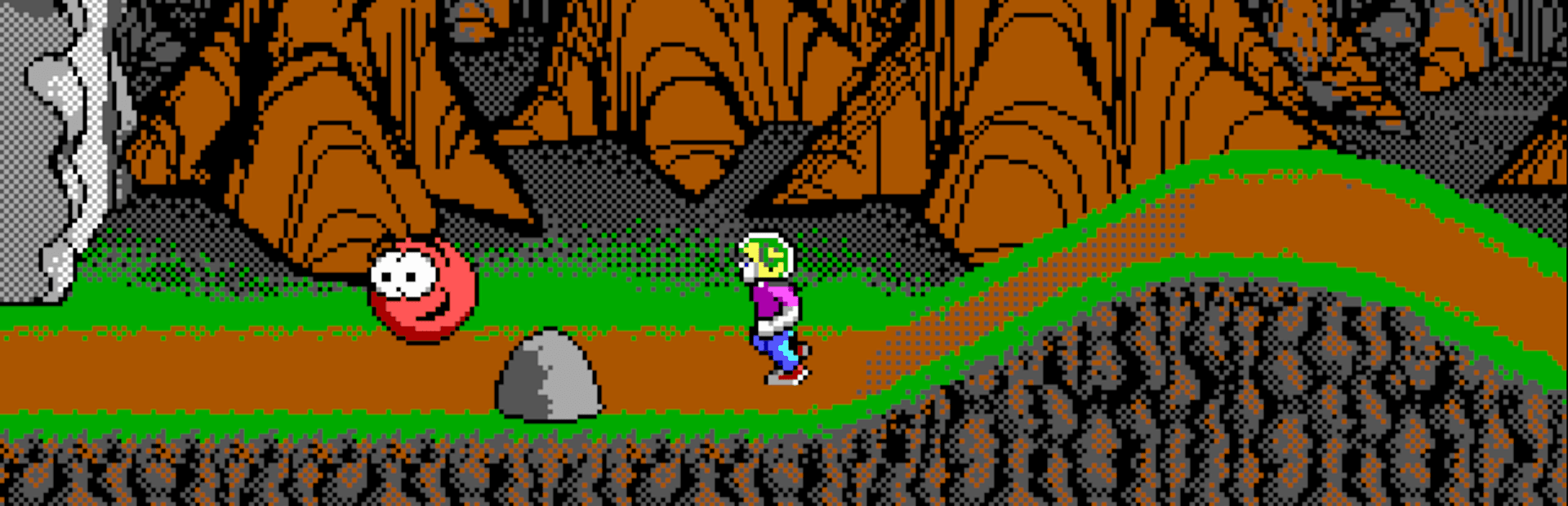
Once inside a stage, the game demands strict spatial discipline. You are armed with a Neural Stunner raygun, but ammo clips are limited. Furthermore, many native creatures ignore your shots entirely. Poison Slugs leave yellow hazardous droppings behind, while red bouncing Bounders and giant Mad Mushrooms bounce unpredictable patterns across critical paths.
The main source of tension in this action game comes from its harsh rules. One touch from an enemy or a single dip into a spike pit instantly costs you a life. There are no health bars or grace periods. When you leap blindly off a high platform without knowing what lies below, you risk landing directly on a fatal hazard.
To survive, you must hunt down colored key gems to open locked doors, gather soda cans and candy for extra score, and search for Lifewater Flasks. Collecting 100 raindrops also earns an extra life, which you will burn through quickly during your first playthrough.
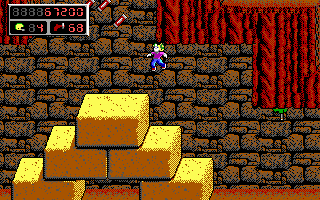
The level design heavily rewards players who test every wall and ceiling ledge. Many of the best secrets are tucked into invisible alcoves that you can only reach by pogo-jumping straight up off-screen. In Border Village, for example, leaping into an empty ceiling space reveals the hidden Lifewater Flask Cavern.
The game also contains one of the most absurd secret levels in DOS history. If you collect twelve inchworms in the Pyramid of the Moons, they form a giant floating foot. Stepping onto this foot transports Billy to a hidden stage called the Pyramid of the Forbidden.
It is inside these water-filled caverns that you encounter the Dopefish. Described by the manual as the second-dumbest creature in the universe, this green, buck-toothed fish spends its time swimming around trying to swallow Billy whole. The creature became an inside joke across the PC gaming industry for decades, but encountering it in its original habitat is still genuinely funny.
The audio presentation complements this goofy tone perfectly. Composer Bobby Prince crafted an FM synthesis soundtrack that made fantastic use of AdLib and Sound Blaster audio cards. Even if your rig only had an internal PC speaker, the sound effects gave distinct, punchy feedback for every stunner shot and pogo bounce.
For all its technical achievements, a few mechanical quirks still irritate players. The pogo stick controls feel twitchy when making micro-adjustments on narrow blocks. Joystick support is especially touchy, meaning most players get far better results sticking to a keyboard.
Difficulty spikes hit hard in the later pyramid levels. Stages fill up with invincible hazards, fire cannons, and fast-moving enemies that cannot be stunned. When combined with blind drops where you cannot see the floor beneath you, progress often devolves into trial-and-error memory tests.
Hardware compatibility had odd edge cases on original 1990 PCs as well. While Carmack's engine ran smoothly on standard systems, certain display adapters like Paradise EGA cards suffered from choppy scrolling. Modern software layers eliminate those old hardware conflicts completely.
When developers John Carmack, John Romero, Tom Hall, and Adrian Carmack built this chapter at id Software, Inc., they originally planned a sprawling trilogy. Publisher Apogee Software, Ltd. released this episode alongside Episode 5 in a shareware dual-pack called "Goodbye, Galaxy!". It distributed widely on bulletin boards and shareware disks, selling hundreds of thousands of copies over its lifespan.
This one holds up well if you appreciate precise, high-stakes platformers. The bright graphics, varied creature behaviors, and sprawling secret paths give you plenty to explore. The instant deaths and tricky pogo physics feel brutal at first, but mastering Billy's movement kit pays off once you get the timing down.
You can jump straight into this classic 1991 classic without setting up vintage hardware. You can play Commander Keen 4: Secret of the Oracle online, running this classic Commander Keen 4: Secret of the Oracle MS-DOS game directly through emulation technology.
You can run Commander Keen 4: Secret of the Oracle free in your browser right here with nothing to install and no setup required. Just launch the window, practice your pogo jump height in the opening map stage, and remember to check every ceiling for hidden Lifewater Flasks.
When you strap on an oversized football helmet to bounce across alien spike pits, Commander Keen 4: Secret of the Oracle demonstrates the exact moment PC platformers stopped feeling like sluggish home computer compromises.
Before Billy Blaze bounced into the Shadowlands, DOS side-scrollers were notoriously stiff. Programmer John Carmack changed that by designing an engine trick called Adaptive Tile Refresh. This tech allowed standard EGA graphics cards on modest 286 machines to scroll smoothly in all directions. Suddenly, PC gamers had a side-scroller that felt like a console title, running smoothly on the hardware they already owned.
That hardware engine powers a very distinct rhythm of movement. As eight-year-old child genius Billy "Commander Keen" Blaze, your primary tool is a homemade pogo stick. Tapping the pogo key sends Billy vaulting twice as high as a standard jump. Mastering this bounce is required if you want to clear wide gaps, reach high platforms, or escape incoming monsters.
It also makes precision landing a constant source of stress. The pogo stick adds slippery forward momentum that demands careful air control. If you overshoot a ledge by a few pixels, you drop straight onto a bed of spears or into a pool of burning poison.
The campaign places you on an isometric map of Gnosticus IV. Your mission is to rescue eight kidnapped Gnosticene Council Members so they can consult their Oracle about an invading alien force called the Shikadi. From this map screen, you pick your route through locations like Border Village, Crystalus, and the Chasm of Zzzzt.
Once inside a stage, the game demands strict spatial discipline. You are armed with a Neural Stunner raygun, but ammo clips are limited. Furthermore, many native creatures ignore your shots entirely. Poison Slugs leave yellow hazardous droppings behind, while red bouncing Bounders and giant Mad Mushrooms bounce unpredictable patterns across critical paths.
The main source of tension in this action game comes from its harsh rules. One touch from an enemy or a single dip into a spike pit instantly costs you a life. There are no health bars or grace periods. When you leap blindly off a high platform without knowing what lies below, you risk landing directly on a fatal hazard.
To survive, you must hunt down colored key gems to open locked doors, gather soda cans and candy for extra score, and search for Lifewater Flasks. Collecting 100 raindrops also earns an extra life, which you will burn through quickly during your first playthrough.
The level design heavily rewards players who test every wall and ceiling ledge. Many of the best secrets are tucked into invisible alcoves that you can only reach by pogo-jumping straight up off-screen. In Border Village, for example, leaping into an empty ceiling space reveals the hidden Lifewater Flask Cavern.
The game also contains one of the most absurd secret levels in DOS history. If you collect twelve inchworms in the Pyramid of the Moons, they form a giant floating foot. Stepping onto this foot transports Billy to a hidden stage called the Pyramid of the Forbidden.
It is inside these water-filled caverns that you encounter the Dopefish. Described by the manual as the second-dumbest creature in the universe, this green, buck-toothed fish spends its time swimming around trying to swallow Billy whole. The creature became an inside joke across the PC gaming industry for decades, but encountering it in its original habitat is still genuinely funny.
The audio presentation complements this goofy tone perfectly. Composer Bobby Prince crafted an FM synthesis soundtrack that made fantastic use of AdLib and Sound Blaster audio cards. Even if your rig only had an internal PC speaker, the sound effects gave distinct, punchy feedback for every stunner shot and pogo bounce.
For all its technical achievements, a few mechanical quirks still irritate players. The pogo stick controls feel twitchy when making micro-adjustments on narrow blocks. Joystick support is especially touchy, meaning most players get far better results sticking to a keyboard.
Difficulty spikes hit hard in the later pyramid levels. Stages fill up with invincible hazards, fire cannons, and fast-moving enemies that cannot be stunned. When combined with blind drops where you cannot see the floor beneath you, progress often devolves into trial-and-error memory tests.
Hardware compatibility had odd edge cases on original 1990 PCs as well. While Carmack's engine ran smoothly on standard systems, certain display adapters like Paradise EGA cards suffered from choppy scrolling. Modern software layers eliminate those old hardware conflicts completely.
When developers John Carmack, John Romero, Tom Hall, and Adrian Carmack built this chapter at id Software, Inc., they originally planned a sprawling trilogy. Publisher Apogee Software, Ltd. released this episode alongside Episode 5 in a shareware dual-pack called "Goodbye, Galaxy!". It distributed widely on bulletin boards and shareware disks, selling hundreds of thousands of copies over its lifespan.
This one holds up well if you appreciate precise, high-stakes platformers. The bright graphics, varied creature behaviors, and sprawling secret paths give you plenty to explore. The instant deaths and tricky pogo physics feel brutal at first, but mastering Billy's movement kit pays off once you get the timing down.
You can jump straight into this classic 1991 classic without setting up vintage hardware. You can play Commander Keen 4: Secret of the Oracle online, running this classic Commander Keen 4: Secret of the Oracle MS-DOS game directly through emulation technology.
You can run Commander Keen 4: Secret of the Oracle free in your browser right here with nothing to install and no setup required. Just launch the window, practice your pogo jump height in the opening map stage, and remember to check every ceiling for hidden Lifewater Flasks.
How Commander Keen 4: Secret of the Oracle is played — the keys the game listens to, grouped by what they do.
Highlighted keys are mapped — hover or tap one to see what it does.
Controls can be customized via the in-game options menu.
The on-screen keyboard and gamepad mapping the browser player uses on a phone, a tablet or a controller, as opposed to the real keys above. $PRO members make their own in the player and share them here; anyone can pick one to play with.
Cheat codes, console commands and memory pokes for Commander Keen 4: Secret of the Oracle — each one verified and attributed.
Sign in to submitHow Commander Keen 4: Secret of the Oracle is played — the keys the game listens to, grouped by what they do.
Highlighted keys are mapped — hover or tap one to see what it does.
Controls can be customized via the in-game options menu.
The on-screen keyboard and gamepad mapping the browser player uses on a phone, a tablet or a controller, as opposed to the real keys above. $PRO members make their own in the player and share them here; anyone can pick one to play with.
Cheat codes, console commands and memory pokes for Commander Keen 4: Secret of the Oracle — each one verified and attributed.
Sign in to submit