
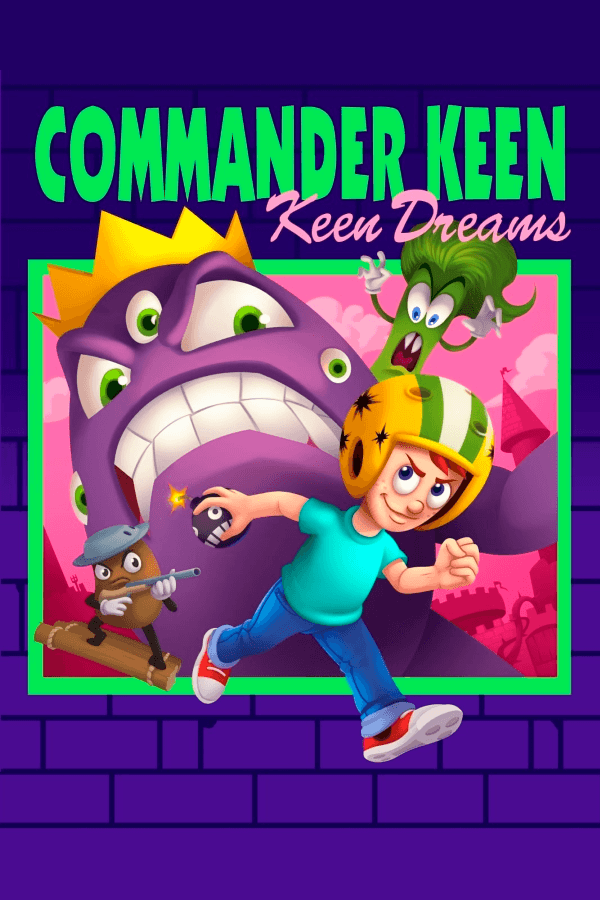

Playing Commander Keen: Keen Dreams on MS-DOS usually leaves fans of the series reaching for a pogo stick that simply is not there. This odd side-chapter replaces Billy Blaze's famous raygun with thrown Flower Power pellets, setting him loose on a kingdom of aggressive root vegetables.
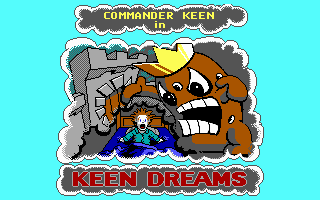
If you come straight from Invasion of the Vorticons, the controls in Keen Dreams feel immediately strange. Eight-year-old child genius Billy Blaze gets grounded for refusing to eat his vegetables, falls asleep, and finds himself summoned to Tuberia by the evil king Boobus Tuber. Instead of bouncing over hazardous pits with his pogo stick, Keen is stuck walking, jumping, and ducking like a standard platforming protagonist.
The absence of the raygun changes combat completely. Instead of blowing enemies to bits, you throw small "Flower Power" pellets that temporarily transform angry broccoli, tomatoes, and asparagus into harmless flowers. If your thrown pellet misses an enemy and bounces off a wall, it drops onto the ground where you have to go pick it up again. Running out of ammo mid-fight means scrambling past charging potatoes to retrieve your spent shots while trying not to touch anything lethal.
The overhead map screen lets you walk between distinct locations across Tuberia to find and destroy the Dream Machine. You navigate top-down paths, pick levels in the order you prefer, and collect Boobus Bombs along the way. Those bombs are the only weapon that can damage King Boobus Tuber when you finally reach his chamber.
To understand why this game plays differently, you have to look at how it came to exist. Designers Tom Hall, John Carmack, John Romero, and Adrian Carmack had just formed id Software after the smash success of their first trilogy. However, they still owed games to Softdisk Publishing to fulfill an existing contract for the Gamer's Edge monthly disk service.
Instead of phone-in work, the team used the opportunity as a testbed for new programming techniques. Carmack and Romero built a pseudo-3D platforming engine featuring sloped floors and semi-solid platforms that you could drop down through by holding down and jump. The camera smoothly scrolled horizontally and vertically, allowing for far more organic level layouts than the rigid grid systems of 1990.
These graphical and mechanical experiments were later polished into Commander Keen in Goodbye, Galaxy!, which is why fans often refer to this title as "Episode 3.5" or the lost episode. The technical improvements were real, even if the vegetable theme and stripped-down weapon mechanics felt like a detour for the character.
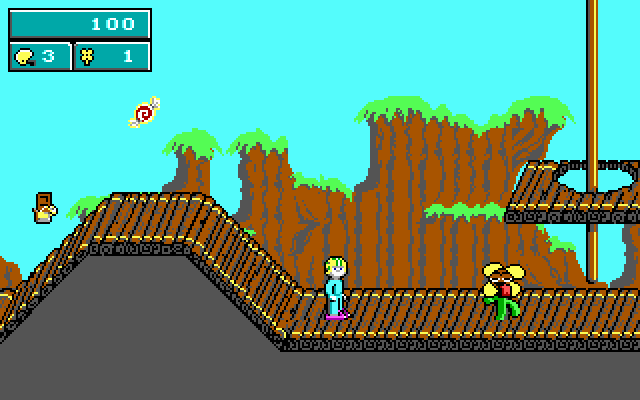
The levels themselves demand careful movement across firemen's poles, narrow ledges, and semi-solid bridges. The enemy design leans heavily on bizarre vegetable monstrosities that react in unpredictable ways. Giant potatoes stomp toward you, while fast-moving asparagus stalkers and heavy tomatoes block narrow passageways.
Because the Flower Power pellets only freeze enemies for a short window, you cannot clear a corridor and take your time. You hit a giant vegetable, watch it turn into a flower pot, and immediately sprint past before the spell wears off and the creature turns around to touch you. Touching any hazard or enemy results in instant death, stripping away a life and sending you back to the level entry point.
Scattered around each area are door keys, score items like sweets, extra life items, and the elusive "magic eyeball" pickup. Finding a magic eyeball refills your ammo reserve and grants three extra lives at once, making it the most valuable secret item in the entire run. Puzzles rarely get more complicated than matching colored keys to locked doors, but the strict jump physics make every drop nerve-wracking.
For all its technical tricks, action fans often struggle with the core rhythm of combat. Turning enemies into flowers rather than removing them from the board creates annoying traffic jams in narrow tunnels. You often stun a tomato on a tiny platform, only to realize you cannot jump over the flower pot without touching its top edge and dying anyway.
The audio presentation is another weak spot that catches players off guard. On original sound hardware, the game relies mostly on brief PC speaker chirps and minimal Sound Blaster jingles when entering or exiting levels. During active gameplay, sound effects are sparse, leaving long stretches of quiet movement across silent platforming spaces.
It is a short game compared to full retail releases from 1991. Skilled players can sprint through the necessary map nodes and collect the required bombs in under an hour. A planned sequel titled Keen Meets the Meats was scrapped entirely, leaving this dream sequence as a unique isolated chapter in Billy Blaze's history.
Despite its odd design choices and missing pogo stick, this chapter is worth playing to see the missing evolutionary link in id Software's tech stack. The smooth sloped movement and refined jump mechanics show exactly how the studio transitioned from early EGA experiments into the fluid 2D engine that powered their later releases.
Most modern players assume the missing raygun makes the game easier, but managing temporary stunning pellets on tight platforms actually demands far quicker reactions. You can test your platforming speed and see how the lost episode feels without hunting down vintage hardware or configuring complex emulator settings.
You can play Commander Keen: Keen Dreams online, free in your browser right here. There is nothing to install and no extra software to configure. Jump straight into Tuberia, dodge aggressive root crops, and see if you can take down King Boobus Tuber on your lunch break.
Playing Commander Keen: Keen Dreams on MS-DOS usually leaves fans of the series reaching for a pogo stick that simply is not there. This odd side-chapter replaces Billy Blaze's famous raygun with thrown Flower Power pellets, setting him loose on a kingdom of aggressive root vegetables.
If you come straight from Invasion of the Vorticons, the controls in Keen Dreams feel immediately strange. Eight-year-old child genius Billy Blaze gets grounded for refusing to eat his vegetables, falls asleep, and finds himself summoned to Tuberia by the evil king Boobus Tuber. Instead of bouncing over hazardous pits with his pogo stick, Keen is stuck walking, jumping, and ducking like a standard platforming protagonist.
The absence of the raygun changes combat completely. Instead of blowing enemies to bits, you throw small "Flower Power" pellets that temporarily transform angry broccoli, tomatoes, and asparagus into harmless flowers. If your thrown pellet misses an enemy and bounces off a wall, it drops onto the ground where you have to go pick it up again. Running out of ammo mid-fight means scrambling past charging potatoes to retrieve your spent shots while trying not to touch anything lethal.
The overhead map screen lets you walk between distinct locations across Tuberia to find and destroy the Dream Machine. You navigate top-down paths, pick levels in the order you prefer, and collect Boobus Bombs along the way. Those bombs are the only weapon that can damage King Boobus Tuber when you finally reach his chamber.
To understand why this game plays differently, you have to look at how it came to exist. Designers Tom Hall, John Carmack, John Romero, and Adrian Carmack had just formed id Software after the smash success of their first trilogy. However, they still owed games to Softdisk Publishing to fulfill an existing contract for the Gamer's Edge monthly disk service.
Instead of phone-in work, the team used the opportunity as a testbed for new programming techniques. Carmack and Romero built a pseudo-3D platforming engine featuring sloped floors and semi-solid platforms that you could drop down through by holding down and jump. The camera smoothly scrolled horizontally and vertically, allowing for far more organic level layouts than the rigid grid systems of 1990.
These graphical and mechanical experiments were later polished into Commander Keen in Goodbye, Galaxy!, which is why fans often refer to this title as "Episode 3.5" or the lost episode. The technical improvements were real, even if the vegetable theme and stripped-down weapon mechanics felt like a detour for the character.
The levels themselves demand careful movement across firemen's poles, narrow ledges, and semi-solid bridges. The enemy design leans heavily on bizarre vegetable monstrosities that react in unpredictable ways. Giant potatoes stomp toward you, while fast-moving asparagus stalkers and heavy tomatoes block narrow passageways.
Because the Flower Power pellets only freeze enemies for a short window, you cannot clear a corridor and take your time. You hit a giant vegetable, watch it turn into a flower pot, and immediately sprint past before the spell wears off and the creature turns around to touch you. Touching any hazard or enemy results in instant death, stripping away a life and sending you back to the level entry point.
Scattered around each area are door keys, score items like sweets, extra life items, and the elusive "magic eyeball" pickup. Finding a magic eyeball refills your ammo reserve and grants three extra lives at once, making it the most valuable secret item in the entire run. Puzzles rarely get more complicated than matching colored keys to locked doors, but the strict jump physics make every drop nerve-wracking.
For all its technical tricks, action fans often struggle with the core rhythm of combat. Turning enemies into flowers rather than removing them from the board creates annoying traffic jams in narrow tunnels. You often stun a tomato on a tiny platform, only to realize you cannot jump over the flower pot without touching its top edge and dying anyway.
The audio presentation is another weak spot that catches players off guard. On original sound hardware, the game relies mostly on brief PC speaker chirps and minimal Sound Blaster jingles when entering or exiting levels. During active gameplay, sound effects are sparse, leaving long stretches of quiet movement across silent platforming spaces.
It is a short game compared to full retail releases from 1991. Skilled players can sprint through the necessary map nodes and collect the required bombs in under an hour. A planned sequel titled Keen Meets the Meats was scrapped entirely, leaving this dream sequence as a unique isolated chapter in Billy Blaze's history.
Despite its odd design choices and missing pogo stick, this chapter is worth playing to see the missing evolutionary link in id Software's tech stack. The smooth sloped movement and refined jump mechanics show exactly how the studio transitioned from early EGA experiments into the fluid 2D engine that powered their later releases.
Most modern players assume the missing raygun makes the game easier, but managing temporary stunning pellets on tight platforms actually demands far quicker reactions. You can test your platforming speed and see how the lost episode feels without hunting down vintage hardware or configuring complex emulator settings.
You can play Commander Keen: Keen Dreams online, free in your browser right here. There is nothing to install and no extra software to configure. Jump straight into Tuberia, dodge aggressive root crops, and see if you can take down King Boobus Tuber on your lunch break.
How Commander Keen: Keen Dreams is played — the keys the game listens to, grouped by what they do.
Highlighted keys are mapped — hover or tap one to see what it does.
Press F3 during gameplay to redefine keyboard commands.
The on-screen keyboard and gamepad mapping the browser player uses on a phone, a tablet or a controller, as opposed to the real keys above. $PRO members make their own in the player and share them here; anyone can pick one to play with.
Cheat codes, console commands and memory pokes for Commander Keen: Keen Dreams — each one verified and attributed.
Sign in to submitHow Commander Keen: Keen Dreams is played — the keys the game listens to, grouped by what they do.
Highlighted keys are mapped — hover or tap one to see what it does.
Press F3 during gameplay to redefine keyboard commands.
The on-screen keyboard and gamepad mapping the browser player uses on a phone, a tablet or a controller, as opposed to the real keys above. $PRO members make their own in the player and share them here; anyone can pick one to play with.
Cheat codes, console commands and memory pokes for Commander Keen: Keen Dreams — each one verified and attributed.
Sign in to submit