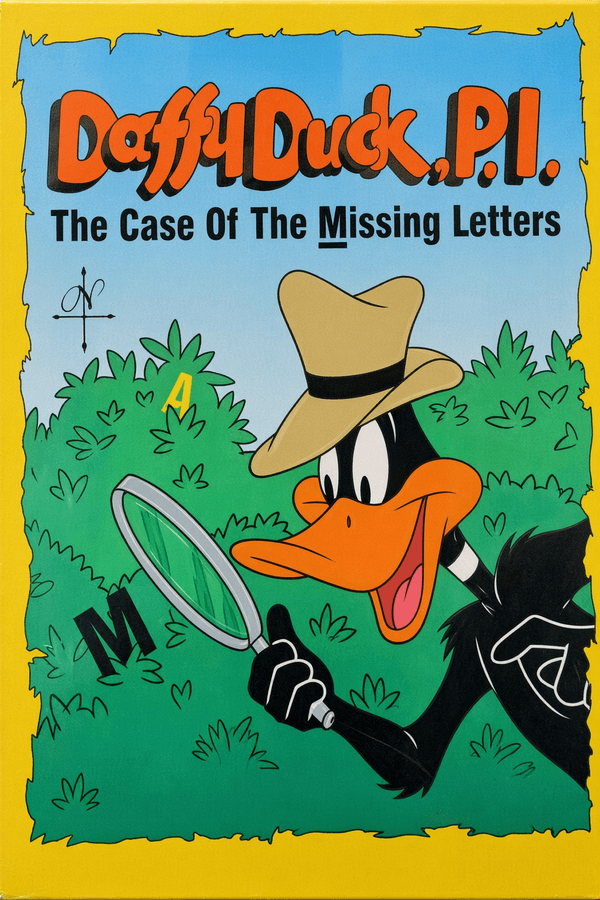
Daffy Duck, P.I.: The Case of the Missing Letters
Rate this game
- Played
- Rarely
In Daffy Duck, P.I.: The Case of the Missing Letters, your job is to guide Looney Tunes' most unhinged detective through single-screen rooms, dodging anvil-tossing rivals while grabbing stray letters to spell words for cash.
What Daffy Duck, P.I.: The Case of the Missing Letters actually asks of you
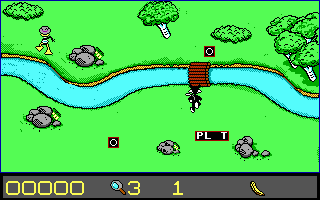
Most licensed PC games aimed at kids in 1991 were content to let you walk left to right while jumping over benign obstacles, but this 1991 release throws you right into the deep end of flip-screen platforming. You control Daffy across self-contained screens filled with platforms, roaming Looney Tunes cast members, incomplete words resting near the top or bottom, and individual letters scattered around the map. Your goal sounds simple enough: fetch the stray floating letters, carry them one by one to their matching blank spots, and clear the room to collect your detective fee.
Executing that idea is where the real stress begins. Daffy does not get a fast run or forgiving physics; he moves with a weight that demands careful positioning on small ledges. If you miss a jump while holding the final letter needed to finish a word, you drop down right into the path of whatever cartoon adversary happens to be patrolling the lower floors.
The cartoon enemies are out for blood
Rather than generic edutainment hazards, Daffy Duck, P.I.: The Case of the Missing Letters pits you against classic adversaries like Elmer Fudd, Yosemite Sam, Sylvester J. Pussycat, and Wile E. Coyote. They do not just wander back and forth idly. They actively block paths to crucial letters, forcing you to engage rather than simply run past. To defend yourself, Daffy relies on a limited arsenal of throwables:
- Bananas: Tossed straight ahead to knock patrolling enemies off their feet and leave them temporarily stunned.
- Eggs: Thrown in an arc to reach foes standing on higher ledges or hiding behind platform structures.
Stunning an enemy only gives you a brief window to grab a letter and scramble to safety before they recover. If you make a mistake, many modern players end up surprised by the difficulty spike, noting that the game is far more punishing than its colorful graphics imply. Losing lives early in a screen means redoing every single letter pickup from scratch.
Matrix word puzzles break up the platforming action
Between the detective assignments on the action screens, the game shifts gears to time-oriented bonus levels. These stages hand you a grid or matrix filled with mixed letters, challenging you to search out and highlight valid hidden words before the countdown runs out. It is a straight-up word search embedded right into an action game, and it serves a very real mechanical purpose.
For every 1,000 points you rack up during these bonus matrix rounds, the game awards you an extra life. Given how easily Elmer or Wile E. Coyote can drain your stock during single-screen platform stages, maximize your score here or prepare for an early Game Over screen. The developer, Riedel Software Productions, Inc., designed these bonus rounds as the primary safety net for younger players struggling with the tricky controls.
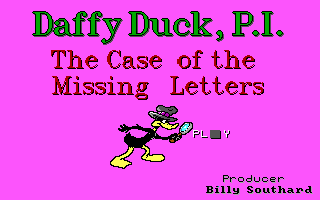
Why this MS-DOS title holds a distinct place for retro fans
Published by Hi-Tech Expressions, Inc., the game features three distinct difficulty settings along with a High Score table to record your best runs. The higher difficulties do not just speed up enemy movement; they tighten the timer in the word search rounds and leave far less room for bad jumps. It creates a strange tension where you need fast action-platforming reflexes alongside a keen eye for vocabulary.
Where it stumbles is in the sheer repetition of carrying one letter at a time back to base. If a word requires five letters, you are making five separate trips across the exact same single-screen hazard layout while dodging the exact same enemy patrols. It lacks the variety of later platformers from the era, but the pure novelty of playing a hard-boiled duck PI trying to fix broken words keeps it interesting enough to test out.
Fire up the DOS version of Daffy Duck, P.I.: The Case of the Missing Letters in your web browser
If you want to try your hand at solving these missing letter cases, you can play Daffy Duck, P.I.: The Case of the Missing Letters online right now. It runs as a full Daffy Duck, P.I.: The Case of the Missing Letters MS-DOS game straight inside your window, so you can test your platforming skills and word-search speed without any setup hassle.
When you start up Daffy Duck, P.I.: The Case of the Missing Letters free in your browser, pick the lowest difficulty first just to get used to how Daffy handles mid-air, and keep a close eye on your banana count before diving past Yosemite Sam for that last vowels pickup.
How Daffy Duck, P.I.: The Case of the Missing Letters is played — the keys the game listens to, grouped by what they do.
- Action
Highlighted keys are mapped — hover or tap one to see what it does.
Key map is incomplete in provided sources; only the ENTER key for picking up letters is documented.
Players' controls
Touch and gamepad controls
The on-screen keyboard and gamepad mapping the browser player uses on a phone, a tablet or a controller, as opposed to the real keys above. $PRO members make their own in the player and share them here; anyone can pick one to play with.
Make your own touch controlsPRO
- 1Open the editorSign in below, then pick what to make. The game starts with the editor open over it.
- 2Place your keysAdd keys and drag them where your thumbs rest, or map a controller's buttons. Test plays the game with them; Save keeps them, and you play with them from then on.
- 3Share themShare them right after saving in the game, or name and share them here. Players vote, and the best become this game's controls for everyone.
Go PROSee how it worksSign in+20 XP for sharing · +50 XP if yours become the game's own
- The game's own controlsKeyboardGamepadWhat every player starts with.In use
2 screenshots
From the archive
No gameplay video yet
No gameplay video for Daffy Duck, P.I.: The Case of the Missing Letters yet. Sign in to add one.
No reviews yet
Tell the community what you think of Daffy Duck, P.I.: The Case of the Missing Letters. Reviews are public and tied to your username.
No archived manuals for Daffy Duck, P.I.: The Case of the Missing Letters yet
No manuals archived for this title yet. Sign in to upload the first scan.
Cheat codes, console commands and memory pokes for Daffy Duck, P.I.: The Case of the Missing Letters — each one verified and attributed.
Sign in to submitNo cheats yet for this title
Know a working cheat, poke or trainer? Add it with the button above. Moderators check every entry before it goes live.
No archived soundtrack for Daffy Duck, P.I.: The Case of the Missing Letters yet
No soundtrack archived for this title yet. Sign in to upload the first rip.
No save states for Daffy Duck, P.I.: The Case of the Missing Letters yet
No save states for this title yet. Sign in to share one.
Discussions
Sign in to post- Threads0
- Total posts0
- Online now6
Community · Daffy Duck, P.I.: The Case of the Missing Letters
Who's contributing, and what's new
- Reviews0
- Threads0
- Uploadsapproved0
- Contributors0
Recent activity
Nothing here yet
Reviews, discussion threads and approved uploads appear here as members add them.