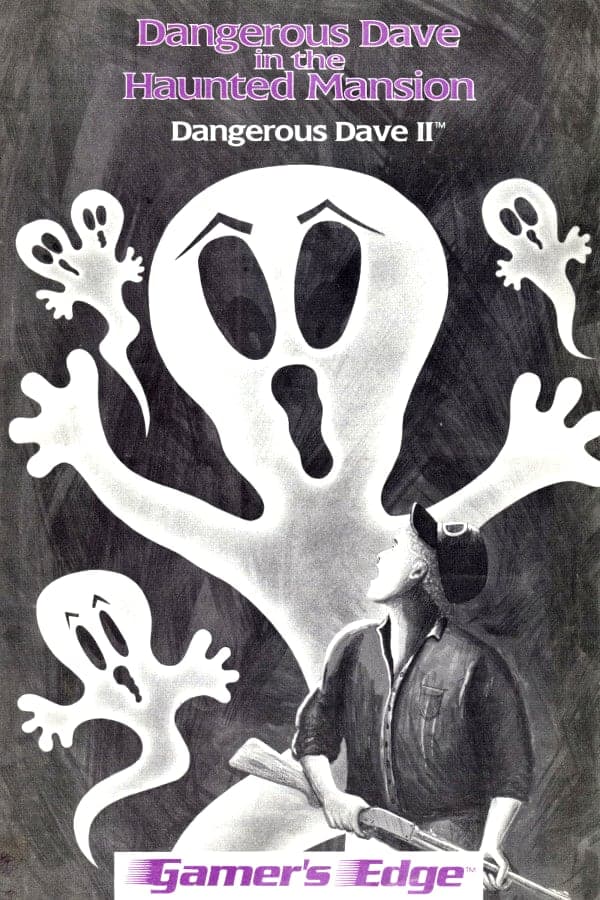
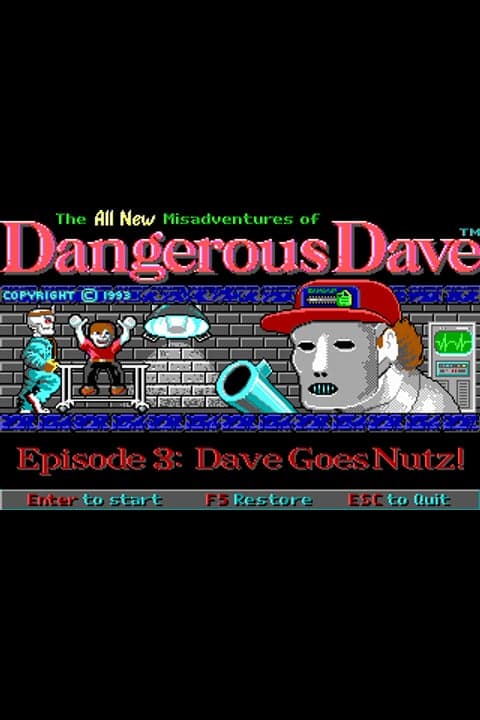
Dangerous Dave in the Deserted Pirate's Hideout
Before he co-founded id Software, John Romero built Dangerous Dave in the Deserted Pirate's Hideout as a compact platformer about dodging hazards for shiny loot. It presents ten single-screen levels of precise jumping, limited jetpack fuel, and instant-death traps where a single missed ledge sends you straight back to the beginning.
How Super Mario Bros. inspired a PC speaker platformer
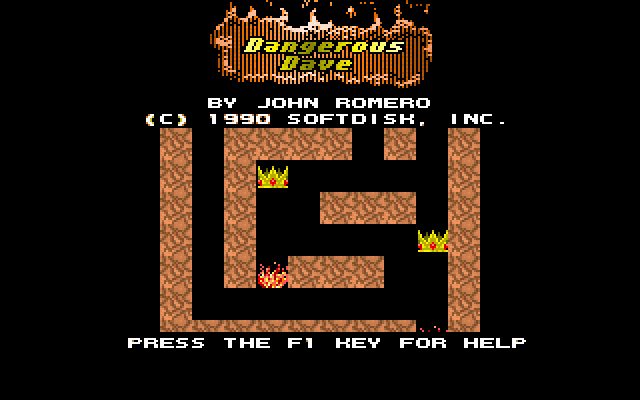
In the late 1980s, computer screens struggled to handle fluid horizontal scrolling without specialized graphics hardware. Romero originally designed the early build of Dave on the Apple II in 1988 to demonstrate his custom programming extension, GraBASIC, for an issue of UpTime disk magazine. When he moved to Softdisk Publishing, he reworked the design into the DOS version that reached player hands as freeware.
Romero openly drew design cues from Super Mario Bros., attempting to bring that console style of momentum, coin collecting, and off-screen secrets to PC monitors. Because smooth scrolling was difficult on standard hardware, he relied on static flip-screen rooms. Every stage fits entirely inside your display, giving you a full view of the platforms, items, and hazards the moment you spawn.
Sound card support was nonexistent for this release, so every jump, pickup effect, and gunshot comes directly from the internal PC speaker. The sharp audio chirps match the stripped-down visuals. Rather than overwhelming players with complex systems, the design focuses entirely on tight timing and spatial awareness across a 16-color layout.
Surviving the hazards of Dangerous Dave in the Deserted Pirate's Hideout
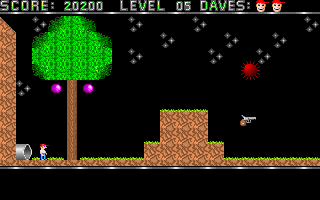
The core setup in Dangerous Dave in the Deserted Pirate's Hideout is straightforward. Dave's rival, Clyde Cooper, has stolen ten golden trophies and hidden them deep within a pirate fortress. Your job is to guide Dave into each room, grab the single golden trophy resting on a high ledge, and walk through the exit door to reach the next challenge.
Reaching that door requires careful movement and quick decisions about which gear to collect:
- The Golden Trophy: The mandatory target in every level that unlocks the exit door once touched.
- Optional Treasures: Extra gems, crowns, rings, and sceptres placed in risky locations to bump up your high score.
- The Pistol: A handgun with limited ammunition that lets you clear persistent creatures standing in your direct path.
- The Jetpack: A flight engine with a temporary fuel gauge, allowing you to bypass large gaps or reach high perches.
Gear does not carry over between levels. If you pick up a jetpack or a pistol on stage three, you lose it the moment you pass through the door, forcing you to adjust to whatever supplies the next room provides. Hazards like fire pits and water pools end your run instantly on contact, as do creatures named FearsomeFire, WickedWater, and WeirdWeeds. Jumping physics follow a fixed arc, meaning once you leave a ledge, you must ride the jump out to its conclusion.
No saves, strict jump arcs, and four secret warp zones
Anyone looking to play Dangerous Dave in the Deserted Pirate's Hideout online today will quickly notice the complete absence of a save system or password feature. You start with a small pool of lives, and if you run out on level nine, the game sends you back to level one. There are no checkpoint flags or mid-stage restarts.
Later screens introduce sharp difficulty spikes with pixel-precise jumps across tiny platforms. Certain monster placements force you to shoot on the fly or drop from a ceiling with perfect timing. The original executable shipped without built-in cheat codes, forcing players to rely on memory trainers or pure practice to beat the final stages.
Romero built clever shortcuts into the map layout for players willing to experiment. By flying or walking beyond the outer borders of levels 5, 8, 9, and 10, you can discover hidden Warp Zones that bypass entire sections of the hideout. This emphasis on secret places directly influenced his future team members. John Carmack and Tom Hall later used Dave's character sprite to build their smooth-scrolling PC tech demo, Dangerous Dave in Copyright Infringement, which mimicked Super Mario Bros. 3 and sparked the founding of id Software.
Play Dangerous Dave in the Deserted Pirate's Hideout right now
The lack of mid-game saves can test your patience on the later screens, but responsive controls and quick restarts keep room-clearing sharp. It is a lean action game from 1990 that expects you to rely entirely on your own reflexes.
You can play Dangerous Dave in the Deserted Pirate's Hideout free in your browser right here, with nothing to install and no setup. Fire it up for ten minutes just to try hovering across a pit of WickedWater on a dying jetpack or hunting down the hidden warp off the screen edge in level five.