Darts (1991)
Rate this game
- Played
- Rarely
Scott Semon brought the familiar pub board to MS-DOS with Darts, a 1991 shareware release that captures the exact mathematics and rules of organized leagues.
Setting your sights on the 62 segments
Most computer adaptations of pub games end up feeling like glorified math puzzles or twitchy timing tests. Sitting down with the 1991 MS-DOS game Darts, you immediately notice how strictly developer Scott Semon stuck to the real thing. There are no fantasy power-ups or cartoon mascots here, just a clear view of the circular board and a straight implementation of official league rules.
The main event is standard 301. You start with 301 points and must count down to exactly zero over a series of three-dart throws. To finish, your final throw has to land on a double-points segment or the central 50-point Bullseye. It sounds simple until you leave yourself with a tricky remainder like 7 points and realize you have to hit a single 3 and a double 2 under pressure.
The dartboard layout itself splits into 20 scoring wedges, each surrounded by a thin outer Double ring and an inner Triple ring. Surrounding the 50-point Bullseye is an Outer Bull ring worth 25 points. Adding up the total combinations gives you 62 distinct target zones on the board, making high-scoring math an absolute necessity if you want to beat your opponents.
Tricky throw controls demand custom PC speeds
While the scoring logic is precise, the physical act of throwing a dart is where the game turns into a real struggle. Instead of a simple mouse point-and-click interface, aiming relies on moving crosshairs or timed indicators that drag across the board. The mechanics are notoriously sensitive, turning tiny adjustments into wild misses that land far outside your intended target wedge.
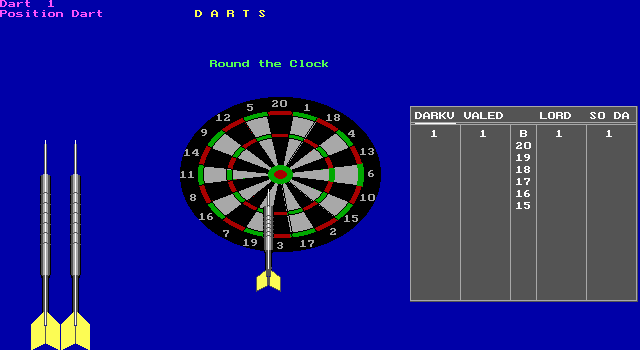
To make matters worse, the game was coded around early PC processor clock speeds. If you run the executable without slowing down your environment, the target indicators fly across the screen faster than human reaction time allows. Adjusting your emulator cycle settings down to a modest 8086 or 286 speed is practically mandatory if you want any hope of hitting a deliberate Triple 20.
Once you dial the execution speed down, the throw mechanic becomes a test of patience. You spend early turns building a rhythm, lining up shots at the high-scoring wedges, and dreading the moment you bust your score by knocking off one point too many on the checkout finish.
Beyond 301: Cricket, Slider, and Round the Clock
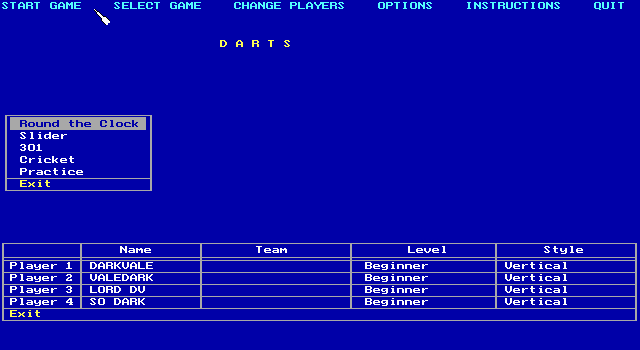
If standard 301 starts to drag, Semon included three additional game variants alongside a raw target practice mode. Up to four human or computer players can cycle through these secondary modes, which changes the dynamic of your turn completely.
- Cricket: Players race to hit and "close" numbers 15 through 20 and the Bullseye by landing three hits in each sector while accumulating points before opponents close them out.
- Round the Clock: A sequential accuracy test where you must hit segments 1 through 20 in exact order followed by the Bullseye.
- Slider: A specialized point-building variant that punishes erratic accuracy while rewarding consistent cluster hitting.
- Target Practice: A free-form training setup designed to help you get a feel for the throw timing without keeping score.
Cricket is easily the highlight of the package for multiplayer sessions. Closing out a segment just before your opponent can start scoring on it brings a layer of tactical spite that 301 simply does not offer.
How this shareware release measures up
Back in 1991, shareware distribution meant floppy disks passed around user groups or uploaded to local BBS networks. Distributed as executable DARTS11.EXE, this project by Scott Semon was designed to give fans of sports games a fast, accessible take on pub leagues without requiring complex hardware upgrades.
It skips complex graphics routines in favor of clean lines and readable numbers. While commercial releases on the Commodore Amiga or later VGA DOS titles tried to simulate 3D bar rooms with animated crowds, Semon kept his program lean. The focus remained entirely on the math, the turn rotations, and the target sectors.
That minimalistic design choice keeps the presentation clean, but it also means there is little audio feedback beyond basic system beeps. You will not hear atmospheric pub noise or commentary, just the plain mechanical layout of the board and your current point total updating at the side of the screen.
Play Darts free in your browser today
You can play Darts online right now without hunting down old system disks or tweaking configuration files. The full shareware experience runs smoothly in a window, giving you immediate access to all four game types and the target practice mode.
Screenshots show the quiet board and simple text overlays, but they do not convey the sudden tension of needing a single Double 1 to close out a 301 match. Launch the game, pick your target mode, and see if you can land three darts in the Triple 20 without sending them flying off the top of the cabinet.
How Darts (1991) is played — the keys the game listens to, grouped by what they do.
- Movement
- Action
- Interface
- Move mouse — Aim dart
- Left click — Set aim and throw dart
- Right click — Re-aim dart
- Middle click — View Out Chart
Highlighted keys are mapped — hover or tap one to see what it does.
Players' controls
Touch and gamepad controls
The on-screen keyboard and gamepad mapping the browser player uses on a phone, a tablet or a controller, as opposed to the real keys above. $PRO members make their own in the player and share them here; anyone can pick one to play with.
Make your own touch controlsPRO
- 1Open the editorSign in below, then pick what to make. The game starts with the editor open over it.
- 2Place your keysAdd keys and drag them where your thumbs rest, or map a controller's buttons. Test plays the game with them; Save keeps them, and you play with them from then on.
- 3Share themShare them right after saving in the game, or name and share them here. Players vote, and the best become this game's controls for everyone.
Go PROSee how it worksSign in+20 XP for sharing · +50 XP if yours become the game's own
- The game's own controlsKeyboardGamepadWhat every player starts with.In use
2 screenshots
From the archive
No gameplay video yet
No gameplay video for Darts (1991) yet. Sign in to add one.
No reviews yet
Tell the community what you think of Darts (1991). Reviews are public and tied to your username.
No archived manuals for Darts (1991) yet
No manuals archived for this title yet. Sign in to upload the first scan.
Cheat codes, console commands and memory pokes for Darts (1991) — each one verified and attributed.
Sign in to submitNo cheats yet for this title
Know a working cheat, poke or trainer? Add it with the button above. Moderators check every entry before it goes live.
No archived soundtrack for Darts (1991) yet
No soundtrack archived for this title yet. Sign in to upload the first rip.
No save states for Darts (1991) yet
No save states for this title yet. Sign in to share one.
Discussions
Sign in to post- Threads0
- Total posts0
- Online now6
Community · Darts (1991)
Who's contributing, and what's new
- Reviews0
- Threads0
- Uploadsapproved0
- Contributors0
Recent activity
Nothing here yet
Reviews, discussion threads and approved uploads appear here as members add them.