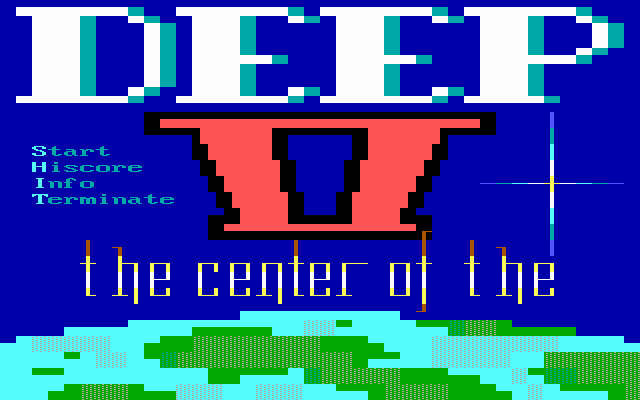
Deep II: The Center of the Earth
Falling through fifty floors of randomly generated rock face in Deep II: The Center of the Earth sounds simple enough until you realize every bump against a cavern wall eats away your precious shields.
Turbo Pascal gave Deep II: The Center of the Earth a sharper edge
The original Deep was a Turbo BASIC project built around one simple mechanic. How far can you drop down a bottomless hole before smashing into the rock? For the 1993 sequel, Dutch developer ALO-Software rebuilt the entire game in Turbo Pascal 4. That technical shift allowed for smoother vertical movement and much cleaner collision routines than the original BASIC build could ever manage.
The premise driving your descent is wonderfully strange. Alien invaders called Zybonians installed a giant control station in the middle of the planet. Their master plan is to wrench Earth out of its natural orbit and pull it across space to their home system. The game documentation dryly admits nobody knows why they want to do this, but saving the world gives you a great excuse to drop down a giant hole.
When you start a session in this 1993 title, the game draws cavern walls procedurally as you descend. No two runs look identical because the gap width contracts and curves at random. You spend your entire drop nudging your ship left and right, trying to stay centered in the moving corridor without scraping the sides.
Managing coins and shields in the automated pit stops
Gravity constantly pulls your craft down the shaft, so precision steering is essential. Touching any part of the cavern wall immediately reduces your shield energy, so sloppy movement gets penalized instantly. The drop down the shaft tests your reactions against several distinct hazards and items:
- Coins: Currency dropped throughout caverns to spend at shop stops.
- Shield Bonuses: Instant pickups that restore damage taken from scraping cavern walls.
- Mines: Floating hazards that explode upon contact with your ship.
- Rock Lines: Solid barriers blocking passages that require weapon fire to breach.
You carry a weapon that can blast through solid rock lines, opening paths through otherwise dead-end passages. However, firing wildly is dangerous because ammo reserves are limited and target space is tight. Clearing obstacles without checking what lies behind them often drops your craft directly into an unexploded mine.
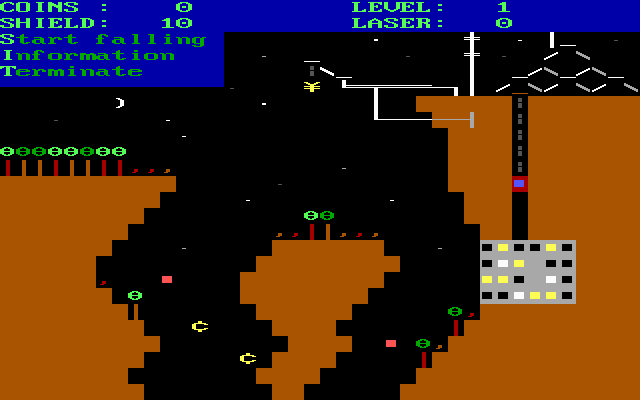
Collecting floating money along the way is crucial for surviving the full journey. Every few levels, you break away from the main descent into automated pit stops built into the rock face. These subterranean shops allow you to buy item refills, repair damage, and upgrade equipment before plunging into deeper caverns.
Managing your wallet between levels introduces real tactical choices to what could have been a simple twitch action game. Spending all your funds on extra blasting power might sound smart until a narrow turn wipes out your remaining shield points. Knowing when to save cash for emergency shield repairs is often what separates a short run from reaching the bottom.
Where the 50-level plunge starts to test your patience
While the shop economy adds good structure to the game, clearing all fifty levels demands real concentration. Because the cave layouts are generated procedurally, the game occasionally spawns punishing choke points. You might hit a tight hairpin turn lined with solid rock and floating mines with almost zero room to maneuver safely.
The lack of visual variety across fifty levels can also make long play sessions feel monotonous. The background graphics and cavern rock textures remain largely unchanged from the upper crust down to the core. Higher floors increase the challenge through faster scroll speeds, narrower passages, and denser minefields rather than new hazard types.
Despite those repetitive stretches, the movement feels sharp and responsive for an early freeware effort. The team behind this title made only one other game, a basic MS-DOS Duck Hunt clone. Compared to that lightweight shooter, this cavern crawler delivers a much meatier arcade challenge that demands your full attention.
The controls give your ship a slight sense of momentum, so quick taps are better than holding down key inputs. If you oversteer into a wide turn, recovery takes a second, usually costing half your shield meter against the jagged rock face. Learning to feather your movement inputs is the main skill you build over successive tries in a release published by ALO-Software.
How to play Deep II: The Center of the Earth online right now
If you want to experience an obscure piece of Dutch shareware history, playing this Deep II: The Center of the Earth MS-DOS game takes only a moment. You can see how early PC coders built tense arcade games out of straightforward mechanics and clever math routines.
You can play Deep II: The Center of the Earth online right now, Deep II: The Center of the Earth free in your browser with no setup needed. Steering your craft through fifty floors of unpredictable rock while balancing shield purchases against minefields offers a quick, satisfying challenge. Jump in, steer clear of the walls, and see if you can reach the Zybonian core on your first attempt.