
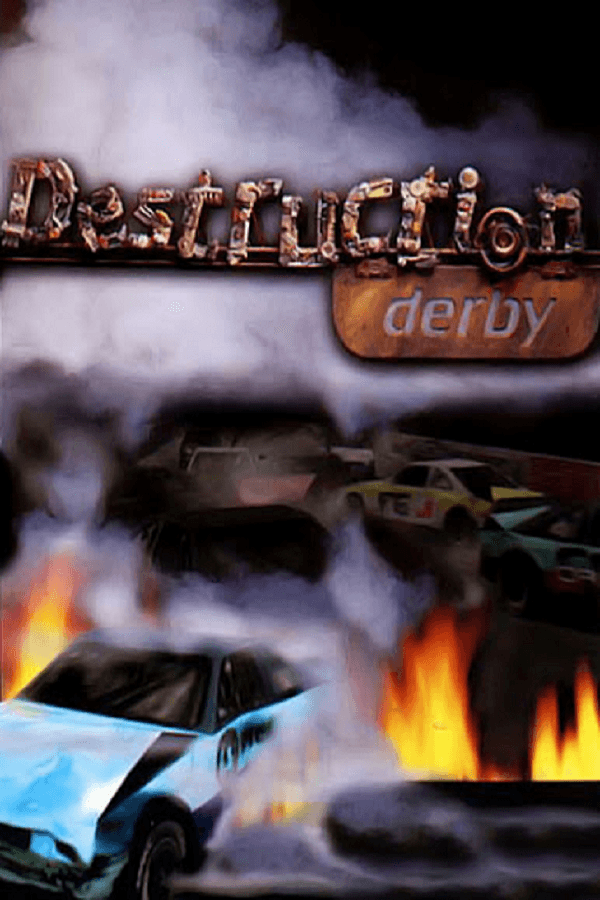
In 1995, Destruction Derby proved that smashing your stock car into a fifteen-driver pileup was infinitely more satisfying than actually crossing the finish line first.
Most racing games from 1995 asked you to pick a clean line, stick to the apex, and avoid touching the guardrails at all costs. Developer Reflections Interactive Limited flipped that logic upside down by turning damage into currency. While you could play a standard Stock Car Racing mode to chase traditional chequered flags, the real heart of the game was Wreckin' Racing, where standard lap times took a back seat to sheer mechanical destruction.
The points system forced you to change how you approached every corner on the circuit. Scraping past another car on the straightaway yielded nothing, but clipping a rival's rear quarter-panel hard enough to spin them around threw heavy points onto your total. A clean 360-degree spin was the holy grail of collisions, rewarding aggressive side-swipes that sent opponents skidding sideways into oncoming traffic. With fifteen computer-controlled cars packed onto tiny, twisting tracks, every turn turned into a metal-twisting choke point where survival depended on reading the chaotic flow of debris.
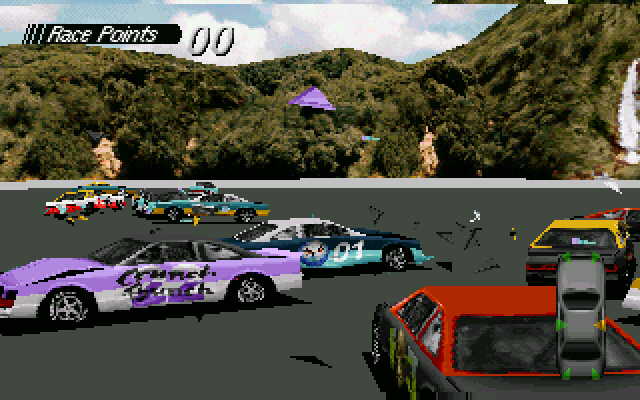
The pure arena mode, held inside a trackless dirt stadium called The Bowl, stripped away the track entirely. All fifteen drivers started lined up against the outer wall facing inward, accelerating straight toward the centre of the dirt floor at full throttle. What followed was a massive, immediate crunch of sheet metal that immediately crippled half the field. In this mode, finishing as the last functional vehicle was the only goal that mattered.
As much fun as it was watching polygonal hoods warp under impact, the DOS version of Destruction Derby carried a brutal tactical trap that caught every newcomer off guard. Locational car damage actually mattered for your speed and steering, but front-end hits were practically lethal. Ramming an opponent head-on directly crumpled your front grille, quickly damaging your radiator until the engine overheated and died completely, abruptly ending your season run regardless of your score.
To survive long enough to top the leaderboards, you had to drive like an absolute maniac while obsessively protecting your front bumper. Serious players quickly learned to reverse at full speed into tight scuffles or swing the tail of their vehicle around like a sledgehammer to protect their fragile cooling system. It looked completely absurd, but swinging your rear end into a pack of cars was the only reliable way to deal massive damage without destroying your own engine in the process.
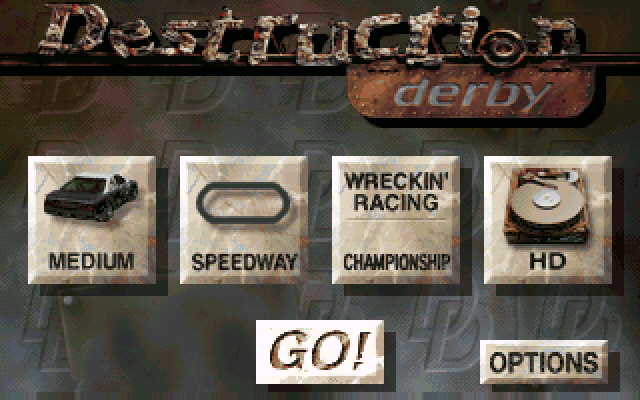
Handling on the PC version pulled no punches, either. Keyboard controls made fine steering adjustments almost impossible, causing cars to slide wildly over slight dirt patches or lock up completely during heavy braking. Some contemporary player reviews on GameFAQs even rated the PC port down to a harsh 2/10, pointing at the off-balanced handling and floaty steering compared to console releases. Yet once you learned to treat the vehicle more like a heavy battering ram than a precision sports car, the stubborn controls started to make a weird kind of sense.
Publisher Psygnosis Limited brought its signature production flair to the technical backend. Designed by Martin Edmondson and programmed by a small team including Mike Troughton, the game pushed software-rendered 3D graphics in 256-color 320x200 VGA mode, powered by a DOS/4GW DOS extender. Rather than spending system memory on vast, sprawling environments, the team deliberately kept the circuits short and tight to keep car density high and physics collisions frequent.
Sound support was extensive, taking advantage of the Miles Audio Interface Library to drive hardware like the Sound Blaster 16, Gravis UltraSound, and Roland RAP-10. Crashing into a rival triggered loud crunching sound effects and sent polygonal debris flying across the track, accompanied by a driving electronic soundtrack composed by Tim Swan and Elliott Sumner.
If you take a break from crashing into rivals to check out the scenery, the trackside billboards are packed with fun details. Psygnosis used the track barriers to promote several of their other high-profile titles from the same generation:
While later titles expanded on the career progression and physics models, the original game retains a lean, immediate focus on pure vehicular chaos. The single-minded focus on physical contact, combined with the constant threat of a dead radiator, turns every race into an aggressive game of tactical chicken. If you enjoy arcade action games that prioritize instant fun over realistic suspension tuning, this title still offers an absolute blast of mid-nineties automotive carnage.
You can play Destruction Derby online free in your browser right here, without setting up old config files or mounting virtual drives. Launch straight into a Wreckin' Racing league or drop directly into the middle of The Bowl to see how many points you can score before your radiator gives out.
In 1995, Destruction Derby proved that smashing your stock car into a fifteen-driver pileup was infinitely more satisfying than actually crossing the finish line first.
Most racing games from 1995 asked you to pick a clean line, stick to the apex, and avoid touching the guardrails at all costs. Developer Reflections Interactive Limited flipped that logic upside down by turning damage into currency. While you could play a standard Stock Car Racing mode to chase traditional chequered flags, the real heart of the game was Wreckin' Racing, where standard lap times took a back seat to sheer mechanical destruction.
The points system forced you to change how you approached every corner on the circuit. Scraping past another car on the straightaway yielded nothing, but clipping a rival's rear quarter-panel hard enough to spin them around threw heavy points onto your total. A clean 360-degree spin was the holy grail of collisions, rewarding aggressive side-swipes that sent opponents skidding sideways into oncoming traffic. With fifteen computer-controlled cars packed onto tiny, twisting tracks, every turn turned into a metal-twisting choke point where survival depended on reading the chaotic flow of debris.
The pure arena mode, held inside a trackless dirt stadium called The Bowl, stripped away the track entirely. All fifteen drivers started lined up against the outer wall facing inward, accelerating straight toward the centre of the dirt floor at full throttle. What followed was a massive, immediate crunch of sheet metal that immediately crippled half the field. In this mode, finishing as the last functional vehicle was the only goal that mattered.
As much fun as it was watching polygonal hoods warp under impact, the DOS version of Destruction Derby carried a brutal tactical trap that caught every newcomer off guard. Locational car damage actually mattered for your speed and steering, but front-end hits were practically lethal. Ramming an opponent head-on directly crumpled your front grille, quickly damaging your radiator until the engine overheated and died completely, abruptly ending your season run regardless of your score.
To survive long enough to top the leaderboards, you had to drive like an absolute maniac while obsessively protecting your front bumper. Serious players quickly learned to reverse at full speed into tight scuffles or swing the tail of their vehicle around like a sledgehammer to protect their fragile cooling system. It looked completely absurd, but swinging your rear end into a pack of cars was the only reliable way to deal massive damage without destroying your own engine in the process.
Handling on the PC version pulled no punches, either. Keyboard controls made fine steering adjustments almost impossible, causing cars to slide wildly over slight dirt patches or lock up completely during heavy braking. Some contemporary player reviews on GameFAQs even rated the PC port down to a harsh 2/10, pointing at the off-balanced handling and floaty steering compared to console releases. Yet once you learned to treat the vehicle more like a heavy battering ram than a precision sports car, the stubborn controls started to make a weird kind of sense.
Publisher Psygnosis Limited brought its signature production flair to the technical backend. Designed by Martin Edmondson and programmed by a small team including Mike Troughton, the game pushed software-rendered 3D graphics in 256-color 320x200 VGA mode, powered by a DOS/4GW DOS extender. Rather than spending system memory on vast, sprawling environments, the team deliberately kept the circuits short and tight to keep car density high and physics collisions frequent.
Sound support was extensive, taking advantage of the Miles Audio Interface Library to drive hardware like the Sound Blaster 16, Gravis UltraSound, and Roland RAP-10. Crashing into a rival triggered loud crunching sound effects and sent polygonal debris flying across the track, accompanied by a driving electronic soundtrack composed by Tim Swan and Elliott Sumner.
If you take a break from crashing into rivals to check out the scenery, the trackside billboards are packed with fun details. Psygnosis used the track barriers to promote several of their other high-profile titles from the same generation:
While later titles expanded on the career progression and physics models, the original game retains a lean, immediate focus on pure vehicular chaos. The single-minded focus on physical contact, combined with the constant threat of a dead radiator, turns every race into an aggressive game of tactical chicken. If you enjoy arcade action games that prioritize instant fun over realistic suspension tuning, this title still offers an absolute blast of mid-nineties automotive carnage.
You can play Destruction Derby online free in your browser right here, without setting up old config files or mounting virtual drives. Launch straight into a Wreckin' Racing league or drop directly into the middle of The Bowl to see how many points you can score before your radiator gives out.
How Destruction Derby is played — the keys the game listens to, grouped by what they do.
Highlighted keys are mapped — hover or tap one to see what it does.
Controls from Destruction Derby 2 were omitted. Settings and controls can be configured via DD.CFG or setup utilities.
The on-screen keyboard and gamepad mapping the browser player uses on a phone, a tablet or a controller, as opposed to the real keys above. $PRO members make their own in the player and share them here; anyone can pick one to play with.
Cheat codes, console commands and memory pokes for Destruction Derby — each one verified and attributed.
Sign in to submitaka Demolish 'Em Derby
How Destruction Derby is played — the keys the game listens to, grouped by what they do.
Highlighted keys are mapped — hover or tap one to see what it does.
Controls from Destruction Derby 2 were omitted. Settings and controls can be configured via DD.CFG or setup utilities.
The on-screen keyboard and gamepad mapping the browser player uses on a phone, a tablet or a controller, as opposed to the real keys above. $PRO members make their own in the player and share them here; anyone can pick one to play with.
Cheat codes, console commands and memory pokes for Destruction Derby — each one verified and attributed.
Sign in to submit