

Dig Dug
aka Arcade Archives: Dig Dug · Arcade Game Series: Dig Dug · DIG DUG for 6000 · Dig-Dug · DigDug
Checking…
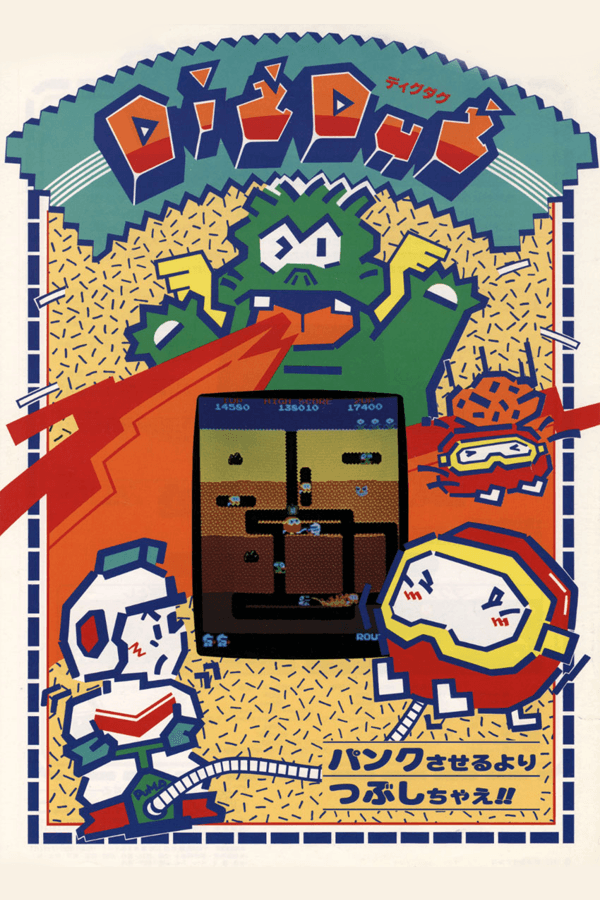
Dig Dug made a surprisingly gruesome premise look cute in arcades, but bringing that underground, monster-inflating action to MS-DOS in 1983 meant fitting a frantic screen-clearing game into four CGA colors.
Stripping an arcade hit down to four CGA colors
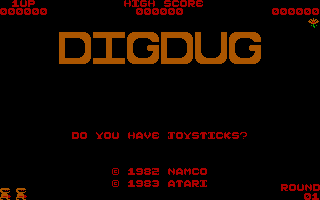
Launching the Atarisoft conversion of Dig Dug on an early PC is an immediate lesson in hardware limits. Instead of the bright arcade cabinet palette, the 1983 release runs as an IBM PC booter rendering the underground dirt and monsters in cyan, magenta, black, and white.
Audio takes a similar hit through the native PC speaker. Yuriko Keino's brilliant arcade soundtrack was famous for a specific trick: the background music only plays while your character is actively walking. On early IBM PCs, that stepping rhythm turns into a sharp, dry chirp that disappears the second you pause to map out your next tunnel.
Yet behind the austere visuals, the essential arcade loop developed by Namco Limited remains entirely intact. You are still digging tunnels, evading pursuit, and trying not to get caught in a dead end.
Digging tunnels, pumping monsters, and dropping rocks
You control the underground digger in a fixed side-view grid filled with dirt and pre-built tunnels. Your goal in every stage is simple: destroy every enemy on the board before they manage to catch you.
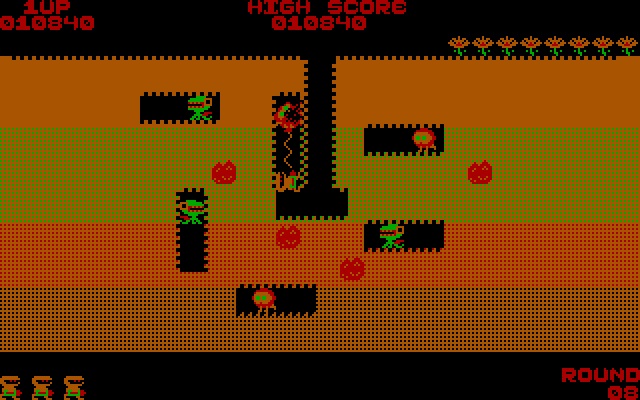
Two distinct creature types hunt you down through the dirt. Pookas are red, goggled monsters that harmlessly chase you, while Fygars are green dragons that can suddenly spit fire horizontally across open tunnels. If you leave monsters alone for too long, they turn into floating eyes that phase straight through solid earth to reach your corridor.
Your primary weapon is a handheld air pump with a long hose. Connecting with a creature lets you pump them full of air until they pop, though stopping halfway lets them slowly deflate back to normal health. Dropping heavy boulders down dug shafts offers a cleaner solution, crushing multiple pursuers at once and spawning bonus vegetables in the middle of the board for big points.
Stiff controls and DOS timing quirks make Dig Dug tricky
The biggest challenge when playing this port on early PC hardware is the movement feel. Trying to make tight, fast turns into narrow dirt side-paths frequently results in input failures, leaving you standing helplessly while a dragon torches your position.
On the flip side, the PC port introduces an accidental advantage for the player. The game timer runs somewhat slower than the original coin-op, which makes handling multiple enemies in quick succession noticeably more forgiving than it was on original cabinet hardware.
A standard high-score run in this 1983 release generally relies on a few core tactical steps:
- Dig tight vertical tunnels directly under heavy rocks to setup dropping traps.
- Freeze a pursuing Pooka with a single air pump charge to block the corridor behind it.
- Lure Fygars from above or below to prevent them from using their horizontal fire attack.
Without distinct boss encounters or unique level layouts, the formula can feel repetitive during longer play sessions. It works best as a straightforward, score-driven action game built for short bursts of play.
Play Dig Dug free in your browser right now
The rigid keyboard response and monochrome CGA visuals show their age, but trapping monsters and collapsing tunnels still feels sharp. Anyone looking for pure score-chasing gameplay from the arcade era will get a kick out of this one.
You can play Dig Dug free in your browser right now with no setup necessary. Fire up the Dig Dug MS-DOS game, get a feel for the rhythm of the air pump, and see how many stages you can clear before the stiff controls trap you in a corner.
Players' controls
Touch and gamepad controls
The on-screen keyboard and gamepad mapping the browser player uses on a phone, a tablet or a controller, as opposed to the real keys above. $PRO members make their own in the player and share them here; anyone can pick one to play with.
Make your own touch controlsPRO
- 1Open the editorSign in below, then pick what to make. The game starts with the editor open over it.
- 2Place your keysAdd keys and drag them where your thumbs rest, or map a controller's buttons. Test plays the game with them; Save keeps them, and you play with them from then on.
- 3Share themShare them right after saving in the game, or name and share them here. Players vote, and the best become this game's controls for everyone.
Go PROSee how it worksSign in+20 XP for sharing · +50 XP if yours become the game's own
- The game's own controlsNone yet: played with a real keyboard only.In use
2 screenshots
From the archive
No reviews yet
Tell the community what you think of Dig Dug. Reviews are public and tied to your username.
No archived manuals for Dig Dug yet
No manuals archived for this title yet. Sign in to upload the first scan.
Cheat codes, console commands and memory pokes for Dig Dug — each one verified and attributed.
Sign in to submitNo cheats yet for this title
Know a working cheat, poke or trainer? Add it with the button above. Moderators check every entry before it goes live.
No archived soundtrack for Dig Dug yet
No soundtrack archived for this title yet. Sign in to upload the first rip.
No save states for Dig Dug yet
No save states for this title yet. Sign in to share one.
Discussions
Sign in to post- Threads0
- Total posts0
- Online now6
Community · Dig Dug
Who's contributing, and what's new
- Reviews0
- Threads0
- Uploadsapproved0
- Contributors0
Recent activity