
You inflate giant dragons until they pop while hunting for marked dirt spots in Dig It!, a side-scrolling platformer where a single wrong turn in a timed cavern ends your entire run.
Inflation, drills, and the sheer chaos of Dig It!
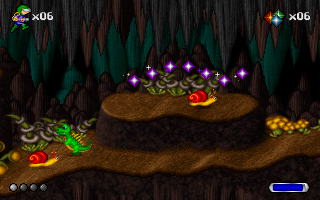
You play as a miner named Dug Kewl. When the Supreme Spurkasaur snatches his wife Dugette, Dug grabs a power drill and a very strange gun to track her down across four distinct worlds. Instead of killing monsters with standard bullets, your sidearm pumps air into enemies. Hit an armored hedgehog or a dragon enough times, and it expands like a party balloon until it floats off the screen or bursts.
That mechanic gives combat a weird, rhythmic pacing. You cannot just spray shots into a crowded hallway and run through. Each shot expands the creature slightly, freezing it in place while you pump enough air to clear the path. Giant snails present an even worse problem. Blowing up an evil snail leaves its shell behind, and that abandoned shell keeps sliding across the floor to clip your health bar if you drop your guard.
Reaching the end of a stage is not as simple as walking to the right side of the screen. Every map requires you to hunt down a ground patch marked with a large letter X. Once you stand over it, you hold the down action to drill straight through the floor and drop into the exit transition. If you reach the far edge of levels like Warm Up Run or Draggostellago without finding that X, you have to turn around and search every ledge you skipped.
Why player discussions call this a bullet hell maze
While early stages give you plenty of space to breathe, the difficulty ramps up sharply once you hit Deep Duggy and Chaos Chasm. Enemies dump dense patterns of projectiles across narrow corridors. Because Dug's jump arc feels stiff, dodging incoming fire while managing floating monsters gets chaotic fast. It does not take long to see why people talking about this 1996 title compare late levels to an arcade bullet hell.
The timer makes that pressure much worse. Stages like the maze inside Spookstone Inn are sprawling, multi-tiered labyrinths filled with dead ends. You are forced to navigate tight passages while keeping a close eye on the clock. Running out of time hurts just as badly as taking a dragon flame to the face, forcing you to move fast even when the screen is packed with hazard sprites.
Action games from this era often used thick background details, but the visual artwork here presents its own challenge. Level backgrounds and foreground platforms share heavily muddy color palettes. Discerning a solid ledge from decorative scenery in levels like Nirp Slirp Alley or Hop-n-Pop takes practice, and missing a drop usually puts you right on top of an armored enemy.
Power-ups, secrets, and Péter Varga's techno beats
To survive late-game maps like Draggo's Revenge and Waterslide Way, you have to rely heavily on items dropped from destroyed foes and smashed chests. Picking up Spring Boots grants high bounds to clear tall walls, while the Jet Pack lets you fly straight over dangerous floor hazards. Collecting Rapid Fire turns your sluggish air gun into a machine that inflates whole rooms of enemies before they can shoot back.
Secret hunting is built directly into the digging system. Beyond the required exit points, Dug can drill into random unmarked dirt patches and suspicious dead ends. Doing so drops you into hidden treasure rooms packed with bonus items, extra lives, and score boosters. Skipping these rooms makes the rest of the campaign significantly harder, as those extra lives act as your primary cushion against strict time limits.
The audio presentation keeps the energy high throughout the struggle. Composer Péter Varga wrote an intense techno soundtrack using the Loudness audio engine. The heavy synth lines sound punchy on a standard Sound Blaster card, giving underwater stages like Seasnail Lake, Hopperfish Havoc, Scubadoobadug, and Bubble Tide a driving momentum that fits the strict timer.

Beat the Supreme Spurkasaur to earn the cheat codes
Developer and publisher Pixel Painters Corporation released this title on CD-ROM as their final commercial project. They built a curious reward directly into the ending sequence. Rather than just rolling credits when you finally defeat the Supreme Spurkasaur and save Dugette, the game prints out its built-in cheat codes on the screen as a reward for finishing the campaign.
Once you know the trick, you hold Backspace and hit secondary keys during play to break the rules wide open. This built-in list of key combinations lets you instantly adjust your equipment and stats without hunting for power-up drops:
- Backspace + X: Grants five extra lives instantly.
- Backspace + S: Activates Superdug invincibility mode.
- Backspace + E: Fully refills your energy meter.
- Backspace + T: Resets the level countdown timer back to maximum.
- Backspace + B: Equips the Spring Boots for high jumping.
- Backspace + J: Grants the Jet Pack for free flight across the map.
- Backspace + R: Enables Rapid Fire mode for your air gun.
Having those codes available turns second playthroughs into an arcade playground. Flying over maze walls with the Jet Pack or running through bullet streams with Superdug active lets you explore every secret digging point without stressing over the clock.
Fire up this DOS classic right now
This Pixel Painters Corporation creation is far from a standard side-scroller. The murky graphics can make navigation tricky, and the strict timers on huge maze levels will frustrate anyone who likes to take things slow. Yet the enemy inflation mechanic remains genuinely fun to pull off, and the fast techno music gives every run a frantic rhythm that sets it apart from typical shareware platformers of the mid-nineties.
If you want to experience this classic Dig It! MS-DOS game today, you do not need an old computer stack or complex software setups. You can play Dig It! online right now. Everything loads fast, so you can test your drill skills and enjoy Dig It! free in your browser within seconds.
How Dig It! is played — the keys the game listens to, grouped by what they do.
- Movement
- Action
- Other
Highlighted keys are mapped — hover or tap one to see what it does.
Key map is based on available reference notes; menu, save, and pause keys are omitted as they were not specified in the sources.
Players' controls
Touch and gamepad controls
The on-screen keyboard and gamepad mapping the browser player uses on a phone, a tablet or a controller, as opposed to the real keys above. $PRO members make their own in the player and share them here; anyone can pick one to play with.
Make your own touch controlsPRO
- 1Open the editorSign in below, then pick what to make. The game starts with the editor open over it.
- 2Place your keysAdd keys and drag them where your thumbs rest, or map a controller's buttons. Test plays the game with them; Save keeps them, and you play with them from then on.
- 3Share themShare them right after saving in the game, or name and share them here. Players vote, and the best become this game's controls for everyone.
Go PROSee how it worksSign in+20 XP for sharing · +50 XP if yours become the game's own
- The game's own controlsKeyboardGamepadWhat every player starts with.In use
2 screenshots
From the archive
No reviews yet
Tell the community what you think of Dig It!. Reviews are public and tied to your username.
No archived manuals for Dig It! yet
No manuals archived for this title yet. Sign in to upload the first scan.
Cheat codes, console commands and memory pokes for Dig It! — each one verified and attributed.
Sign in to submitNo cheats yet for this title
Know a working cheat, poke or trainer? Add it with the button above. Moderators check every entry before it goes live.
No archived soundtrack for Dig It! yet
No soundtrack archived for this title yet. Sign in to upload the first rip.
No save states for Dig It! yet
No save states for this title yet. Sign in to share one.
Discussions
Sign in to post- Threads0
- Total posts0
- Online now6
Community · Dig It!
Who's contributing, and what's new
- Reviews0
- Threads0
- Uploadsapproved0
- Contributors0
Recent activity
Nothing here yet
Reviews, discussion threads and approved uploads appear here as members add them.