


Duke it out in D.C. takes the standard arsenal of Duke Nukem 3D and drops you right into the middle of the Smithsonian and the White House to rescue Bill Clinton from an alien invasion.
The design team at Sunstorm Interactive built this commercial expansion around a single clear idea: taking Duke out of anonymous sci-fi corridors and putting him inside recognizable American landmarks. Built on Ken Silverman's Build engine for MS-DOS PCs running version 1.3d or the Atomic Edition, the add-on trades abstract video game geometry for complex real-world layouts. When you step into levels like Smithsonian Terror or Metro Mayhem, you immediately notice how different the combat feels compared to the base game. Hallways are wider, ceilings are higher, and open spaces give enemies line of sight from angles you rarely had to cover in the original levels.
That sense of scale is impressive, but it changes how you move. Because the add-on reuses the standard enemy roster without adding new weapons, your tactics come down to how you clear room by room. Sniping a Pig Cop across a massive display hall requires checking every balcony above you first. If you drop down without clearing the upper level, you get shredded from behind before you even reach the next display case.
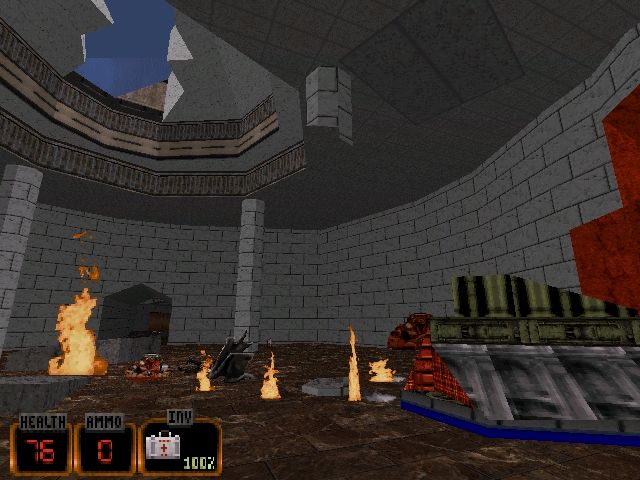
While the levels genuinely feel like real Washington locations, the progression logic hits a wall in the middle of the campaign. The nine main levels rely heavily on finding keycards and obscure switches scattered across huge areas. In levels like Nuked Files or Brown Water, it is entirely too easy to clear a room of Octabrains, only to spend the next twenty minutes running back and forth trying to figure out which switch opened a door three halls back. You end up hunting through underwater pipes or diving into shark tanks just to flip a single critical toggle.
This pacing drop is the main flaw of add-on releases from this era. When level design prioritizes detailed real-world geometry over clear flow, players pay the price in backtracking. You can always resort to typing DNCORNHOLIO for god mode or DNSTUFF to give yourself all keys and weapons, but relying on cheats just to bypass a hidden wall switch proves how tedious the search gets. If you are planning a full playthrough of this 1997 release, be prepared for some heavy manual searching in the mid-game maps.
For players who take the time to hunt down hidden pathways, the real treat of the set is finding the secret level, Top Secret. Level designer Robert Travis hid a full time machine inside this map, dropping Duke into an homage to H.G. Wells alongside a repurposed user map called Aztec. It feels distinct from the urban grid of the main D.C. locations and shows off what the Build engine could do when developers pushed its sector-based tricks past normal city streets.
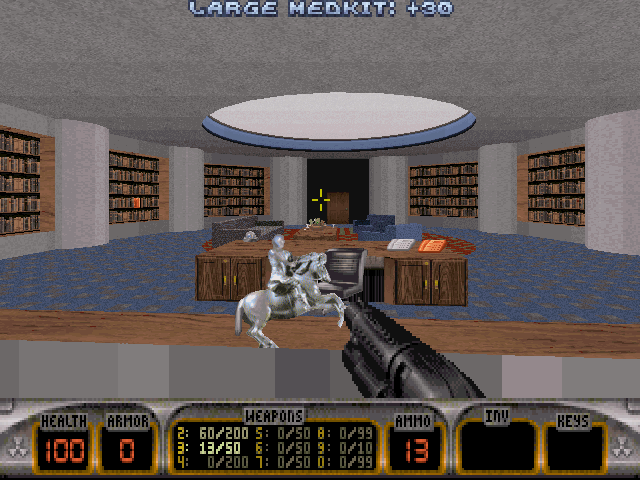
Published by WizardWorks, the expansion managed to deliver some of the best environment design available for the engine, even if it lacked new voice lines or new guns. The level set culminates in Capitol Punishment and a final showdown with the Cycloid Emperor, leading to a brief, comedic slideshow ending that wraps up Duke's rescue mission with typical late-nineties satire.
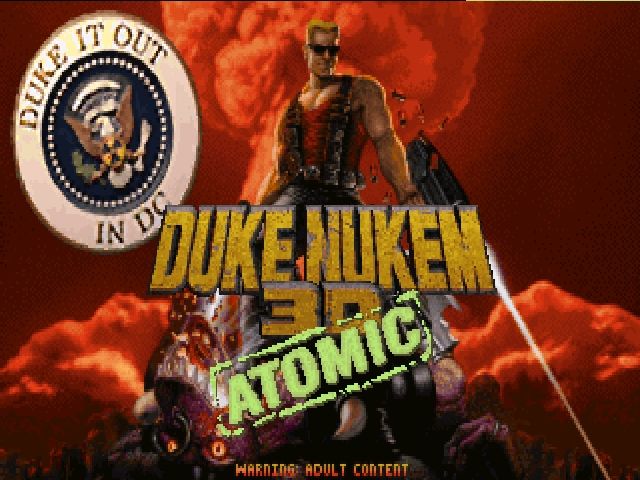
If you want to play Duke it out in D.C. MS-DOS game levels today, the visual craftsmanship of maps like Dread October - complete with its fully functional nuclear submarine layout - still makes it worth a run-through. It shows exactly how talented modders and contract designers could stretch standard 2.5D graphics to construct believable real-world spaces before full 3D engines took over the shooter market.
You can play Duke it out in D.C. free in your browser right now, with nothing to install and no setup required. Modern players often expect custom weapons or extra enemy types, but once you launch into Hell to the Chief, you will quickly find that raw level design and tight ammunition management are more than enough to keep you on your toes.
Duke it out in D.C. takes the standard arsenal of Duke Nukem 3D and drops you right into the middle of the Smithsonian and the White House to rescue Bill Clinton from an alien invasion.
The design team at Sunstorm Interactive built this commercial expansion around a single clear idea: taking Duke out of anonymous sci-fi corridors and putting him inside recognizable American landmarks. Built on Ken Silverman's Build engine for MS-DOS PCs running version 1.3d or the Atomic Edition, the add-on trades abstract video game geometry for complex real-world layouts. When you step into levels like Smithsonian Terror or Metro Mayhem, you immediately notice how different the combat feels compared to the base game. Hallways are wider, ceilings are higher, and open spaces give enemies line of sight from angles you rarely had to cover in the original levels.
That sense of scale is impressive, but it changes how you move. Because the add-on reuses the standard enemy roster without adding new weapons, your tactics come down to how you clear room by room. Sniping a Pig Cop across a massive display hall requires checking every balcony above you first. If you drop down without clearing the upper level, you get shredded from behind before you even reach the next display case.

While the levels genuinely feel like real Washington locations, the progression logic hits a wall in the middle of the campaign. The nine main levels rely heavily on finding keycards and obscure switches scattered across huge areas. In levels like Nuked Files or Brown Water, it is entirely too easy to clear a room of Octabrains, only to spend the next twenty minutes running back and forth trying to figure out which switch opened a door three halls back. You end up hunting through underwater pipes or diving into shark tanks just to flip a single critical toggle.
This pacing drop is the main flaw of add-on releases from this era. When level design prioritizes detailed real-world geometry over clear flow, players pay the price in backtracking. You can always resort to typing DNCORNHOLIO for god mode or DNSTUFF to give yourself all keys and weapons, but relying on cheats just to bypass a hidden wall switch proves how tedious the search gets. If you are planning a full playthrough of this 1997 release, be prepared for some heavy manual searching in the mid-game maps.
For players who take the time to hunt down hidden pathways, the real treat of the set is finding the secret level, Top Secret. Level designer Robert Travis hid a full time machine inside this map, dropping Duke into an homage to H.G. Wells alongside a repurposed user map called Aztec. It feels distinct from the urban grid of the main D.C. locations and shows off what the Build engine could do when developers pushed its sector-based tricks past normal city streets.

Published by WizardWorks, the expansion managed to deliver some of the best environment design available for the engine, even if it lacked new voice lines or new guns. The level set culminates in Capitol Punishment and a final showdown with the Cycloid Emperor, leading to a brief, comedic slideshow ending that wraps up Duke's rescue mission with typical late-nineties satire.

If you want to play Duke it out in D.C. MS-DOS game levels today, the visual craftsmanship of maps like Dread October - complete with its fully functional nuclear submarine layout - still makes it worth a run-through. It shows exactly how talented modders and contract designers could stretch standard 2.5D graphics to construct believable real-world spaces before full 3D engines took over the shooter market.
You can play Duke it out in D.C. free in your browser right now, with nothing to install and no setup required. Modern players often expect custom weapons or extra enemy types, but once you launch into Hell to the Chief, you will quickly find that raw level design and tight ammunition management are more than enough to keep you on your toes.
How Duke it out in D.C. is played — the keys the game listens to, grouped by what they do.
Highlighted keys are mapped — hover or tap one to see what it does.
Set up for modern play: W A S D move, the mouse turns and aims, left click fires. The arrow keys still turn. Ctrl and Alt are left free because the browser uses them (Ctrl + W closes the tab).
The on-screen keyboard and gamepad mapping the browser player uses on a phone, a tablet or a controller, as opposed to the real keys above. $PRO members make their own in the player and share them here; anyone can pick one to play with.
Cheat codes, console commands and memory pokes for Duke it out in D.C. — each one verified and attributed.
Sign in to submitaka Duke Nukem 3D: Duke It Out in D.C. · Duke à Washington
How Duke it out in D.C. is played — the keys the game listens to, grouped by what they do.
Highlighted keys are mapped — hover or tap one to see what it does.
Set up for modern play: W A S D move, the mouse turns and aims, left click fires. The arrow keys still turn. Ctrl and Alt are left free because the browser uses them (Ctrl + W closes the tab).
The on-screen keyboard and gamepad mapping the browser player uses on a phone, a tablet or a controller, as opposed to the real keys above. $PRO members make their own in the player and share them here; anyone can pick one to play with.
Cheat codes, console commands and memory pokes for Duke it out in D.C. — each one verified and attributed.
Sign in to submit