
Earl Weaver Baseball II
aka Earl Weaver Baseball 2
Rate this game
- Played
- Rarely
Earl Weaver Baseball II takes you straight to the dugout rail, letting you call every pitch, adjust your defensive shifts, and adjust outfield fences across four distinct difficulty levels.
The view from the dugout changes how you handle every count
You step up to the plate or grab the manager card, and the first thing you notice is the camera. Instead of flat 2D sprite displays common to early PC dugouts, lead designer Eddie Dombrower used a 3D camera model to mirror real television broadcasts, drawing on architectural spatial code he originally built while working at Mattel. Pitch selection depends heavily on context: you pick fastballs, sliders, or curveballs based on over 50 hitter stats and 30 distinct pitcher metrics. If you lean too hard on a tiring starter, the engine punishes you with line drives into the gaps.
The tactical depth forces you to manage real strategy rather than just reflex button-timing. When facing heavy pull hitters, shifting your outfielders or pulling the infield in for a play at the plate makes the difference between an inning-ending double play and a ruined bullpen. The top-down radar display keeps track of base runners, while the main viewport displays animated fielders diving for grounders and tracking fly balls against custom outfield walls.
Sound design plays a direct role in reading the action. Arranged by Dave Warhol and David Hayes with music by Nathan Wang, the audio cues give immediate feedback when a bat connects cleanly. Running this sports game on a classic Sound Blaster card delivered sharp stadium cracks and crowd noises that standard PC speakers converted into harsh beeps.
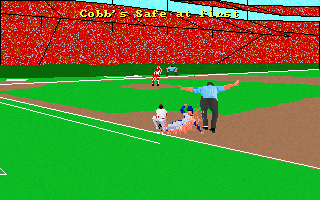
Earl Weaver Baseball II gave managers full control over the ball club
Beyond the single-game dugout decisions, the inclusion of the Commissioner's Disk II module expanded the scope of the package. Players could build custom stadiums from scratch, editing wall height, outfield distances, and foul territory bounds to create specialized hitter parks or pitcher havens. The toolset also included a Manager Construction Set to build custom AI opponents, complete fantasy league drafting systems, and printable baseball card templates.
Developed by Mirage Graphics, Inc. and released as an Electronic Arts, Inc. title, the design relied heavily on former Baltimore Orioles manager Earl Weaver's statistical philosophies. The simulation emphasized late-inning bench play, platooning hitters based on left-right matchups, and avoiding low-percentage plays like the sacrifice bunt. Programmers Bill Rommerdahl, Robert J. M. Dietz, Mike Burton, Kenneth C. Dullea III, and W. Mark Whittlesey built these principles directly into the computer manager's logic gates.
That level of customization sets it apart from simpler contemporary arcade entries. A full season run requires constant roster maintenance, balance monitoring, and tactical adjustments as your pitching rotation tires across a long schedule.
Computer Gaming World cheered while Strategy Plus called foul
When the title arrived on store shelves, critical reaction split sharply depending on what reviewers expected from the sequel. Computer Gaming World praised the structural changes, calling it a complete redesign rather than a simple incremental patch, while Peter Scisco wrote in Compute! that it offered a brighter spring training for PC tabletop managers. However, Joseph McCullough expressed strong disappointment in Computer Games Strategy Plus, claiming the release failed to match pre-launch hype and represented only a minor iteration over version 1.5.
Player frustration focused heavily on technical stability at launch. Electronic Arts pushed the 1991 release to market before the development team could distribute critical stability patches like Version 1.1, leaving early buyers with frequent crashes and execution bugs during league play. EA later addressed these flaws by publishing a Commemorative Edition box, which packaged the 256-color VGA version alongside the Commissioner's Disk II, updated MLBPA stats, and Earl Weaver's book, Weaver on Strategy.
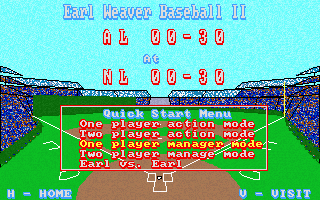
Despite those early software errors, the engine's core physics and mathematical modeling delivered an authentic simulation of major league play. If you want deep statistical management paired with direct tactical control, this MS-DOS game offers a sharp look at early 1990s sports engineering.
You can play Earl Weaver Baseball II online in your web browser right now
While static screenshots capture the detailed menus and field layouts, they miss the tension of setting an full count pitch with bases loaded in the ninth inning. You can experience that managerial pressure firsthand without digging out old floppy disks or setting up system files.
You can play Earl Weaver Baseball II online for free right here in your browser, with no setup required. Jump straight onto the bench, configure your team's tactical card, and see if your pitch sequences can outsmart Earl Weaver himself.
Players' controls
Touch and gamepad controls
The on-screen keyboard and gamepad mapping the browser player uses on a phone, a tablet or a controller, as opposed to the real keys above. $PRO members make their own in the player and share them here; anyone can pick one to play with.
Make your own touch controlsPRO
- 1Open the editorSign in below, then pick what to make. The game starts with the editor open over it.
- 2Place your keysAdd keys and drag them where your thumbs rest, or map a controller's buttons. Test plays the game with them; Save keeps them, and you play with them from then on.
- 3Share themShare them right after saving in the game, or name and share them here. Players vote, and the best become this game's controls for everyone.
Go PROSee how it worksSign in+20 XP for sharing · +50 XP if yours become the game's own
- The game's own controlsNone yet: played with a real keyboard only.In use
2 screenshots
From the archive
No gameplay video yet
No gameplay video for Earl Weaver Baseball II yet. Sign in to add one.
No reviews yet
Tell the community what you think of Earl Weaver Baseball II. Reviews are public and tied to your username.
No archived manuals for Earl Weaver Baseball II yet
No manuals archived for this title yet. Sign in to upload the first scan.
Cheat codes, console commands and memory pokes for Earl Weaver Baseball II — each one verified and attributed.
Sign in to submitNo cheats yet for this title
Know a working cheat, poke or trainer? Add it with the button above. Moderators check every entry before it goes live.
No archived soundtrack for Earl Weaver Baseball II yet
No soundtrack archived for this title yet. Sign in to upload the first rip.
No save states for Earl Weaver Baseball II yet
No save states for this title yet. Sign in to share one.
Discussions
Sign in to post- Threads0
- Total posts0
- Online now6
Community · Earl Weaver Baseball II
Who's contributing, and what's new
- Reviews0
- Threads0
- Uploadsapproved0
- Contributors0
Recent activity
Nothing here yet
Reviews, discussion threads and approved uploads appear here as members add them.