
Playing Ecstatica II means navigating a vast, treacherous castle built out of smooth 3D ellipsoids while fighting off an endless horde of demons and dark sorcerers.
You start as a nameless Prince returning home to get married, only to find the realm overrun by nightmare creatures. The land's chief sorcerer shattered the holy Elder Sign while dabbling in black magic, and its seven pieces lie scattered across a massive, sprawling castle grounds. Your job is to explore every inch of this world, retrieve the fragments, and stop the Archmage before he sacrifices Ecstatica.
The original game felt like a contained, surreal fairy tale, but this sequel expands into a massive, free-roaming fantasy setting. You navigate through a Prison Tower, deep Sewers, sprawling Catacombs, a Hunter's Lodge, and a treacherous Main Tower Maze. The engine uses fixed-point integer math to render its unique ellipsoid 3D characters in SVGA resolution, giving the graphics a distinct, rounded look.
A custom bytecode interpreter handles character AI and game scripting under the hood. While the visual tech upgraded significantly from the first release, Andrew Spencer Studios stripped away most of the bizarre, slapstick humor. The tone shifts heavily toward dark fantasy horror, replacing cheeky goblins with a genuinely oppressive atmosphere.
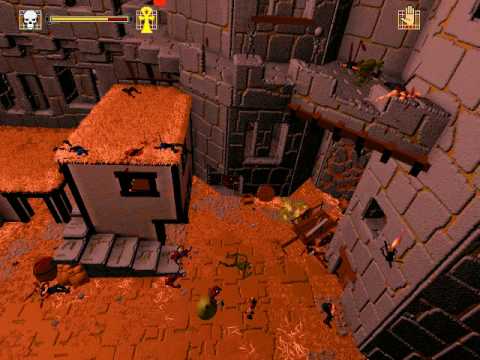
Your main threat throughout the realm comes from an unrelenting army of monsters. You fight off human barbarians, winged demons, floating squids, and drooling hunchbacks using swords, a Battle Axe, a Golden Sword, and magic staves. Magic scrolls let you cast offensive spells, but most encounters come down to brutal close-quarters melee combat.
The real enemy, however, is often the fixed camera system. As you move between pre-rendered scenes, shifting perspectives can suddenly reverse your directional inputs or completely obscure an incoming enemy attack. To survive, you must master the tank-style keyboard controls, carefully aligning your swings before an enemy gets close enough to trap you.
Enemy stuns present a massive hurdle for new players. If a group corners you, their strikes can hit in rapid succession, locking your character in a flinching loop until your health drops to zero. Getting through tight corridors requires pulling single enemies away from groups rather than charging blindly into room after room.
Shortly after launch, early players flooded forums and feedback channels complaining about the game's brutal design. Beyond the tricky camera, monsters respawn rapidly whenever you clear a screen and double back. Simple object-retrieval puzzles require backtracking through long corridors, forcing you to fight the exact same goblins and dark sorcerers over and over.
Publisher Psygnosis Limited realized the challenge was pushing casual players away. The developers added two easier difficulty options right before shipping physical copies to tone down the combat pacing. Even on lower settings, managing your health and positioning during heavy skirmishes demands intense concentration.
The original PC release was also notorious for a severe late-game bug. Later chapters contained a graphic rendering glitch that could freeze the engine completely, forcing players to wait for a patch file. The table below outlines how key technical features functioned on 1997 MS-DOS setups:

If you enjoy exploration, the sheer density of the map offers hours of discovery. Beyond the core quest to find the Elder Sign pieces, hidden doorways lead to bonus areas and obscure items. Dedicated explorers can even uncover a secret easter egg room dedicated entirely to creator Andrew Spencer.
This entry in the 1997 action space stands apart due to its art direction and sheer scale. While contemporary 3D titles pushed polygonal hardware, this series stuck to its curved mathematical shapes. The result is a distinct visual style that looks like nothing else from the mid-nineties.
It is a challenging project that tests your patience as much as your reflexes. The heavy control feel and shifting camera perspectives demand real commitment to master. Yet, clearing out a dangerous courtyard or solving a multi-stage lock puzzle delivers a genuine feeling of triumph.
You can play Ecstatica II online right now without downloading patches or setting up an emulator. The classic 1997 MS-DOS game runs directly in your web browser with simple one-click access.
When you start your adventure, take a few minutes in the opening courtyard to get comfortable with the tank movement controls. Practice drawing your sword and stepping backward before taking on larger groups of goblins. Once you master the combat rhythm, you can explore the castle depths free in your browser today.
Playing Ecstatica II means navigating a vast, treacherous castle built out of smooth 3D ellipsoids while fighting off an endless horde of demons and dark sorcerers.
You start as a nameless Prince returning home to get married, only to find the realm overrun by nightmare creatures. The land's chief sorcerer shattered the holy Elder Sign while dabbling in black magic, and its seven pieces lie scattered across a massive, sprawling castle grounds. Your job is to explore every inch of this world, retrieve the fragments, and stop the Archmage before he sacrifices Ecstatica.
The original game felt like a contained, surreal fairy tale, but this sequel expands into a massive, free-roaming fantasy setting. You navigate through a Prison Tower, deep Sewers, sprawling Catacombs, a Hunter's Lodge, and a treacherous Main Tower Maze. The engine uses fixed-point integer math to render its unique ellipsoid 3D characters in SVGA resolution, giving the graphics a distinct, rounded look.
A custom bytecode interpreter handles character AI and game scripting under the hood. While the visual tech upgraded significantly from the first release, Andrew Spencer Studios stripped away most of the bizarre, slapstick humor. The tone shifts heavily toward dark fantasy horror, replacing cheeky goblins with a genuinely oppressive atmosphere.

Your main threat throughout the realm comes from an unrelenting army of monsters. You fight off human barbarians, winged demons, floating squids, and drooling hunchbacks using swords, a Battle Axe, a Golden Sword, and magic staves. Magic scrolls let you cast offensive spells, but most encounters come down to brutal close-quarters melee combat.
The real enemy, however, is often the fixed camera system. As you move between pre-rendered scenes, shifting perspectives can suddenly reverse your directional inputs or completely obscure an incoming enemy attack. To survive, you must master the tank-style keyboard controls, carefully aligning your swings before an enemy gets close enough to trap you.
Enemy stuns present a massive hurdle for new players. If a group corners you, their strikes can hit in rapid succession, locking your character in a flinching loop until your health drops to zero. Getting through tight corridors requires pulling single enemies away from groups rather than charging blindly into room after room.
Shortly after launch, early players flooded forums and feedback channels complaining about the game's brutal design. Beyond the tricky camera, monsters respawn rapidly whenever you clear a screen and double back. Simple object-retrieval puzzles require backtracking through long corridors, forcing you to fight the exact same goblins and dark sorcerers over and over.
Publisher Psygnosis Limited realized the challenge was pushing casual players away. The developers added two easier difficulty options right before shipping physical copies to tone down the combat pacing. Even on lower settings, managing your health and positioning during heavy skirmishes demands intense concentration.
The original PC release was also notorious for a severe late-game bug. Later chapters contained a graphic rendering glitch that could freeze the engine completely, forcing players to wait for a patch file. The table below outlines how key technical features functioned on 1997 MS-DOS setups:

If you enjoy exploration, the sheer density of the map offers hours of discovery. Beyond the core quest to find the Elder Sign pieces, hidden doorways lead to bonus areas and obscure items. Dedicated explorers can even uncover a secret easter egg room dedicated entirely to creator Andrew Spencer.
This entry in the 1997 action space stands apart due to its art direction and sheer scale. While contemporary 3D titles pushed polygonal hardware, this series stuck to its curved mathematical shapes. The result is a distinct visual style that looks like nothing else from the mid-nineties.
It is a challenging project that tests your patience as much as your reflexes. The heavy control feel and shifting camera perspectives demand real commitment to master. Yet, clearing out a dangerous courtyard or solving a multi-stage lock puzzle delivers a genuine feeling of triumph.
You can play Ecstatica II online right now without downloading patches or setting up an emulator. The classic 1997 MS-DOS game runs directly in your web browser with simple one-click access.
When you start your adventure, take a few minutes in the opening courtyard to get comfortable with the tank movement controls. Practice drawing your sword and stepping backward before taking on larger groups of goblins. Once you master the combat rhythm, you can explore the castle depths free in your browser today.
How Ecstatica II is played — the keys the game listens to, grouped by what they do.
Highlighted keys are mapped — hover or tap one to see what it does.
Character movement uses the standard cursor keys rather than the numeric keypad layout used in the first game.
The on-screen keyboard and gamepad mapping the browser player uses on a phone, a tablet or a controller, as opposed to the real keys above. $PRO members make their own in the player and share them here; anyone can pick one to play with.
Cheat codes, console commands and memory pokes for Ecstatica II — each one verified and attributed.
Sign in to submitHow Ecstatica II is played — the keys the game listens to, grouped by what they do.
Highlighted keys are mapped — hover or tap one to see what it does.
Character movement uses the standard cursor keys rather than the numeric keypad layout used in the first game.
The on-screen keyboard and gamepad mapping the browser player uses on a phone, a tablet or a controller, as opposed to the real keys above. $PRO members make their own in the player and share them here; anyone can pick one to play with.
Cheat codes, console commands and memory pokes for Ecstatica II — each one verified and attributed.
Sign in to submit