


Trapped in the damp courtyard of Killbragant Castle, playing Elvira: Mistress of the Dark means learning the hard way that every unexamined door or clumsy swing of a sword ends with a grisly trip to the game over screen.
Killbragant Castle turns every step into a trial by blood
You drop into Killbragant Castle with zero ceremony. You are an unnamed protagonist summoned by the Mistress of the Dark herself to stop her ancestor, the evil witch Emelda, from clawing her way back into the realm of the living. Her undead army has overrun the estate, and the horror begins the instant you look around the first room from a grid-based, flip-screen first-person perspective. There are no navigational hand-rails, no minimaps, and no graceful tutorial steps to ease you into the nightmare.
Every turn presents a dense static viewport framed by interactive icons. You click to step forward, pivot ninety degrees, or rummage through dusty stone altars and rotting chests. Exploration spans a sprawling property: gloomy courtyard grounds, draughty turrets, claustrophobic dungeons, subterranean catacombs, and a hedge maze in the garden that has driven thousands of map-makers to tears. Finding key items like rusty keys, silver daggers, or obscure herbs is mandatory if you want to make any forward progress.
Progress is constantly blocked by puzzles rooted in brutal trial and error. Forget logic that lets you slide through on intuition; if you drink an unlabelled potion or pick up a cursed relic without reading the fine print, you simply collapse dead on the flagstones. Navigating the fortress requires saving your progress on every fresh tile and keeping a physical notebook by your keyboard.
Real-time combat in this MS-DOS game will ruin your evening
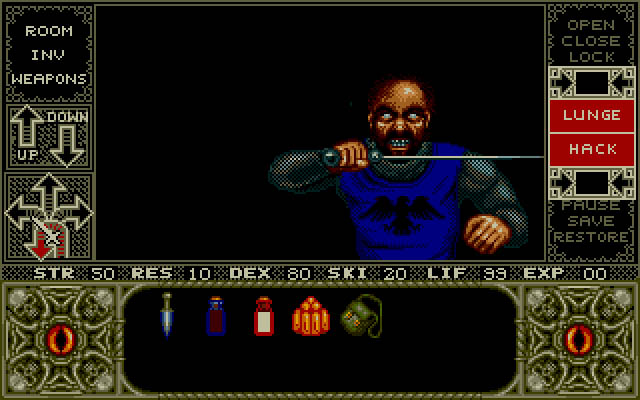
Most first-person crawlers of 1990 allowed turn-based tactical planning, but developer Horror Soft Ltd. took a far more aggressive route. Encountering an enemy switches the display into a real-time battle where monstrous guards, skeletal knights, and mutated beastmen slash at you without pause. You have to actively toggle between attacking and parrying, watching your enemy's wind-up animation to shield yourself before counter-striking.
The combat interface is infamous for its lack of mercy. Hitboxes feel narrow, stamina drains rapidly, and missing a parry by half a second usually results in losing half your health bar. To survive the tougher encounters deeper in the catacombs, you cannot rely on steel alone. You must forage for obscure ingredients across the castle grounds and bring them to Elvira’s cauldron to mix magical spells that offer defensive buffs or direct elemental damage.
Despite the ferocious difficulty wall, critics were captivated by the scale. When Dragon reviewed the game in 1991, they awarded it 4 out of 5 stars, writing that its sprawling vastness of 800 rooms was well worth the purchase price. Computer Gaming World went even further, crowning it Role-Playing Game of the Year in November 1991. The contrast between high critical acclaim and player frustration comes down to patience: those who enjoyed mapping massive layouts loved it, while those expecting slick hack-and-slash action ran straight into a wall.
Horror Soft built a legend on an engine meant for MUDs
The technical backbone of this 1990 release by publisher Accolade, Inc. is an fascinating piece of engineering. Design leads Alan Bridgman, Keith Wadhams, Michael Woodroffe, and Simon Woodroffe constructed the title using the AGOS engine. This toolset was originally developed as a graphical extension of AberMUD, a text-based multi-user dungeon platform created by Alan Cox. Adapting a text parser engine into a point-and-click horror crawler gave the game its unusually rich world interaction, letting players inspect and collect an astonishing array of small environmental props.
This tech stack extended well beyond one castle. Horror Soft refined the formula for two subsequent releases: the direct sequel Elvira II: The Jaws of Cerberus and their atmospheric spiritual successor Waxworks. All three games share the same signature combination of heavy inventory management, flip-screen navigation, and uncompromising visual splatter.
The gruesome price of failure in Elvira: Mistress of the Dark
If there is one aspect fans still talk about decades later, it is the spectacular gore reserved for death scenes. When your health hits zero, the game does not simply display a polite failure text. Instead, you are treated to custom, highly detailed animations illustrating your hero's unpleasant demise. If you fall to the undead cook in the castle kitchen, the screen cuts to your severed head bobbing quietly inside her boiling cauldron. Triggers elsewhere cause your character to be impaled, melted, or dissolved in acid.
This willingness to shock made a huge impression on contemporary reviewers. While Computer and Video Games gave the 1990 PC release an 84% score and praised its oppressive atmosphere, they explicitly warned that the combat timing was frustratingly stiff. Modern retro reviews echo those same points: the thick horror charm and crisp digitised sound effects are matched by an interface that feels stiff and puzzle design that gives zero warning before killing you outright.
Surviving requires a strict routine:
- Map every room manually on graph paper so you never lose your bearings in the maze.
- Save before opening any chest, drinking any liquid, or stepping into a new doorway.
- Gather every loose ingredient scattered across floors to keep Elvira's cauldron stocked with spell components.
- Study combat animations closely to learn exactly when a monster transitions from idle to an active attack frame.
Step back inside Killbragant Castle right now
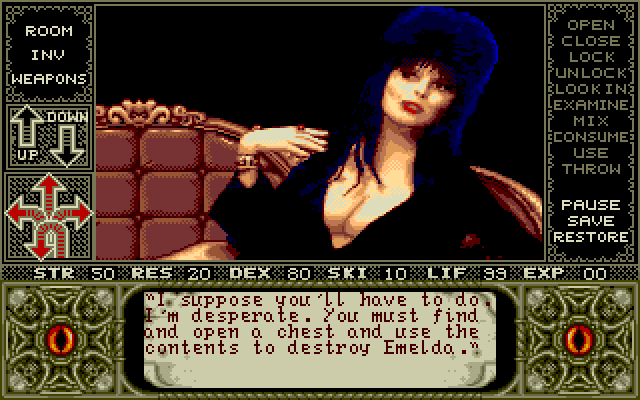
Nothing matches the tension of stepping through those creaking castle gates, listening to the ambient sound design on a simulated PC speaker, and praying that the next door does not hide a trap door or a spectral knight. The high-resolution digitised graphics of Elvira herself and the shock value of the death screens still hold their punch, providing a fascinating look at how late-eighties adventure design collided with real-time combat systems.
If you want to experience this classic action-adventure without digging through floppy disk images, you can launch Elvira: Mistress of the Dark free in your browser right now. If you want to play Elvira: Mistress of the Dark online, it runs in a single click with no setup required. Start charting those dungeon corridors, and try your absolute best to keep your head out of the cook's cauldron.
How Elvira: Mistress of the Dark is played — the keys the game listens to, grouped by what they do.
- Movement
- Action
- Interface
Highlighted keys are mapped — hover or tap one to see what it does.
The mouse is the primary control method, with keyboard arrow navigation offered as an alternative. Keyboard control details are limited in accessible documentation.
Players' controls
Touch and gamepad controls
The on-screen keyboard and gamepad mapping the browser player uses on a phone, a tablet or a controller, as opposed to the real keys above. $PRO members make their own in the player and share them here; anyone can pick one to play with.
Make your own touch controlsPRO
- 1Open the editorSign in below, then pick what to make. The game starts with the editor open over it.
- 2Place your keysAdd keys and drag them where your thumbs rest, or map a controller's buttons. Test plays the game with them; Save keeps them, and you play with them from then on.
- 3Share themShare them right after saving in the game, or name and share them here. Players vote, and the best become this game's controls for everyone.
Go PROSee how it worksSign in+20 XP for sharing · +50 XP if yours become the game's own
- The game's own controlsKeyboardGamepadWhat every player starts with.In use
3 screenshots
From the archive
No gameplay video yet
No gameplay video for Elvira: Mistress of the Dark yet. Sign in to add one.
No reviews yet
Tell the community what you think of Elvira: Mistress of the Dark. Reviews are public and tied to your username.
No archived manuals for Elvira: Mistress of the Dark yet
No manuals archived for this title yet. Sign in to upload the first scan.
Cheat codes, console commands and memory pokes for Elvira: Mistress of the Dark — each one verified and attributed.
Sign in to submitNo cheats yet for this title
Know a working cheat, poke or trainer? Add it with the button above. Moderators check every entry before it goes live.
No archived soundtrack for Elvira: Mistress of the Dark yet
No soundtrack archived for this title yet. Sign in to upload the first rip.
No save states for Elvira: Mistress of the Dark yet
No save states for this title yet. Sign in to share one.
Discussions
Sign in to post- Threads0
- Total posts0
- Online now6
Community · Elvira: Mistress of the Dark
Who's contributing, and what's new
- Reviews0
- Threads0
- Uploadsapproved0
- Contributors0
Recent activity
Nothing here yet
Reviews, discussion threads and approved uploads appear here as members add them.