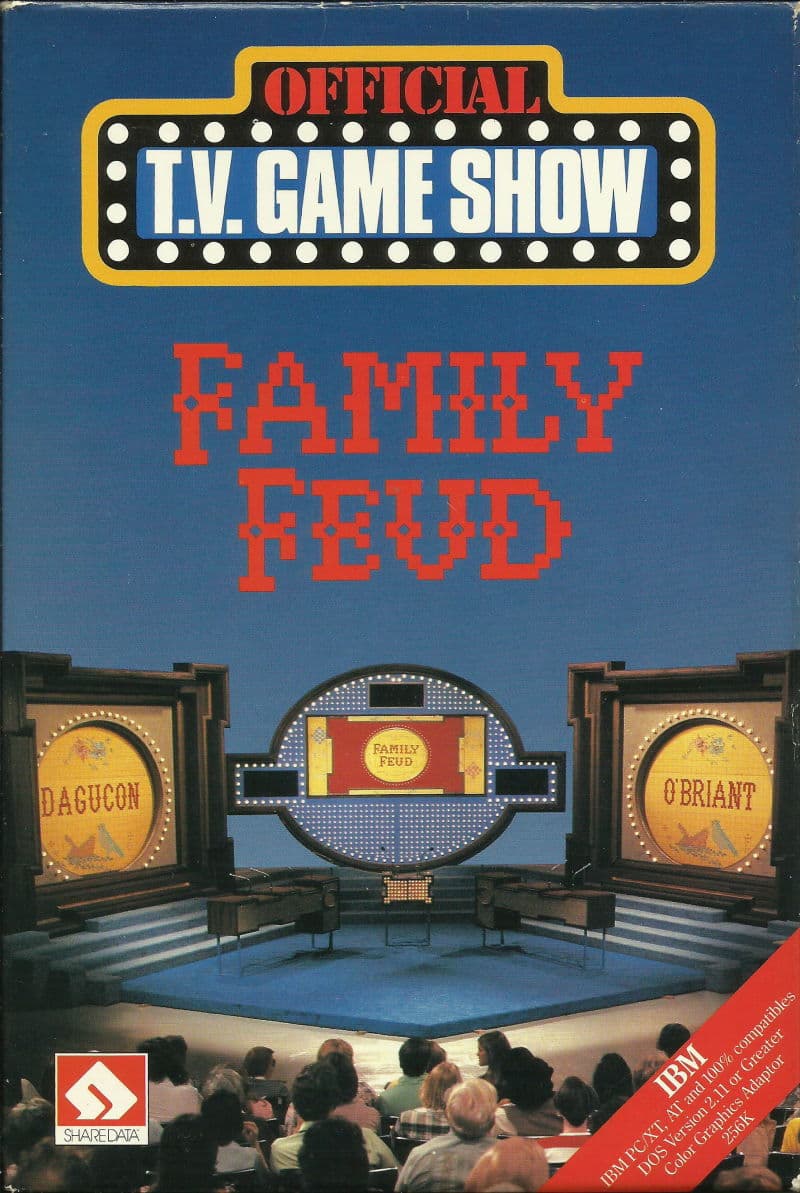
Long before modern quiz games managed full speech synthesis and broadcast graphics, the 1987 release of Family Feud brought the television studio home through blocky text and PC speaker beeps. You type in survey responses to match what a hundred polled citizens thought, trying to outscore a opposing family before the final clock runs out.
Launching Family Feud on a system built in 1987 delivers a specific kind of quiet tension. Five family members line up against five opponents, controlled either by a roomful of friends sitting around one keyboard or by an artificial intelligence team. The prompt asks what people bring to a picnic or what job requires working late, and you have to type an exact match for the survey results within seconds.
The core structure mirrors the classic television layout across three primary rounds. The first team to hit the buzzer gets the opportunity to play or pass, after which each family member takes turns guessing the hidden answers on the board. Get three strikes by typing responses that fail to match the top hundred responses, and control flips instantly to the rival family for a single steal opportunity.
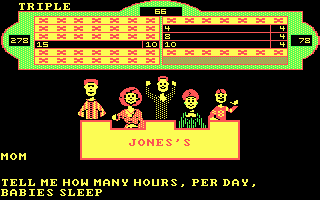
Because input relies entirely on text entry, precision matters immensely. If you miss a keyword by phrasing your response too casually, the game registers a strike without mercy. Navigating those text fields demands quick keyboard work, making every round a race against your own vocabulary and spelling speed.
While the initial matches offer genuine friction between human opponents, the long-term bank of survey questions suffers from strict limitations. Play through a handful of sessions, and you will notice the exact same prompts appearing again. Once you know that fifty people said "flashlight" for a specific prompt, the competitive edge shifts from general trivia knowledge to simple memory retrieval.
This repeating pool of survey data remains the biggest flaw of this early version. The graphics stay basic and purely functional, which fits an early text-driven title, but the lack of dynamic or expanded question sets hampers extended play sessions. When you play against a computer-controlled team, the artificial intelligence can occasionally feel rigid, either guessing top answers with robotic precision or missing obvious entries entirely.
Despite those quirks, the mechanical transfer of the broadcast format works. As an entry in the broader catalog of educational games of the era, it leans far more into party competition than classroom instruction. It expects players to understand popular consensus rather than textbook facts, which gives it a distinct rhythm compared to standard trivia software of the decade.
Reaching the end of the third round opens the signature finale: the Fast-Money round. Two representatives from the leading family step up to answer five consecutive survey prompts under a tight countdown timer. The first player types out five quick answers before the time limit expires, and then the second player must provide alternate responses to the exact same five questions without duplicating what their teammate already chose.
The scoring system ramps up during this phase. Accumulating two hundred total points across both players secures the match victory. The tick of the timer combined with the hazard of entering a duplicate answer creates the most urgent moments in the entire design. A single slip on the keyboard during Fast-Money can ruin a massive lead built up over the preceding three rounds.
Managing the keyboard between two players on one computer adds an extra layer of physical chaotic fun. Passing the seat while trying not to clear the prompt window requires fast handoffs. That physical hustle around a desktop monitor is where the multiplayer setup shines brightest.
The conversion of this broadcast property to home computers went through a few hands. Action Graphics originally developed the underlying structure for the Coleco Adam system before developer Softie, Inc. adapted the project into a proper ShareData, Inc. release for PC hardware. Softie later returned to the property in 1989 to produce The All New Family Feud, which upgraded the presentation with EGA color schemes and extra audio routines.
The original MS-DOS disk release relies entirely on CGA display modes and minimalist internal PC speaker sound effects. The audio offers little beyond basic buzzes for wrong answers and rising chimes for correct board hits. Yet that bare-bones presentation allowed the software to boot smoothly on minimal memory configurations, making it accessible to practically any home PC owner at the time.
Comparing this build to other trivia adaptations of the late eighties shows how tightly focused the underlying code was on the broadcast rules. There are no extra minigames or unnecessary board movements to slow down the pace. You open the file, set the family names, and jump straight into guessing survey statistics.
The 1987 release is a direct adaptation of game show mechanics that works best when played with a second person sitting right next to you. The question repetitions will eventually show up, but for a fast match, the core cycle of guessing population statistics keeps you hooked. If you want to see how home computers handled television licenses on the early PC, this title gives you the raw experience.
You can try this classic Family Feud MS-DOS game straight from your web browser without hunting down ancient floppy disks. If you want to play Family Feud online right now, you can launch the full Family Feud free in your browser right on this page with nothing to install and zero setup required. Jump into the main menu, pick your family roster, and see if you can hit two hundred points in the Fast-Money round on your very first try.
Long before modern quiz games managed full speech synthesis and broadcast graphics, the 1987 release of Family Feud brought the television studio home through blocky text and PC speaker beeps. You type in survey responses to match what a hundred polled citizens thought, trying to outscore a opposing family before the final clock runs out.
Launching Family Feud on a system built in 1987 delivers a specific kind of quiet tension. Five family members line up against five opponents, controlled either by a roomful of friends sitting around one keyboard or by an artificial intelligence team. The prompt asks what people bring to a picnic or what job requires working late, and you have to type an exact match for the survey results within seconds.
The core structure mirrors the classic television layout across three primary rounds. The first team to hit the buzzer gets the opportunity to play or pass, after which each family member takes turns guessing the hidden answers on the board. Get three strikes by typing responses that fail to match the top hundred responses, and control flips instantly to the rival family for a single steal opportunity.

Because input relies entirely on text entry, precision matters immensely. If you miss a keyword by phrasing your response too casually, the game registers a strike without mercy. Navigating those text fields demands quick keyboard work, making every round a race against your own vocabulary and spelling speed.
While the initial matches offer genuine friction between human opponents, the long-term bank of survey questions suffers from strict limitations. Play through a handful of sessions, and you will notice the exact same prompts appearing again. Once you know that fifty people said "flashlight" for a specific prompt, the competitive edge shifts from general trivia knowledge to simple memory retrieval.
This repeating pool of survey data remains the biggest flaw of this early version. The graphics stay basic and purely functional, which fits an early text-driven title, but the lack of dynamic or expanded question sets hampers extended play sessions. When you play against a computer-controlled team, the artificial intelligence can occasionally feel rigid, either guessing top answers with robotic precision or missing obvious entries entirely.
Despite those quirks, the mechanical transfer of the broadcast format works. As an entry in the broader catalog of educational games of the era, it leans far more into party competition than classroom instruction. It expects players to understand popular consensus rather than textbook facts, which gives it a distinct rhythm compared to standard trivia software of the decade.
Reaching the end of the third round opens the signature finale: the Fast-Money round. Two representatives from the leading family step up to answer five consecutive survey prompts under a tight countdown timer. The first player types out five quick answers before the time limit expires, and then the second player must provide alternate responses to the exact same five questions without duplicating what their teammate already chose.
The scoring system ramps up during this phase. Accumulating two hundred total points across both players secures the match victory. The tick of the timer combined with the hazard of entering a duplicate answer creates the most urgent moments in the entire design. A single slip on the keyboard during Fast-Money can ruin a massive lead built up over the preceding three rounds.

Managing the keyboard between two players on one computer adds an extra layer of physical chaotic fun. Passing the seat while trying not to clear the prompt window requires fast handoffs. That physical hustle around a desktop monitor is where the multiplayer setup shines brightest.
The conversion of this broadcast property to home computers went through a few hands. Action Graphics originally developed the underlying structure for the Coleco Adam system before developer Softie, Inc. adapted the project into a proper ShareData, Inc. release for PC hardware. Softie later returned to the property in 1989 to produce The All New Family Feud, which upgraded the presentation with EGA color schemes and extra audio routines.
The original MS-DOS disk release relies entirely on CGA display modes and minimalist internal PC speaker sound effects. The audio offers little beyond basic buzzes for wrong answers and rising chimes for correct board hits. Yet that bare-bones presentation allowed the software to boot smoothly on minimal memory configurations, making it accessible to practically any home PC owner at the time.
Comparing this build to other trivia adaptations of the late eighties shows how tightly focused the underlying code was on the broadcast rules. There are no extra minigames or unnecessary board movements to slow down the pace. You open the file, set the family names, and jump straight into guessing survey statistics.
The 1987 release is a direct adaptation of game show mechanics that works best when played with a second person sitting right next to you. The question repetitions will eventually show up, but for a fast match, the core cycle of guessing population statistics keeps you hooked. If you want to see how home computers handled television licenses on the early PC, this title gives you the raw experience.
You can try this classic Family Feud MS-DOS game straight from your web browser without hunting down ancient floppy disks. If you want to play Family Feud online right now, you can launch the full Family Feud free in your browser right on this page with nothing to install and zero setup required. Jump into the main menu, pick your family roster, and see if you can hit two hundred points in the Fast-Money round on your very first try.
The on-screen keyboard and gamepad mapping the browser player uses on a phone, a tablet or a controller, as opposed to the real keys above. $PRO members make their own in the player and share them here; anyone can pick one to play with.
Cheat codes, console commands and memory pokes for Family Feud — each one verified and attributed.
Sign in to submitThe on-screen keyboard and gamepad mapping the browser player uses on a phone, a tablet or a controller, as opposed to the real keys above. $PRO members make their own in the player and share them here; anyone can pick one to play with.
Cheat codes, console commands and memory pokes for Family Feud — each one verified and attributed.
Sign in to submit