


Fragile Allegiance
Streaming build
Checking storage…528 MB
Preload in background
In Fragile Allegiance, you begin your career as a corporate middle manager for TetraCorp, tasked with turning bare asteroid craters into profitable mining hubs while keeping aggressive alien rivals from blowing your operations into dust.
TetraCorp does not care about your survival, only your bottom line
The campaign kicks off on May 25, 2496, dropping you into the Fragmented Sectors with a single bare asteroid and a quota to fill. Developed by Gremlin Interactive Ltd. as an expanded successor to their 1994 Amiga game K240, this 1996 release swaps traditional fantasy empire building for cold, balance-sheet survival. You lay down life-support grids, clear crater space, and construct living quarters, power plants, hydroponics bays, and radiation filters just to keep your workers breathing.
Once your basic colony stops choking on vacuum, the real job begins: extracting up to 12 distinct ores, including Traxium and Barium, from the rock beneath your feet. You do not store wealth in an abstract treasury, because every ton of raw material sits in your silos until the Federal Ore Transporter arrives to buy your haul. If you miscalculate your power draw or forget to build enough storage before the transport docks, your income halts instantly, leaving your expansion stranded.
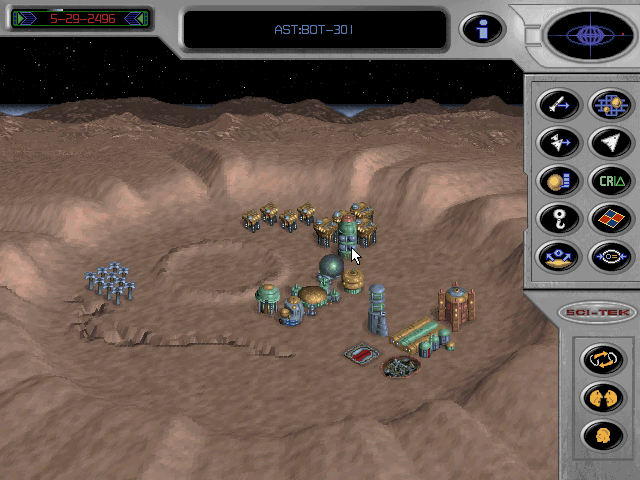
Fragile Allegiance trades tech trees for corporate blueprint shopping
Most real-time strategy and tactics games of the era forced you to wait out long research timers to unlock new hardware. In Fragile Allegiance, progress is purely transactional: you purchase 36 individual blueprints directly from the market whenever your corporate account can afford them. If you need advanced missiles or specialized defense grids immediately, you buy the schematics and start production on the spot.
This economic focus extends to your interactions with the six rival alien factions sharing the sector. Diplomatic screens trigger fully animated, voice-acted alien representatives who react in real time to your proposals. You can sign non-aggression pacts, form joint combat treaties, or quietly hire covert agents to handle what diplomacy cannot.
A typical espionage strategy involves sending spies to sabotage an opponent's life-support filters or buying restricted military gear on the black market behind TetraCorp's back. When dealing with overtly aggressive neighbors like the Mauna, peaceful negotiation rarely lasts, making clandestine sabotage essential before open war breaks out.
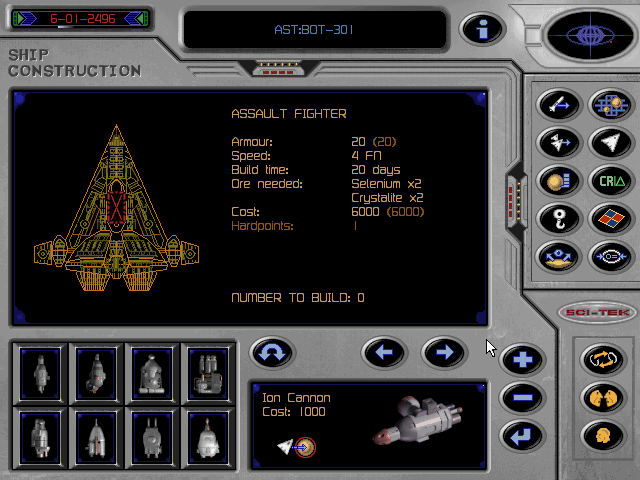
Attaching rocket engines to rocks turns asteroid mining into heavy artillery
When diplomatic channels fail, combat in this Gremlin Interactive title takes on a brutal, physical presence. Ships are customizable, but the real star of your arsenal is the missile silo array. You load launches with specialized warheads tailored to specific tactical problems:
- Nuclear warheads for raw structural destruction across crater grids
- Incendiary and freezing payloads to disable delicate base systems
- Bio-infectious strikes designed to wipe out worker populations cleanly
- EMP warheads to drop defense shields before a fleet movement
- Seismic warheads built specifically to shatter minor celestial bodies
Your best tactical move comes after an asteroid is mined clean. Instead of abandoning the dead rock, you bolt massive engine thrusters onto its crust and pilot the entire asteroid directly into an enemy base. Watching a spent mining colony flatten a rival installation in real time never gets old.
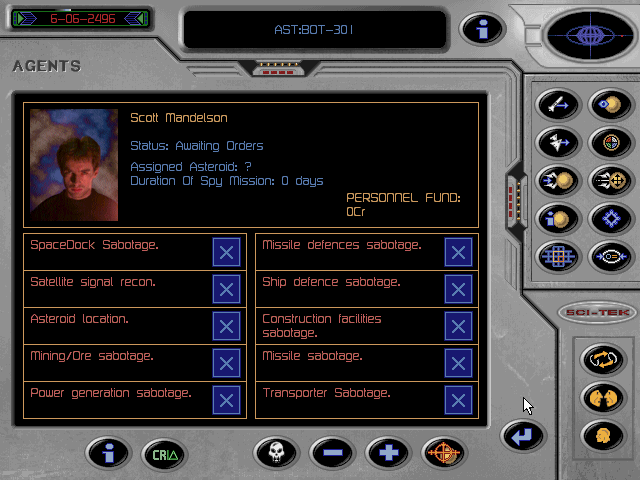
Where this Fragile Allegiance MS-DOS game stumbles under corporate pressure
The top-down perspective keeps every crater visible, but the interface demands serious patience. Navigating multiple asteroids through nested icon menus takes time to master, and the learning curve hits hard during your first few encounters. I found that losing a single critical power plant early on can trigger a domino collapse across your entire colony before you even notice the warning light.
Reviewers at the time picked up on this deliberate pacing. GameSpot praised the tactical depth and the visual detail of watching warheads zip out of silos across space, but accurately noted its slower operational flow. Meanwhile, PC Gamer UK handed it a Game of Distinction award for its crisp SVGA visuals and clean sound presentation.
If you played it on original hardware, you likely remember how unforgiving the stability could be when porting save files to later systems like Windows XP. The real-time simulation runs complex underlying calculations for every life-support filter, ore transport schedule, and agent contract simultaneously. That depth makes victory deeply rewarding, but a sudden system crash after an hour of unchecked expansion teaches you to save often.
Fire up your asteroid colony and play today
Despite its initial learning curve, the mix of corporate accounting, orbital espionage, and kinetic asteroid warfare holds up well. Deciding whether to sell your ore haul to fund missile blueprints or invest in a fleet of heavy transports creates tight, ongoing tension throughout every match.
You can play Fragile Allegiance online free in your browser right now, with no setup required. When you start your first sector, build your hydroponics and life-support units close to your main power core, secure an ore contract immediately, and keep a close eye on the Mauna border before mounting your first asteroid engines.
How Fragile Allegiance is played — the keys the game listens to, grouped by what they do.
- Interface
Highlighted keys are mapped — hover or tap one to see what it does.
Fragile Allegiance is primarily controlled via a point-and-select mouse interface.
Players' controls
Touch and gamepad controls
The on-screen keyboard and gamepad mapping the browser player uses on a phone, a tablet or a controller, as opposed to the real keys above. $PRO members make their own in the player and share them here; anyone can pick one to play with.
Make your own touch controlsPRO
- 1Open the editorSign in below, then pick what to make. The game starts with the editor open over it.
- 2Place your keysAdd keys and drag them where your thumbs rest, or map a controller's buttons. Test plays the game with them; Save keeps them, and you play with them from then on.
- 3Share themShare them right after saving in the game, or name and share them here. Players vote, and the best become this game's controls for everyone.
Go PROSee how it worksSign in+20 XP for sharing · +50 XP if yours become the game's own
- The game's own controlsKeyboardGamepadWhat every player starts with.In use
4 screenshots
From the archive
No gameplay video yet
No gameplay video for Fragile Allegiance yet. Sign in to add one.
No reviews yet
Tell the community what you think of Fragile Allegiance. Reviews are public and tied to your username.
No archived manuals for Fragile Allegiance yet
No manuals archived for this title yet. Sign in to upload the first scan.
Cheat codes, console commands and memory pokes for Fragile Allegiance — each one verified and attributed.
Sign in to submitNo cheats yet for this title
Know a working cheat, poke or trainer? Add it with the button above. Moderators check every entry before it goes live.
No archived soundtrack for Fragile Allegiance yet
No soundtrack archived for this title yet. Sign in to upload the first rip.
No save states for Fragile Allegiance yet
No save states for this title yet. Sign in to share one.
Discussions
Sign in to post- Threads0
- Total posts0
- Online now6
Community · Fragile Allegiance
Who's contributing, and what's new
- Reviews0
- Threads0
- Uploadsapproved0
- Contributors0
Recent activity
Nothing here yet
Reviews, discussion threads and approved uploads appear here as members add them.