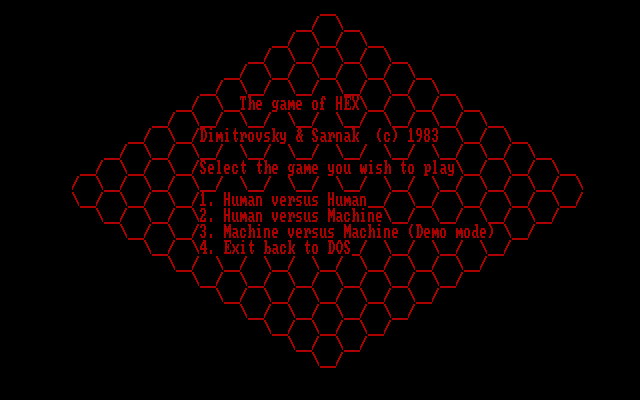
Playing Hex on an early IBM PC means staring down an 11x11 grid where a single misplaced turn snaps your supply line forever. Released in 1983 as part of PC Disk Magazine, this digital version brings Piet Hein and John Nash's mathematical board game straight to MS-DOS text modes.
In 1983, developers Neil Sarnak and Isaac Dimitrovsky adapted the abstract board game for PC hardware. The rules take ten seconds to learn. You and your opponent take turns placing one stone at a time onto an 11x11 diamond grid composed of hexagonal cells.
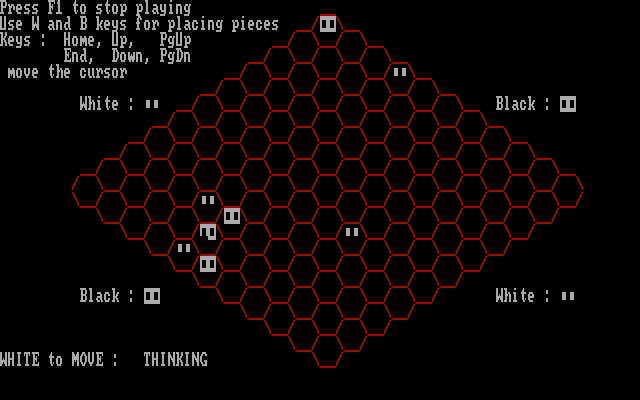
White seeks to connect the top-left and bottom-right edges with a chain of pieces. Black attempts to build a continuous path between the top-right and bottom-left edges. Because hex cells share six borders instead of four, paths can curve around blocks in ways standard square grids never allow.
The mathematical design guarantees that a draw is impossible. One player must eventually form an unbroken bridge across the board. Every empty cell you pick denies space to your rival while simultaneously extending your own network.
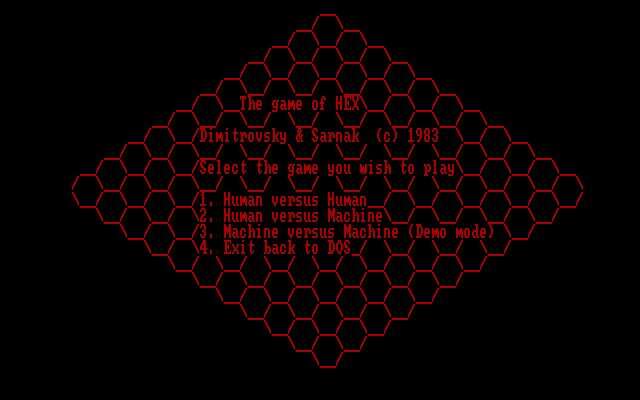
When you launch the executable, you choose between human matches, facing the computer, or running a demo mode where two artificial intelligence routines battle each other. Watching the demo mode run at full speed reveals how quickly the computer identifies weak connections.
In human versus machine mode, the program forces you to think three moves ahead. Early turns look harmless as both sides drop single pieces across opposite ends of the board. The real trap sits in the middle ground, where virtual skirmishes form over crucial diagonal intersections.
If you drop a stone too far from your main grouping, the AI cuts your line in two moves. You cannot capture enemy pieces or push them off the board. Once a cell is occupied, that position remains locked for the rest of the game.
Bad turns stack up rapidly. Placing a piece one hex off target often hands your opponent an unblockable path across the board before you even realize you are in trouble.
Ziff-Davis shipped the software inside volume one, number three of PC Disk Magazine. While many disk magazine titles were simple utility scripts, this release offered a complete strategy game written by Dimitrovsky & Sarnak.
The display relies on standard character rendering to draw the hexagonal grid on green or monochrome PC monitors. ASCII symbols and simple block characters differentiate player stones, keeping the screen clean and legible.
You will not hear elaborate Sound Blaster tunes here. Sound design is restricted to the basic PC speaker, emitting short chirps when keypresses register or when a match concludes.
The interface relies entirely on keyboard inputs to select row and column coordinates. Typing your move requires careful checking, as entering the wrong cell reference instantly places your piece on the board with no undo prompt.
Despite its crisp execution, the 1983 release suffers from a structural flaw inherited from the base game's simplest setup. White moves first, and on an 11x11 grid, first-player advantage is massive without the standard swap rule.
The board game community solved this imbalance years earlier with the pie rule, where player two can elect to steal player one's first move. The digital version omits this option completely. If you play White against a human friend, you hold a severe theoretical edge from move one.
The absence of a move confirmation step also leads to frustrating miskeys. Hitting the enter key on an intended coordinate can easily ruin a thirty-minute match if your finger slips by one key.
Furthermore, the computer AI operates on basic heuristic checks rather than deep lookahead trees. Experienced players will eventually spot predictable patterns in how the machine defends its borders, softening the challenge after a few dozen rounds.
This 1983 translation gives you pure tactical puzzles without unnecessary fluff. It strips away story elements and flash in favor of raw geometric competition that demands your full attention.
If you enjoy classic board translations from 1983, this title delivers a fast, uncompromising session of territorial control. It captures the quiet tension of tabletop gaming in a small package.
You can play Hex online right now, fully free in your browser. There is nothing to install and no complex software setup required. Fire up a match, watch out for sneaky diagonal cuts from the computer player, and see if you can construct an unbroken path across the board.
Playing Hex on an early IBM PC means staring down an 11x11 grid where a single misplaced turn snaps your supply line forever. Released in 1983 as part of PC Disk Magazine, this digital version brings Piet Hein and John Nash's mathematical board game straight to MS-DOS text modes.
In 1983, developers Neil Sarnak and Isaac Dimitrovsky adapted the abstract board game for PC hardware. The rules take ten seconds to learn. You and your opponent take turns placing one stone at a time onto an 11x11 diamond grid composed of hexagonal cells.
White seeks to connect the top-left and bottom-right edges with a chain of pieces. Black attempts to build a continuous path between the top-right and bottom-left edges. Because hex cells share six borders instead of four, paths can curve around blocks in ways standard square grids never allow.
The mathematical design guarantees that a draw is impossible. One player must eventually form an unbroken bridge across the board. Every empty cell you pick denies space to your rival while simultaneously extending your own network.
When you launch the executable, you choose between human matches, facing the computer, or running a demo mode where two artificial intelligence routines battle each other. Watching the demo mode run at full speed reveals how quickly the computer identifies weak connections.
In human versus machine mode, the program forces you to think three moves ahead. Early turns look harmless as both sides drop single pieces across opposite ends of the board. The real trap sits in the middle ground, where virtual skirmishes form over crucial diagonal intersections.
If you drop a stone too far from your main grouping, the AI cuts your line in two moves. You cannot capture enemy pieces or push them off the board. Once a cell is occupied, that position remains locked for the rest of the game.
Bad turns stack up rapidly. Placing a piece one hex off target often hands your opponent an unblockable path across the board before you even realize you are in trouble.

Ziff-Davis shipped the software inside volume one, number three of PC Disk Magazine. While many disk magazine titles were simple utility scripts, this release offered a complete strategy game written by Dimitrovsky & Sarnak.
The display relies on standard character rendering to draw the hexagonal grid on green or monochrome PC monitors. ASCII symbols and simple block characters differentiate player stones, keeping the screen clean and legible.
You will not hear elaborate Sound Blaster tunes here. Sound design is restricted to the basic PC speaker, emitting short chirps when keypresses register or when a match concludes.
The interface relies entirely on keyboard inputs to select row and column coordinates. Typing your move requires careful checking, as entering the wrong cell reference instantly places your piece on the board with no undo prompt.
Despite its crisp execution, the 1983 release suffers from a structural flaw inherited from the base game's simplest setup. White moves first, and on an 11x11 grid, first-player advantage is massive without the standard swap rule.
The board game community solved this imbalance years earlier with the pie rule, where player two can elect to steal player one's first move. The digital version omits this option completely. If you play White against a human friend, you hold a severe theoretical edge from move one.
The absence of a move confirmation step also leads to frustrating miskeys. Hitting the enter key on an intended coordinate can easily ruin a thirty-minute match if your finger slips by one key.
Furthermore, the computer AI operates on basic heuristic checks rather than deep lookahead trees. Experienced players will eventually spot predictable patterns in how the machine defends its borders, softening the challenge after a few dozen rounds.

This 1983 translation gives you pure tactical puzzles without unnecessary fluff. It strips away story elements and flash in favor of raw geometric competition that demands your full attention.
If you enjoy classic board translations from 1983, this title delivers a fast, uncompromising session of territorial control. It captures the quiet tension of tabletop gaming in a small package.
You can play Hex online right now, fully free in your browser. There is nothing to install and no complex software setup required. Fire up a match, watch out for sneaky diagonal cuts from the computer player, and see if you can construct an unbroken path across the board.
How Hex is played — the keys the game listens to, grouped by what they do.
Highlighted keys are mapped — hover or tap one to see what it does.
Control map is incomplete due to limited surviving documentation.
The on-screen keyboard and gamepad mapping the browser player uses on a phone, a tablet or a controller, as opposed to the real keys above. $PRO members make their own in the player and share them here; anyone can pick one to play with.
Cheat codes, console commands and memory pokes for Hex — each one verified and attributed.
Sign in to submitaka Hex (EU)
How Hex is played — the keys the game listens to, grouped by what they do.
Highlighted keys are mapped — hover or tap one to see what it does.
Control map is incomplete due to limited surviving documentation.
The on-screen keyboard and gamepad mapping the browser player uses on a phone, a tablet or a controller, as opposed to the real keys above. $PRO members make their own in the player and share them here; anyone can pick one to play with.
Cheat codes, console commands and memory pokes for Hex — each one verified and attributed.
Sign in to submit