Hugo III: Jungle of Doom
Hugo III: Jungle of Doom swaps the haunted houses of the previous chapters for a South American rainforest, but it still expects you to solve tropical crises by guessing exact text parser commands.
A text parser in the South American rainforest
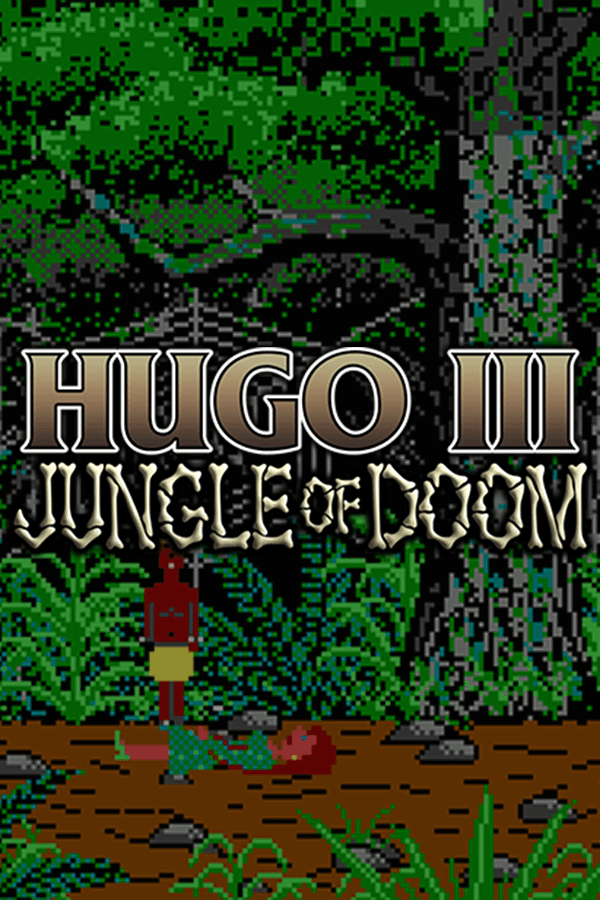
The adventure opens immediately after a plane crash in the Amazon. Hugo steps out of the wreckage intact, but his girlfriend Penelope is bitten by a venomous creature moments later, leaving her incapacitated on the ground. Your objective is simple on paper: explore the jungle, find a magic lagoon, and retrieve a flask of its water to cure her before time runs out.
In practice, you spend your first few minutes fighting the typing parser rather than the wildlife. Moving Hugo around the screen with the arrow keys feels direct enough, but interacting with the environment requires guessing the exact verb and noun combination the game wants. Typing look into plane fails to return a result, even when standing right next to the fuselage, requiring you to test alternate phrasings until the game finally acknowledges what you are looking at. It is a system typical of early adventure games, where half the challenge lies in reading the designer's mind.
Unlike earlier titles in the series, you cannot actually die from a bad decision in this installment. The threat of a sudden game-over screen is gone, which removes some of the tension. However, the game still allows you to leave crucial items behind or walk into dead ends without warning, forcing you to reload an earlier save if you realize twenty minutes later that you missed an essential object near the crash site.
Making voodoo dolls and blocking rivers in Hugo III: Jungle of Doom
The puzzle chain in the middle section of the game relies on classic inventory combination logic, though the actual solutions lean heavily into absurd territory. After wandering past a native village, Hugo is captured by a local witch doctor and locked inside a wooden cage. Escaping requires moulding a piece of clay into a voodoo doll and sticking pins into it while trapped inside the cage, which forces the guard outside to drop his key.
Once free, the most famous puzzle in the game involves reaching the magic lagoon hidden behind a roaring waterfall. To stop the water flow, you have to use a blowpipe with darts to stun an elephant standing nearby, causing its body to fall into the stream and dam the river. Developer David P. Gray added a dry note in the official hint material acknowledging that wild elephants do not live in the Amazon, joking that this particular one must have escaped from a local zoo.
To navigate the jungle and reach the final cure, you end up collecting a strange assortment of items across the linear screens:
- A piece of clay and pins used to craft the voodoo doll inside the cage.
- A blowpipe loaded with darts to collapse the elephant into the stream.
- A bell, candle, and spell book required to bypass magical barriers.
- A water flask to carry the magic liquid back from the lagoon to Penelope.
EGA art upgrades and standard PC speaker audio
Visually, this 1992 release was a noticeable step up for independent shareware releases of its day. Background artist Gary Sirois drew colorful 16-color EGA screens that gave the trees, witch doctor huts, and waterfalls far more detail than the sparse rooms of the earlier games. The screens look rich for 320x200 resolution, making the Amazon setting look surprisingly varied across its handful of locations.
The sound hardware support remains strictly minimalist, however. The game completely ignores Sound Blaster audio hardware, relying entirely on simple PC Speaker bleeps for musical cues and sound effects. Hearing the internal PC speaker chirp through action scenes gives the experience a distinct early-PC charm, even if it sounded crude compared to rival VGA titles arriving in store shelves that same year.
The game engine built by Grey Design also included a couple of technical features meant to make navigation smoother. A built-in turbo key speeds up Hugo's walking animation across wide open screens, and a built-in hint menu provides subtle nudges if you get completely stuck on a parser phrase. It also features a brief cameo by the mysterious Old Man character seen in previous installments, offering cryptic advice to players who talk to him.
Where the short length and parser dead ends bite back
The biggest issue most players encounter with this Hugo III: Jungle of Doom MS-DOS game is just how brief it is. An experienced player who already knows the typing commands can finish the entire story in less than fifteen minutes. Because the world consists of only a dozen interconnected screens, there is very little room for exploration, and the short narrative ending leaves very little impression after you finally carry the flask back to Penelope.
The parser also suffers from obtuse puzzle cues. At one point, you are required to type look behind specific background objects without any visual hint that something might be hidden there. I spent nearly half an hour staring at one screen simply because I hadn't typed the exact spatial command the game expected for a hidden item. These moments of synthetic difficulty extend the runtime, but they do so by frustrating the player rather than testing their logic.
Published by Gray Design Associates, the original release was distributed via shareware networks, where players could order the complete registered package for around thirty dollars. It marked the final traditional text-and-graphics adventure in the line; the series shifted directions entirely for its next entry, turning into the 3D first-person shooter Nitemare 3D. As a send-off to the original format, it makes for a fast, unusual entry from the PC shareware scene.
Playing the jungle adventure today
If you enjoy early nineties shareware logic, short puzzle sequences, and retro typing parsers, this third entry is worth an afternoon check. It fails to build much narrative weight, but its hand-drawn EGA jungle screens and bizarre solutions give it a distinct personality. The quick pacing means it never overstays its welcome, provided you keep a parser guide handy for the more obscure phrasing traps.
You can play Hugo III: Jungle of Doom online free in your browser right now, with no setup required. When you start your run, remember to examine every corner of the plane crash site immediately before venturing deeper into the trees, and don't hesitate to type exact commands when trying to use your items on the wildlife.