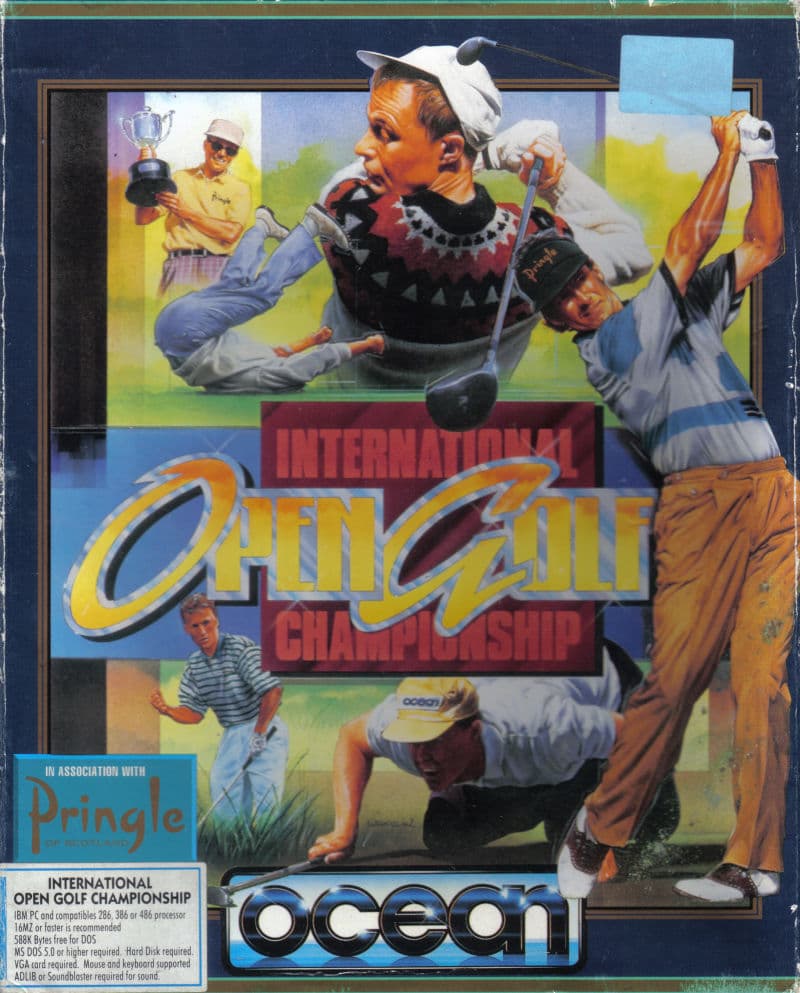
Ocean Software teamed up with Pringle of Scotland to deliver International Open Golf Championship, a 3D links simulator complete with swaying trees and portable player handicaps. It tried to rethink traditional golf swing mechanics, though its rigid power notches split player opinion straight down the middle.
Why International Open Golf Championship traded classic meters for power steps
Most golf titles from the early nineties relied on the classic three-click arc meter. You clicked once to start the backswing, once for maximum power, and a third time to lock in your accuracy on the snap. RISC decided to dump that intuitive system entirely when programming this sports game. They opted instead for a controversial setup where you pick strict percentage notches for shot strength.
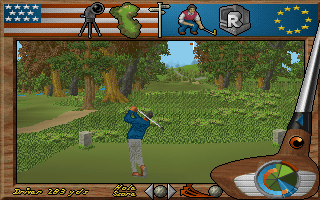
When you stand over the ball, you select full power, three-quarter power, half power, or quarter power. You adjust your club selection, check the wind direction arrow, and trigger the swing. Without smooth, continuous power selection, fine control around the fringe becomes an exercise in awkward math. If you need sixty percent power to clear a sand trap, you must over-club or under-hit on purpose.
That design choice instantly infuriated players who were used to fine-tuning every approach shot by feel. One review highlighted this exact issue, calling the rigid power tiers a failed attempt to differentiate the game from competing simulators. Yet once you get used to calculated club swaps, managing your approach becomes less about timing and more about mechanical precision.
Swaying trees, bird's-eye cameras, and Roland MT-32 sound
Visually, the game was quite ambitious for the 1993 PC market. Artist Tony Meredith helped construct a fully realized 3D landscape with polygon terrain that included rippling water hazards and trees that swayed in the wind. French magazine Tilt praised the game for accommodating modest PC setups while still running smooth, dynamic camera movements.
After you launch a ball into the sky, the camera switches smoothly to follow the trajectory. You can inspect the entire course layout using real-time 3D bird's-eye tracking shots. Seeing your shot sail over polygon foliage in a smooth sweep was genuinely impressive when most competitors still rendered static digitized photographs.
The audio side, composed by Mike Anderton using the MED engine, also packed a neat technical trick. While standard PC speakers and basic sound cards provided basic fx, DOS players with upgraded gear had an extra option. Launching the game with a specific command-line switch, typing GOLF_.EXE 1, enabled full Roland MT-32 synthesizer support for much richer ambient audio.

From strokeplay to skins across three difficulty tiers
Beyond the core swing mechanics, the game provided plenty of options for long weekend sessions with friends. The feature set packed in multiple game modes, including strokeplay, matchplay, skins, foursomes, practice, and fourball. You could set up custom games for casual afternoon rounds or serious tournament play.
Difficulty was broken down into three distinct tiers: amateur, professional, and master level. As you raised the difficulty, environmental factors like crosswinds became much harsher, and green reads required tighter precision. To make progress feel meaningful, developers Martin Lyons, David Harrison, and James Shaw added a save system for player handicaps.
- Amateur mode offers forgiving wind conditions and gentle green slopes.
- Professional mode increases wind drift and narrows fairway landing zones.
- Master mode demands perfect club selection and exact power management.
- Floppy disk exporting lets you move handicap stats to another PC.
You could save your character statistics and current handicap straight onto a floppy disk. Taking that disk to a friend's house let you load your stats onto another machine without losing your established standing. It was a neat piece of early physical portability that suited local multiplayer competitions perfectly.
The split review scores and that infamous 17 percent rating
Publisher Ocean Software Ltd. enjoyed heavy commercial tie-in branding with knitwear manufacturer Pringle of Scotland. The classic argyle aesthetic adorned both the physical box art by Bob Wakelin and the in-game menus. However, that high-end presentation could not protect the game from wildly polarized review scores across Europe.
German publications showed massive disagreement over the game's overall quality. Play Time awarded the DOS version a solid 75 percent, and PC Games handed out a respectable 70 percent score. Further down the scale, PC Joker dropped to 58 percent, while PC Player sat at 53 percent.
The absolute lowest mark came from German magazine ASM, which slapped the game with a brutal 17 percent rating. Critics who hated the title pointed directly at the clunky four-step power controls and rigid swing execution. Critics who liked it pointed to the fast engine speeds, light hardware requirements, and varied match types.
Experience International Open Golf Championship free in your browser today
Despite those stiff power controls, it gives you a sharp look at early 3D sports design. The polygon terrain, dynamic camera work, and licensed tournament feel make it well worth playing today. You can skip the old command-line parameters and floppy disk transfers entirely when setting up your first tee time.
You can play International Open Golf Championship online right now for free in your browser. It loads straight away with zero setup required, letting you hit the links, test the step-power controls, and take in the sway of the 3D trees immediately.