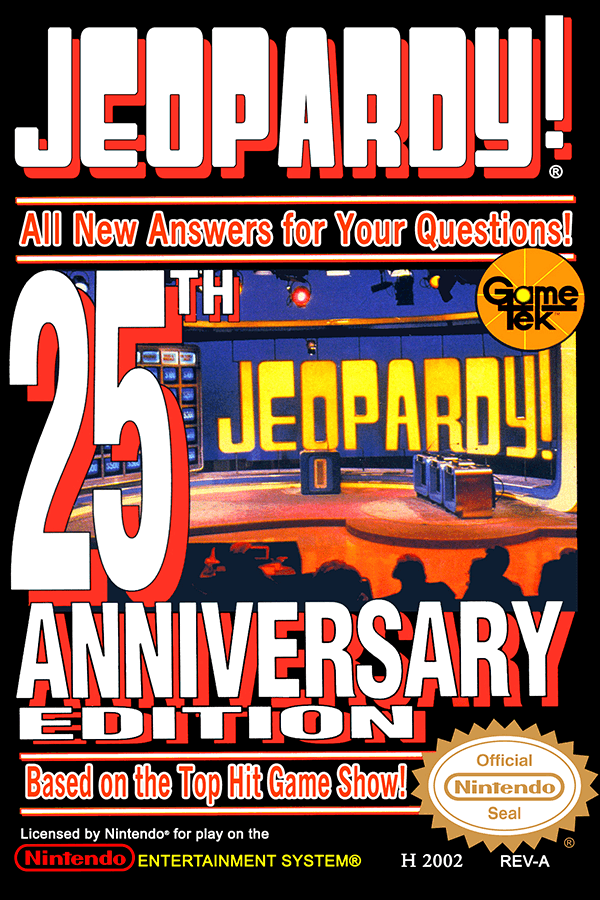

Playing Jeopardy! 25th Anniversary Edition on a PC means taking one of TV's fastest trivia games and slowing it down to the speed of your mechanical keyboard.
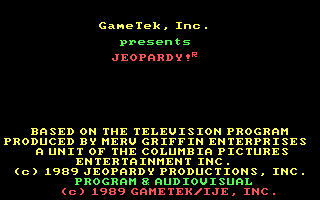
GameTek made an entire business out of converting television game shows into computer software, and this 1991 release for MS-DOS was one of dozens of adaptations they churned out. If you loaded up Jeopardy! 25th Anniversary Edition back then, you were greeted by a surprisingly faithful digital layout of the studio board, complete with three-round game structures, Daily Doubles, and a simulated contestant lineup. You can set up matches for up to three human players sharing a single keyboard, or fill the remaining podiums with computer-controlled opponents.
Before the questions start, you select a pre-made contestant profile or type in a custom name. The digitized portraits attempt to add a bit of personality to the match, complete with simple character animations that react when answers are judged right or wrong. It feels like a genuine effort to bring the set home, but the illusion hits a massive speed bump the moment the first clue appears on the screen.
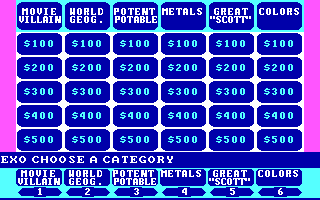
The flow of a game mimics the show step for step across the Jeopardy! round, Double Jeopardy!, and Final Jeopardy!. You pick from six categories with five clues each, ranging in dollar values, and hit your designated key to buzz in when you know the solution. That is where the tension shifts from trivia knowledge to raw input endurance. You are given a time limit based on your chosen difficulty level - ranging from 40 to 50 seconds - to physically spell out your answer on the keyboard.
Typing out full responses in the required form of a question turns simple trivia into a nerve-wracking race against the clock. When you buzz in, you cannot just type the core subject; you have to spell out the phrasing cleanly before time runs out. The system features an extremely strict parser that is completely unforgiving of misspellings or common abbreviations. Entering "Huck Finn" when the code expects "Huckleberry Finn" results in an immediate penalty, draining your bank balance and handing control over to the computer opponents.
On the audio side, the game relies heavily on standard PC speaker output. While higher-end sound cards deliver a passable digital version of the famous theme song during the intro and Final Jeopardy!, general gameplay is dominated by harsh, primitive bleeps and bloops that count down your remaining seconds. The audio feedback when you lose money on a strict parser rejection feels almost mockingly sharp.
The largest issue with long-term play is the finite nature of its trivia pool. After a few evenings of playing the MS-DOS version of Jeopardy!, categories and individual clues begin to cycle back around. Once you recognize the precise text strings the text parser demands for repeated clues, the challenge disappears entirely, turning the game into an exercise in memory retyping.
The mechanical quirks and rigid text parsing keep it from feeling like a smooth trivia game, but it shows how developers tried to solve television adaptations on early home computers. If you have a friend nearby to share a keyboard with, the hotseat multiplayer still produces plenty of shouts when someone loses a small fortune over a missing letter.
You can test your trivia speed and fight the strict text parser right now. You can play Jeopardy! 25th Anniversary Edition free in your browser without downloading any files or dealing with old system setups. Pick your category, keep your fingers ready on the buzz-in key, and make sure you spell out your answer completely before that digital timer runs dry.
Playing Jeopardy! 25th Anniversary Edition on a PC means taking one of TV's fastest trivia games and slowing it down to the speed of your mechanical keyboard.
GameTek made an entire business out of converting television game shows into computer software, and this 1991 release for MS-DOS was one of dozens of adaptations they churned out. If you loaded up Jeopardy! 25th Anniversary Edition back then, you were greeted by a surprisingly faithful digital layout of the studio board, complete with three-round game structures, Daily Doubles, and a simulated contestant lineup. You can set up matches for up to three human players sharing a single keyboard, or fill the remaining podiums with computer-controlled opponents.
Before the questions start, you select a pre-made contestant profile or type in a custom name. The digitized portraits attempt to add a bit of personality to the match, complete with simple character animations that react when answers are judged right or wrong. It feels like a genuine effort to bring the set home, but the illusion hits a massive speed bump the moment the first clue appears on the screen.
The flow of a game mimics the show step for step across the Jeopardy! round, Double Jeopardy!, and Final Jeopardy!. You pick from six categories with five clues each, ranging in dollar values, and hit your designated key to buzz in when you know the solution. That is where the tension shifts from trivia knowledge to raw input endurance. You are given a time limit based on your chosen difficulty level - ranging from 40 to 50 seconds - to physically spell out your answer on the keyboard.
Typing out full responses in the required form of a question turns simple trivia into a nerve-wracking race against the clock. When you buzz in, you cannot just type the core subject; you have to spell out the phrasing cleanly before time runs out. The system features an extremely strict parser that is completely unforgiving of misspellings or common abbreviations. Entering "Huck Finn" when the code expects "Huckleberry Finn" results in an immediate penalty, draining your bank balance and handing control over to the computer opponents.
On the audio side, the game relies heavily on standard PC speaker output. While higher-end sound cards deliver a passable digital version of the famous theme song during the intro and Final Jeopardy!, general gameplay is dominated by harsh, primitive bleeps and bloops that count down your remaining seconds. The audio feedback when you lose money on a strict parser rejection feels almost mockingly sharp.
The largest issue with long-term play is the finite nature of its trivia pool. After a few evenings of playing the MS-DOS version of Jeopardy!, categories and individual clues begin to cycle back around. Once you recognize the precise text strings the text parser demands for repeated clues, the challenge disappears entirely, turning the game into an exercise in memory retyping.
The mechanical quirks and rigid text parsing keep it from feeling like a smooth trivia game, but it shows how developers tried to solve television adaptations on early home computers. If you have a friend nearby to share a keyboard with, the hotseat multiplayer still produces plenty of shouts when someone loses a small fortune over a missing letter.
You can test your trivia speed and fight the strict text parser right now. You can play Jeopardy! 25th Anniversary Edition free in your browser without downloading any files or dealing with old system setups. Pick your category, keep your fingers ready on the buzz-in key, and make sure you spell out your answer completely before that digital timer runs dry.
How Jeopardy! 25th Anniversary Edition is played — the keys the game listens to, grouped by what they do.
Highlighted keys are mapped — hover or tap one to see what it does.
Control map is incomplete as full manual was not available in research notes.
The on-screen keyboard and gamepad mapping the browser player uses on a phone, a tablet or a controller, as opposed to the real keys above. $PRO members make their own in the player and share them here; anyone can pick one to play with.
Cheat codes, console commands and memory pokes for Jeopardy! 25th Anniversary Edition — each one verified and attributed.
Sign in to submitHow Jeopardy! 25th Anniversary Edition is played — the keys the game listens to, grouped by what they do.
Highlighted keys are mapped — hover or tap one to see what it does.
Control map is incomplete as full manual was not available in research notes.
The on-screen keyboard and gamepad mapping the browser player uses on a phone, a tablet or a controller, as opposed to the real keys above. $PRO members make their own in the player and share them here; anyone can pick one to play with.
Cheat codes, console commands and memory pokes for Jeopardy! 25th Anniversary Edition — each one verified and attributed.
Sign in to submit