
In Jetpack, a lone adventurer straps on a thruster pack to sweep 100 screen-sized rooms clean of green emeralds while avoiding steel worm segments and razor-sharp spikes.
Adam Pedersen solved the shareware puzzle with pure momentum
Back in 1993, budget PC gaming was dominated by shareware episodes passed around on floppy disks or downloaded over dial-up bulletin boards. Teenager Adam Pedersen built a fast, single-screen action game that could run on an old 4 MHz 8086 processor while still displaying full 256-color MCGA graphics. When Software Creations published it in 1993, the game took off immediately and became the company's biggest commercial seller.
The core concept is simple enough that anyone can grasp it in five seconds, but mastering it takes serious practice. You walk into a vault, collect every green gem scattered across the layout, and duck into the open exit door before an enemy catches you. Instead of giving you a gun to vaporize every monster on screen, the game gives you a jetpack, limited fuel, and a utility beam that alters the terrain itself.
Carving through brick walls with a beam that cannot harm a soul
Your primary defense in Jetpack is the phase shifter beam, a tool that burrows directly through soft phaseable bricks to open temporary tunnels or drop items down to lower ledges. The catch is that this beam passes right through enemies without doing a single point of damage. You cannot shoot your way out of a corner, so your survival depends on reading the layout of the room and keeping your eyes on moving hazards.
Flying requires fuel, which you gather from single tanks, double tanks, or stationary fuel grids built into the structure of the room. Managing your gas gauge is critical because hovering in place or fighting gravity burns through your reserve in seconds. Powerups like temporary invulnerability and enemy freezers show up occasionally to give you brief breathing room, but precise flight control remains your main survival tool.
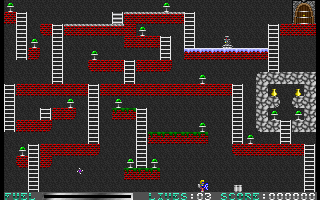
The roster of enemies forces you to adapt your movement style constantly depending on what is sharing the room with you:
- Trackbots patrol along surface contours and punish players who linger near floors or walls.
- Whirling spikes drift through open air to block smooth flight paths between platforms.
- Standard robots march predictable paths but cut off narrow exit hallways.
- The Marble Worm slithers around as a long chain of steel balls that fills up entire corridors.
When fuel runs dry, precision platforming takes over
Just when you get comfortable managing your thrusters, the level design strips them away entirely. Several rooms contain no fuel tanks whatsoever, turning the game into a strict, gravity-bound puzzle where you rely entirely on ladders, platforming, and exact timing. A single wrong step onto slick ice or a sudden shift on a conveyor belt will send you sliding straight into a deadly hazard.
Other levels feature force fields, teleporter pads, and energy drain zones that siphon off your fuel supply the second you drift through them. These layout tricks create severe difficulty spikes later in the campaign, where one small mistake means instant death and forces a total restart of the level. The precise hitboxes on spikes and fast-moving hazards mean you will lose plenty of lives while figuring out the safe routes.
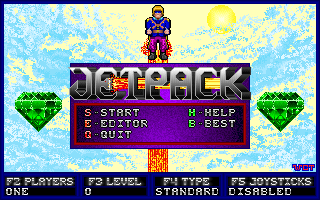
Sound card support added plenty of personality to the experience under DOS. Hearing the digitized audio effects chirping through a Sound Blaster card made every emerald pickup satisfying, though the built-in PC speaker driver handled the beep-heavy audio surprisingly well if you lacked dedicated sound hardware.
The built-in level editor made Jetpack immortal on shareware disks
While the main campaign offered 100 tricky levels, the included level editor was the feature players spent hundreds of hours with. The construction tool gave players access to every tile type, hazard, and enemy behavior found in the main game, making it easy to build custom level packs and share them across local bulletin board systems. The editor felt so fast and flexible that many fans spent more time creating nightmare mazes than playing the stock levels.
A seasonal spin-off called the Jetpack Christmas Special arrived late in 1993, swapping out the unnamed explorer for Santa Claus, who gathered presents around decorated Christmas trees instead of mining emeralds. Pedersen eventually released the original Jetpack MS-DOS game as freeware in 1998, pushing its total download count past the one million mark over the following years.
Clear every vault without paying a dime
The pixel-perfect collision and sudden difficulty walls will test your patience, but the quick restarts and creative stage layouts make it hard to put down. If you enjoy classic DOS arcade puzzles like Lode Runner or Kroz, this is one of the tightest action games on the system.
You can play Jetpack online free in your browser right now, with no setup required. Load up the first level, grab your thruster pack, and see if you can clear the initial emerald maze without burning through your fuel tank on the very first drop.