


Playing Jones in the Fast Lane is a lesson in how fast a paycheck disappears between university tuition, fast food, and a sudden visit from a street mugger.
The core loop of this 1992 simulation game is cruel in its simplicity. You step onto a board styled like a corporate cityscape, competing against human friends or the computer-controlled rival Jones to reach four arbitrary target totals: Wealth, Happiness, Education, and Career. Each turn covers a single week of your life, measured in strict time units that tick down as you travel between storefronts.
Your first few turns set a brisk pace. You start unemployed, living in Low Rent Apartments, and desperate enough for quick cash to take a shift flipping patties at Monolith Burger. Every move around the map costs precious time, meaning you are constantly calculating whether you can afford to walk to the University for a class before your shift starts, or if you must settle for cheap junk food because you ran out of hours to cook at home. Sierra On-Line, Inc. stripped away complex text commands and replaced them with fixed visual menus, keeping the focus entirely on your weekly schedule.
The strategic tension comes from the fact that progress in one vector actively undermines another. Earning a degree opens up managerial positions at the Bank or Grant's Department Store, but spending your weekends studying leaves you broke and starving. Buying better clothes lets you interview for higher-paying jobs, but if you do not own a refrigerator, the groceries you bought at the market will spoil by Monday morning. It is an economic juggle where a single bad estimate leaves you short on rent.
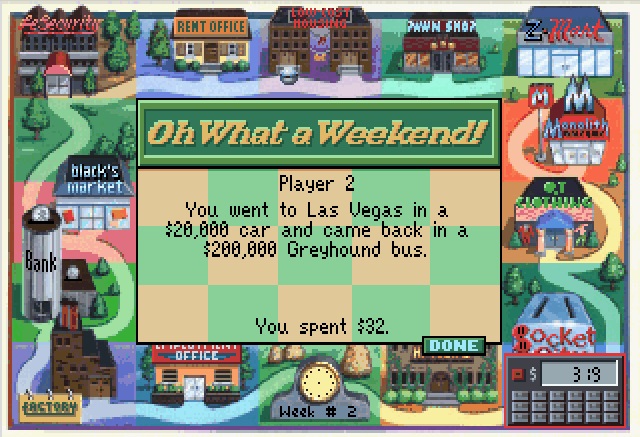
Even when you balance your checkbook down to the exact dollar, random events love to throw your plans off the rails. The game tracks four distinct victory conditions, and keeping them in harmony is tricky when the environment turns hostile:
The biggest threat to a perfect run is not rival players, but the random events that hit between weeks. You might finish a turn with just enough money for next week's rent, only for an "Oh What a Weekend" prompt to inform you that you spent your savings at an amusement park. Worse still is the recurring menace known as Wild Willie, a mugger who pops up without warning to strip away cash you carried instead of depositing at the Bank.
These random setbacks force quick pivots. If Wild Willie steals your tuition money, you cannot attend class that week, which delays your promotion, which leaves you stuck in a low-rent apartment taking heat from your landlord. I spent three consecutive games watching a commanding lead vanish because I got lazy about banking my salary at the end of every turn.
Built on Sierra's Creative Interpreter engine (SCI1), the expanded CD-ROM version from 1992 transformed a dry board game into something full of personality. Director Bill Davis and writer Josh Mandel packed the script with dry workplace humor, but the real star of this edition is the Redbook CD Audio voice track. Every clerk, landlord, and banker speaks directly to you, backed by Ken Allen's rich MIDI soundtrack pumping through a Sound Blaster or Roland MT-32 card.
The digitized actors behind the store counters add a distinct charm to mundane errands. The clerk at Monolith Burger greets you with deadpan exhaustion, while the manager at the department store treats you with smug condescension until you show up wearing an expensive business suit. These animated portraits and full voice lines gave the game a TV sitcom feel that stood completely apart from dark fantasy RPGs and serious flight simulators on PC displays at the time.
Despite the multimedia polish, the physical game footprint on your hard drive remained tiny. Because the audio streamed straight off the CD-ROM, players got full digitized speech without sacrificing hundreds of megabytes of disk space, which was a massive relief for DOS users during the early nineties multimedia transition.
If you put time into the game, the illusion of limitless strategy begins to crack. Once you figure out the optimal progression route, rushing an early university degree, securing a high-paying job, and immediately buying a refrigerator and security system, the tension recedes. The AI player, Jones, follows predictable routines and rarely adapts when you cut off his career path by taking the open position he was qualified for.
The structural weakness that stings most is the ending. After spending an hour carefully managing career shifts, stock market shifts, and appliance investments, reaching the win condition triggers nothing more than a brief score panel announcing who crossed the finish line first. There is no final animated sequence or celebratory payout, just a sudden halt that feels anticlimactic after such a tense race.
Yet as a multiplayer board game shared around a single keyboard, the fast pace keeps it fun. Playing the Jones in the Fast Lane MS-DOS game with friends brings out a competitive bite, as everyone screams when a rival gets mugged by Wild Willie or catches a lucky break on the stock market.
This upgraded CD release takes a straightforward board game framework and makes it memorable through sharp audio work and fast turns. The simple interface and turn-based structure mean you never have to fight complex controls to enjoy the economic hustle, even if a bad weekend event leaves you broke right before rent is due.
You can play Jones in the Fast Lane online for free in your browser right now. There is nothing to install, so you can jump straight into the rat race, test your luck against Jones, and see if you can buy that hot tub before Wild Willie empties your wallet.
Playing Jones in the Fast Lane is a lesson in how fast a paycheck disappears between university tuition, fast food, and a sudden visit from a street mugger.
The core loop of this 1992 simulation game is cruel in its simplicity. You step onto a board styled like a corporate cityscape, competing against human friends or the computer-controlled rival Jones to reach four arbitrary target totals: Wealth, Happiness, Education, and Career. Each turn covers a single week of your life, measured in strict time units that tick down as you travel between storefronts.
Your first few turns set a brisk pace. You start unemployed, living in Low Rent Apartments, and desperate enough for quick cash to take a shift flipping patties at Monolith Burger. Every move around the map costs precious time, meaning you are constantly calculating whether you can afford to walk to the University for a class before your shift starts, or if you must settle for cheap junk food because you ran out of hours to cook at home. Sierra On-Line, Inc. stripped away complex text commands and replaced them with fixed visual menus, keeping the focus entirely on your weekly schedule.
The strategic tension comes from the fact that progress in one vector actively undermines another. Earning a degree opens up managerial positions at the Bank or Grant's Department Store, but spending your weekends studying leaves you broke and starving. Buying better clothes lets you interview for higher-paying jobs, but if you do not own a refrigerator, the groceries you bought at the market will spoil by Monday morning. It is an economic juggle where a single bad estimate leaves you short on rent.

Even when you balance your checkbook down to the exact dollar, random events love to throw your plans off the rails. The game tracks four distinct victory conditions, and keeping them in harmony is tricky when the environment turns hostile:
The biggest threat to a perfect run is not rival players, but the random events that hit between weeks. You might finish a turn with just enough money for next week's rent, only for an "Oh What a Weekend" prompt to inform you that you spent your savings at an amusement park. Worse still is the recurring menace known as Wild Willie, a mugger who pops up without warning to strip away cash you carried instead of depositing at the Bank.
These random setbacks force quick pivots. If Wild Willie steals your tuition money, you cannot attend class that week, which delays your promotion, which leaves you stuck in a low-rent apartment taking heat from your landlord. I spent three consecutive games watching a commanding lead vanish because I got lazy about banking my salary at the end of every turn.

Built on Sierra's Creative Interpreter engine (SCI1), the expanded CD-ROM version from 1992 transformed a dry board game into something full of personality. Director Bill Davis and writer Josh Mandel packed the script with dry workplace humor, but the real star of this edition is the Redbook CD Audio voice track. Every clerk, landlord, and banker speaks directly to you, backed by Ken Allen's rich MIDI soundtrack pumping through a Sound Blaster or Roland MT-32 card.
The digitized actors behind the store counters add a distinct charm to mundane errands. The clerk at Monolith Burger greets you with deadpan exhaustion, while the manager at the department store treats you with smug condescension until you show up wearing an expensive business suit. These animated portraits and full voice lines gave the game a TV sitcom feel that stood completely apart from dark fantasy RPGs and serious flight simulators on PC displays at the time.
Despite the multimedia polish, the physical game footprint on your hard drive remained tiny. Because the audio streamed straight off the CD-ROM, players got full digitized speech without sacrificing hundreds of megabytes of disk space, which was a massive relief for DOS users during the early nineties multimedia transition.
If you put time into the game, the illusion of limitless strategy begins to crack. Once you figure out the optimal progression route, rushing an early university degree, securing a high-paying job, and immediately buying a refrigerator and security system, the tension recedes. The AI player, Jones, follows predictable routines and rarely adapts when you cut off his career path by taking the open position he was qualified for.
The structural weakness that stings most is the ending. After spending an hour carefully managing career shifts, stock market shifts, and appliance investments, reaching the win condition triggers nothing more than a brief score panel announcing who crossed the finish line first. There is no final animated sequence or celebratory payout, just a sudden halt that feels anticlimactic after such a tense race.
Yet as a multiplayer board game shared around a single keyboard, the fast pace keeps it fun. Playing the Jones in the Fast Lane MS-DOS game with friends brings out a competitive bite, as everyone screams when a rival gets mugged by Wild Willie or catches a lucky break on the stock market.
This upgraded CD release takes a straightforward board game framework and makes it memorable through sharp audio work and fast turns. The simple interface and turn-based structure mean you never have to fight complex controls to enjoy the economic hustle, even if a bad weekend event leaves you broke right before rent is due.
You can play Jones in the Fast Lane online for free in your browser right now. There is nothing to install, so you can jump straight into the rat race, test your luck against Jones, and see if you can buy that hot tub before Wild Willie empties your wallet.
How Jones in the Fast Lane (Enhanced CD-ROM) is played — the keys the game listens to, grouped by what they do.
Highlighted keys are mapped — hover or tap one to see what it does.
Primarily played with a mouse, though arrow keys, keypad, or joystick can optionally be used.
The on-screen keyboard and gamepad mapping the browser player uses on a phone, a tablet or a controller, as opposed to the real keys above. $PRO members make their own in the player and share them here; anyone can pick one to play with.
Cheat codes, console commands and memory pokes for Jones in the Fast Lane (Enhanced CD-ROM) — each one verified and attributed.
Sign in to submitHow Jones in the Fast Lane (Enhanced CD-ROM) is played — the keys the game listens to, grouped by what they do.
Highlighted keys are mapped — hover or tap one to see what it does.
Primarily played with a mouse, though arrow keys, keypad, or joystick can optionally be used.
The on-screen keyboard and gamepad mapping the browser player uses on a phone, a tablet or a controller, as opposed to the real keys above. $PRO members make their own in the player and share them here; anyone can pick one to play with.
Cheat codes, console commands and memory pokes for Jones in the Fast Lane (Enhanced CD-ROM) — each one verified and attributed.
Sign in to submit