Mastering Kick Off 2 requires accepting that the ball is a physical object on a field rather than something glued to your boot. Designed by Dino Dini, this 1990 football title turns sprinting into a high-strung balancing act between sharp control and total chaos.
Dino Dini dropped player magnetic feet for genuine ball physics
The moment you first take the pitch, your instincts from other digital soccer titles will work against you. In most sports games, running into the ball automatically snapped it to your player sprite, allowing you to turn on a dime without losing possession. Here, the ball is continuously pushed forward as a separate entity on a dynamic physics model. Pressing sprint without careful tapping sends the ball rolling meters ahead, inviting an eager defender to slide in and steal it.
Once you learn to trap the ball under your player foot, the match completely changes. Stopping dead in your tracks gives you a precious second to scan the pitch from the top-down perspective, allowing you to plot long-range through-balls, back-heels, or acrobatic overhead kicks. Dribbling requires rhythm: tap the directional controls to nudge the ball forward, run up to meet it, and tap again. It turns every break across the pitch into a tense sequence where a single mistimed tap surrenders the ball.
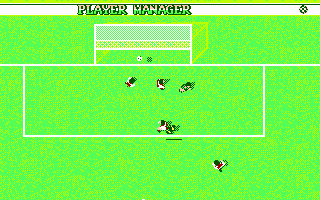
The top-down viewport alters how you construct attacks across the field. Because you can see wide spaces opening up on the flanks long before a defender can cover them, successful play relies on quick passes into space rather than individual heroics. Trying to weave through three defenders manually almost always ends in loss of possession, forcing you to think like a real manager looking for open channels.
Pitches, referees, and pitch types shape the match in Kick Off 2
Matches do not take place on identical green carpets. The developers included four distinct pitch types that drastically alter how the ball rolls and bounces. Playing on wet mud slows passes down to a crawl, while the controversial plastic pitches feature unpredictable, uneven ball bounces that make trapping incoming passes a nerve-wracking exercise. Those synthetic surfaces were famously disputed when several English league clubs installed them during the 1980s, and their chaotic nature is captured faithfully here.
Pitch variables combine with an impressive system of match officials to keep you on edge. The game features 24 individual referees, each assigned distinct temperaments that dictate how strictly they judge tackles:
- Strict referees flag subtle mistimed challenges and hand out yellow cards early in the match.
- Lenient officials let heavy slide tackles from behind go unpunished, encouraging aggressive defending.
- Unpredictable referees keep both sides guessing, calling fouls at random while letting brutal tackles slide.
If a tournament match ends in a draw after full time and extra minutes, you are forced into a sudden death penalty shoot-out. Taking penalties requires precise control over power and direction, as a slight over-tilt sends the shot soaring into the crowd. Defending penalties is equally ruthless, asking you to commit your goalkeeper before the striker strikes the ball.
Expansions and data disks tested player patience and wallets
Anco Software Ltd. supported the main game with a stream of add-on data disks that received mixed reactions from contemporary gaming magazines. While players welcomed extra teams in expansions like Giants of Europe and Return To Europe, other releases felt like unnecessary commercial cash-ins. When the Winning Tactics expansion arrived, French reviewer Marc Lacombe wrote in Tilt (issue 93, September 1991) that the original game's eight tactical setups were already enough, giving the add-on an 8/20 score because it did not alter gameplay enough to justify its retail price.
Other regional press proved more receptive to the ongoing expansion line. The French magazine Joystick handed Return to Europe a solid 74% score on the Amiga, praising the updated club rosters and fresh tournament brackets. German publication Play Time took a middle ground on The Final Whistle expansion, rating it 64% on Amiga and a lower 52% on Atari ST due to minor presentation drawbacks. For die-hard fans of Anco Software Ltd., the best feature was direct interoperability: you could build custom tactics and squads in Player Manager and import them directly into your squad roster for tournament play.
Why this top-down simulation remains brutally unforgiving today
The learning curve in this 1990 release is steep enough to alienate anyone expecting a casual, pick-up-and-play sports title. The fast frame rate means a split second of hesitation turns a clean defensive clearance into an embarrassing own goal. Defending is notoriously difficult: attempting a slide tackle requires calculating the target's vector three paces ahead, and missing the ball completely usually leaves your defender sprawled out on the turf while the attacker runs free toward your net.
Audio is another area where hardware differences made a real impact at the time. While the standard MS-DOS sports games environment offered squeaky PC speaker effects or basic Sound Blaster support, playing on expanded setups provided far richer crowd chants and punchier referee whistles. The inclusion of an Action Replay feature allowed fans to review highlights and save exceptional goals directly to floppy disk in normal or slow motion, a feature that felt years ahead of competing titles.
What holds up is the raw velocity and satisfaction of landing a clean pass-and-move sequence. What fails to impress modern players is how easily matches degenerate into pinball-like chaos on uneven pitches, as well as the complete absence of real player names due to licensing limits. Yet as an arcade-focused simulation of fast-paced action, Dino Dini's core mechanical design remains sharp and uncompromising.
Play Kick Off 2 online right now in your browser
If you want to try this seminal entry in football gaming history, you can play Kick Off 2 free in your browser without downloading extra software. The biggest mistake new players make when launching the Kick Off 2 MS-DOS game is holding down the movement keys constantly while in possession. Tap the keys lightly to keep the ball near your feet, set up your passes early, and avoid sprint buttons until you have wide open field ahead of you.
How Kick Off 2 is played — the keys the game listens to, grouped by what they do.
- Movement
Highlighted keys are mapped — hover or tap one to see what it does.
Detailed keyboard bindings could not be located in full; joystick calibration is required in options.
Players' controls
Touch and gamepad controls
The on-screen keyboard and gamepad mapping the browser player uses on a phone, a tablet or a controller, as opposed to the real keys above. $PRO members make their own in the player and share them here; anyone can pick one to play with.
Make your own touch controlsPRO
- 1Open the editorSign in below, then pick what to make. The game starts with the editor open over it.
- 2Place your keysAdd keys and drag them where your thumbs rest, or map a controller's buttons. Test plays the game with them; Save keeps them, and you play with them from then on.
- 3Share themShare them right after saving in the game, or name and share them here. Players vote, and the best become this game's controls for everyone.
Go PROSee how it worksSign in+20 XP for sharing · +50 XP if yours become the game's own
- The game's own controlsKeyboardGamepadWhat every player starts with.In use
2 screenshots
From the archive
No reviews yet
Tell the community what you think of Kick Off 2. Reviews are public and tied to your username.
No archived manuals for Kick Off 2 yet
No manuals archived for this title yet. Sign in to upload the first scan.
Cheat codes, console commands and memory pokes for Kick Off 2 — each one verified and attributed.
Sign in to submitNo cheats yet for this title
Know a working cheat, poke or trainer? Add it with the button above. Moderators check every entry before it goes live.
No archived soundtrack for Kick Off 2 yet
No soundtrack archived for this title yet. Sign in to upload the first rip.
No save states for Kick Off 2 yet
No save states for this title yet. Sign in to share one.
Discussions
Sign in to post- Threads0
- Total posts0
- Online now6
Community · Kick Off 2
Who's contributing, and what's new
- Reviews0
- Threads0
- Uploadsapproved0
- Contributors0
Recent activity