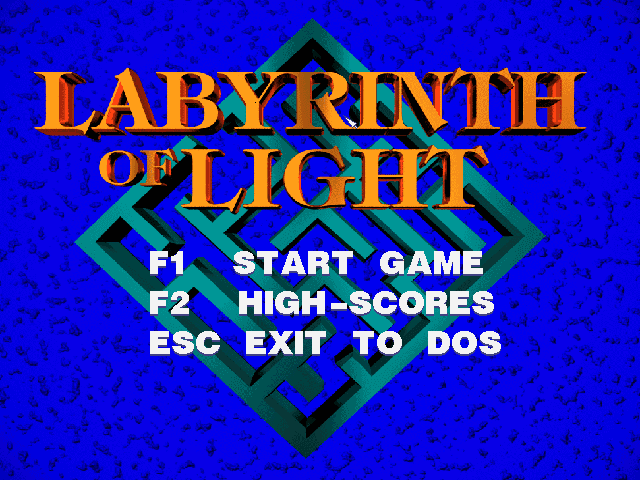
Labyrinth of Light
If you ever spent a frantic afternoon shifting colored blocks on a grid just to route a single laser beam into a red target, Labyrinth of Light will instantly feel familiar.
Precision laser routing in high resolution
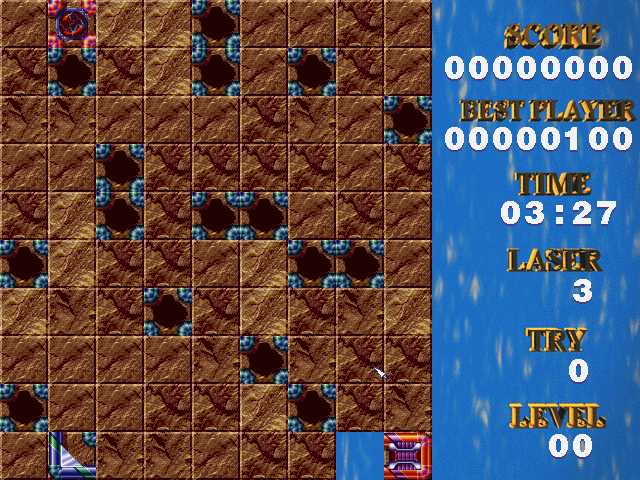
The core setup in Labyrinth of Light seems simple on the surface, but it gets tricky fast. You control a single blue square on a grid, shifting it strictly horizontally and vertically to manipulate the surrounding board. When your square bumps into an object, it swaps positions with it, shoving that piece into the next cell. Your entire goal is to build a clean optical path from the laser emitter to a target marked by a sparkling circle inside a bright red frame.
You are managing a whole array of optical components rather than just sliding generic mirrors around. Purple circular mirrors allow light to pass through while bending the angle, while glass obstacles block your path entirely. You also have to factor in concave and convex lenses that focus or spread the beam across multiple rows. Once you think every piece sits in the exact right spot, you right-click the laser module to fire and watch the beam travel.
Why playing this Labyrinth of Light MS-DOS game tests your patience
Developer Dongleware Verlags GmbH did not give players unlimited room for trial and error. Every board carries a strict four-minute countdown timer. If your beam hits an obstacle or leaves the edge of the board, you lose one attempt. You only get three tries before the screen snaps to a complete game over, forcing you to think ahead before firing.
That rigid penalty system changes how you approach every single level in this 1994 release. You cannot simply throw pieces around randomly and trigger the light beam to see what happens. You spend most of your time calculating angles in your head, double-checking line-of-sight, and carefully clearing redundant clutter out of the pathway.
The push mechanic itself adds an extra layer of difficulty to the board design. Because moving your blue cursor square pushes objects into adjacent spaces, you can easily trap a vital lens against a wall or lock two components together. One careless move often ruins an entire board attempt long before you even press the button to launch the laser.
Visual clarity over unnecessary splash
When publisher Megadream Software shipped the title, its main selling point was crisp SuperVGA graphics in 256 bright colors. That high screen resolution actually serves the logic of the puzzle engine extremely well. The clean board rendering lets you spot light pathways, lenses, and mirrors across a crowded grid without squinting.
Compared to other puzzle games from the middle of the decade, the art direction avoids distracting fluff. There are no animated mascot characters dancing on the sidelines or elaborate story cutscenes wasting your time. Everything on the monitor exists purely to deliver clear optical information, which makes analyzing a complex solution feel logical and fair.
- High-resolution 256-color SVGA artwork that keeps elements clearly readable.
- Direct tile-pushing controls using horizontal and vertical cursor movements.
- Multiple optical elements including splitters, glass hazards, and focal lenses.
- Strict four-minute stage clocks and a three-strike failure rule per attempt.
The final verdict on this optical classic
Where many tile manipulation games rely on fast reflexes, this one demands calm spatial planning. The strict strike limit and unforgiving restart mechanics will frustrate players who prefer casual, zero-stakes logic puzzles. However, the crisp graphics and tight mechanical design make solving a long light chain immensely satisfying.
If you enjoy classic optical puzzles, you can play Labyrinth of Light online right now. You can experience Labyrinth of Light free in your browser without downloading files or setting up custom software. Fire up the first level, watch where your light beam bounces, and try not to jam your mirror pieces into the corner grid on your very first move.