
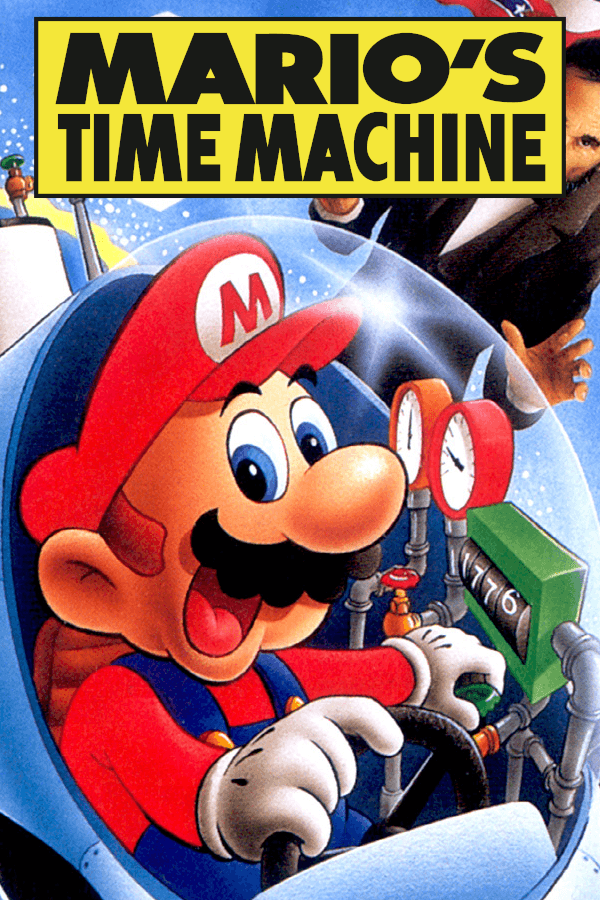

In Mario's Time Machine, you wander around Bowser's artifact museum, snatch stolen treasures back from patrolling Koopas, and use a time machine to return them to figures like Isaac Newton and Thomas Edison before history unravels.
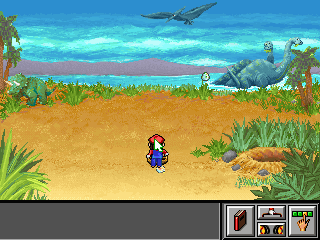
When you start up this 1993 MS-DOS title, you do not jump across floating blocks or hurl fireballs at incoming enemies. Instead, you guide Mario around a quiet museum hub housing 25 stolen relics across five separate rooms. To retrieve an object, like Isaac Newton's apple or Thomas Edison's lightbulb, you walk up to a roaming Koopa Troopa, stomp on it, and collect the prize. That brief point-and-click scuffle is essentially all the physical action the game offers you.
Once an item is safely in your inventory, the real chore begins. You must walk over to the "Timulator" time travel device, work out the destination coordinates, and read historical biographies to piece together where the object belongs. Rather than letting you jump around historical epochs like a standard platform game, the design halts everything so you can review wall text and solve fill-in-the-blank history worksheets.
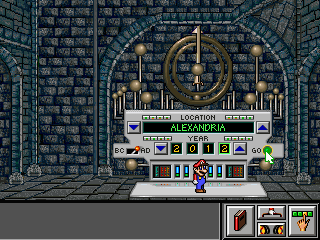
To set dates and jump back to past centuries, you interact with the on-board Date-O-Matic analyzer and Almanac Computer. The interface asks you to complete context-heavy historical reports by clicking missing words into place. If you already know when Newton published his physical theories or where Gutenberg printed his bible, you can breeze through the menus in seconds. If you do not, the game forces you into blind guesswork or tedious reading sessions inside the build-in reference documents.
This structural setup is where the mechanics turn painful for anyone expecting actual platforming action. Game designer Don Lloyd and artist Cesar De Castro built the interactive screens around point-and-click menu choices rather than responsive movement. Mario's signature jumping skill is reduced to an arbitrary requirement for grabbing floating tokens or knocking down a single turtle per room. Contemporary coverage in PC Zone noted back in July 1993 that its heavy reliance on the computer almanac aimed directly at a younger audience, but modern players quickly realize how much it feels like doing history homework after school.
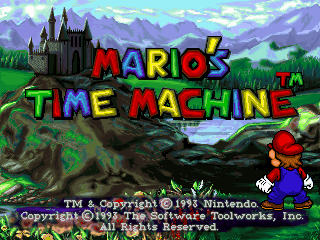
Developer and publisher The Software Toolworks, Inc. created this project as part of their Mario Discovery Series following a licensing deal with Nintendo of America. Their financial goal was simple: tap into the lucrative educational software market dominated by Broderbund's Where in Time Is Carmen Sandiego?. Their previous educational project, Mario Is Missing!, had generated millions in profit, giving the team every incentive to reuse the formula with higher production values.
One area where the floppy disk release shines is its audio presentation. Composer Mark Knight adapted classic Koji Kondo themes from Super Mario World for standard PC sound hardware. Hearing those familiar Nintendo melodies playback through a Sound Blaster card alongside synthesized historical jingles gave the game a genuine PC flavor that set it apart from typical floppy-disk software of the period.
The game features a surprisingly unforgiving endgame condition based on speed and placement order. If you return artifacts in the wrong sequence or take too long filling out your historical documents, Bowser escapes to a tropical paradise while Mario is left behind, or Bowser gets banished to the Jurassic era in an alternate sequence. Navigating through multiple slow menu choices just to hit a dead-end failure screen is a point of genuine frustration for players attempting a full run.
As an adventure game, the experience falls flat on traditional challenge because there are no real puzzles to solve outside of memorizing historical facts. The point-and-click movement feels sluggish, the Koopa combat is completely trivial, and the educational text quickly becomes repetitive. It is an odd sight from the days when console mascots were routinely licensed out to star in classroom PC games.
You can play Mario's Time Machine online free in your browser right now, with no installation needed. If you want to see how Nintendo's flagship plumber handled educational trivia back in 1993, load up the MS-DOS release and try returning Isaac Newton's apple without looking up the answers beforehand.
In Mario's Time Machine, you wander around Bowser's artifact museum, snatch stolen treasures back from patrolling Koopas, and use a time machine to return them to figures like Isaac Newton and Thomas Edison before history unravels.
When you start up this 1993 MS-DOS title, you do not jump across floating blocks or hurl fireballs at incoming enemies. Instead, you guide Mario around a quiet museum hub housing 25 stolen relics across five separate rooms. To retrieve an object, like Isaac Newton's apple or Thomas Edison's lightbulb, you walk up to a roaming Koopa Troopa, stomp on it, and collect the prize. That brief point-and-click scuffle is essentially all the physical action the game offers you.
Once an item is safely in your inventory, the real chore begins. You must walk over to the "Timulator" time travel device, work out the destination coordinates, and read historical biographies to piece together where the object belongs. Rather than letting you jump around historical epochs like a standard platform game, the design halts everything so you can review wall text and solve fill-in-the-blank history worksheets.
To set dates and jump back to past centuries, you interact with the on-board Date-O-Matic analyzer and Almanac Computer. The interface asks you to complete context-heavy historical reports by clicking missing words into place. If you already know when Newton published his physical theories or where Gutenberg printed his bible, you can breeze through the menus in seconds. If you do not, the game forces you into blind guesswork or tedious reading sessions inside the build-in reference documents.
This structural setup is where the mechanics turn painful for anyone expecting actual platforming action. Game designer Don Lloyd and artist Cesar De Castro built the interactive screens around point-and-click menu choices rather than responsive movement. Mario's signature jumping skill is reduced to an arbitrary requirement for grabbing floating tokens or knocking down a single turtle per room. Contemporary coverage in PC Zone noted back in July 1993 that its heavy reliance on the computer almanac aimed directly at a younger audience, but modern players quickly realize how much it feels like doing history homework after school.
Developer and publisher The Software Toolworks, Inc. created this project as part of their Mario Discovery Series following a licensing deal with Nintendo of America. Their financial goal was simple: tap into the lucrative educational software market dominated by Broderbund's Where in Time Is Carmen Sandiego?. Their previous educational project, Mario Is Missing!, had generated millions in profit, giving the team every incentive to reuse the formula with higher production values.
One area where the floppy disk release shines is its audio presentation. Composer Mark Knight adapted classic Koji Kondo themes from Super Mario World for standard PC sound hardware. Hearing those familiar Nintendo melodies playback through a Sound Blaster card alongside synthesized historical jingles gave the game a genuine PC flavor that set it apart from typical floppy-disk software of the period.
The game features a surprisingly unforgiving endgame condition based on speed and placement order. If you return artifacts in the wrong sequence or take too long filling out your historical documents, Bowser escapes to a tropical paradise while Mario is left behind, or Bowser gets banished to the Jurassic era in an alternate sequence. Navigating through multiple slow menu choices just to hit a dead-end failure screen is a point of genuine frustration for players attempting a full run.
As an adventure game, the experience falls flat on traditional challenge because there are no real puzzles to solve outside of memorizing historical facts. The point-and-click movement feels sluggish, the Koopa combat is completely trivial, and the educational text quickly becomes repetitive. It is an odd sight from the days when console mascots were routinely licensed out to star in classroom PC games.
You can play Mario's Time Machine online free in your browser right now, with no installation needed. If you want to see how Nintendo's flagship plumber handled educational trivia back in 1993, load up the MS-DOS release and try returning Isaac Newton's apple without looking up the answers beforehand.
The on-screen keyboard and gamepad mapping the browser player uses on a phone, a tablet or a controller, as opposed to the real keys above. $PRO members make their own in the player and share them here; anyone can pick one to play with.
Cheat codes, console commands and memory pokes for Mario's Time Machine — each one verified and attributed.
Sign in to submitThe on-screen keyboard and gamepad mapping the browser player uses on a phone, a tablet or a controller, as opposed to the real keys above. $PRO members make their own in the player and share them here; anyone can pick one to play with.
Cheat codes, console commands and memory pokes for Mario's Time Machine — each one verified and attributed.
Sign in to submit