Master of Orion II: Battle at Antares
Streaming build
Checking storage…1.1 GB
Preload in background
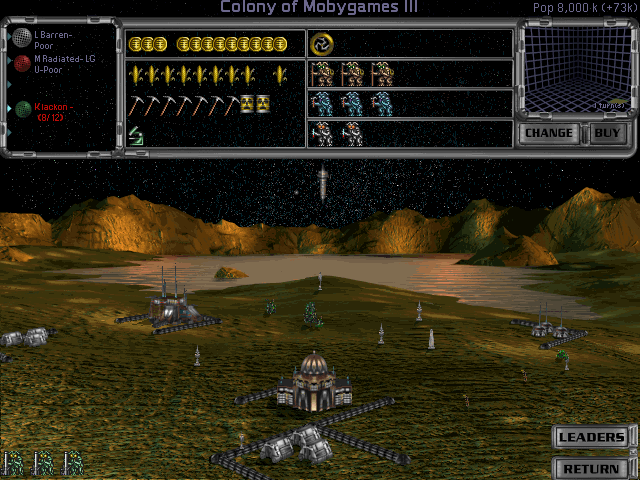
When you design a custom race in Master of Orion II: Battle at Antares, pairing Telepathic mind control with an Aquatic growth boost, you realize how much freedom SimTex handed players back in 1996.
Building custom races in Master of Orion II: Battle at Antares breaks the universe in the best way
The original game used sliders to manage planets and gave you pre-baked alien species with set traits. Designers Steve Barcia and Kenneth Burd threw that restrictive model out for the sequel. Instead of picking one of the 13 stock alien species and sticking to its preset perks, you get a pool of creation points to build your own faction from scratch.
You can trade off physical weakness or bad homeworld conditions for terrifying offensive abilities. If you choose Subterranean along with Creative tech development, your population capacity skyrockets while your scientists unlock every branching technology on the research tree rather than forcing you to pick just one. Period magazines like PC Player awarded the game 100% precisely because this flexible system gave strategy fans endless room to experiment.
Of course, total freedom means total imbalance if you know what you are doing. Experienced players quickly figured out that combining Telepathic with Repulsive let you instantly assimilate conquered worlds while completely ignoring tedious diplomatic gifts. It feels completely broken against the computer AI, but figuring out those insane synergies is half the fun of setting up a new galaxy run.
Grid tactical combat makes ship design actually matter
When two hostile fleets meet over an unexplored planet, the game switches away from the turn-based galaxy map onto a tactical grid where ship design decides everything. You do not just throw abstract fleet numbers at each other. You position each starship, angle weapon arcs, manage shield facings, and launch individual salvos of nuclear missiles or heavy laser fire.
The ship designer screen lets you pick hull sizes from tiny frigates up to huge doom stars, stuffing them with specialized gear. You can fit your hulls with heavy armor, force fields, or exotic hardware like the Blackhole Generator and Phasing Cloak. If you assign a skilled military leader to your fleet, their personal bonuses can turn even a modest cruiser into a lethal force projection tool.
The tactical grid also allows for creative board-and-capture tactics. If you equip assault shuttles and tractor beams, you can immobilize an enemy battleship, board it with marine shock troops, and capture the vessel intact. A famous glitch even allowed players to refit captured enemy hulls into custom human templates if a leader was on board, giving you top-tier alien hulls decades before your own research tree could produce them.
There is also the matter of Orion itself. The ancient world sitting at the center of the galaxy is guarded by a massive ancient warship called the Guardian. Defeating that beast requires a focused tactical fleet built specifically to survive its death rays. Take Orion down, though, and you win high-tech artifacts along with the unique "Avenger" flagship, instantly transforming your empire into a galactic superpower.
Where the late-game galaxy starts to grind
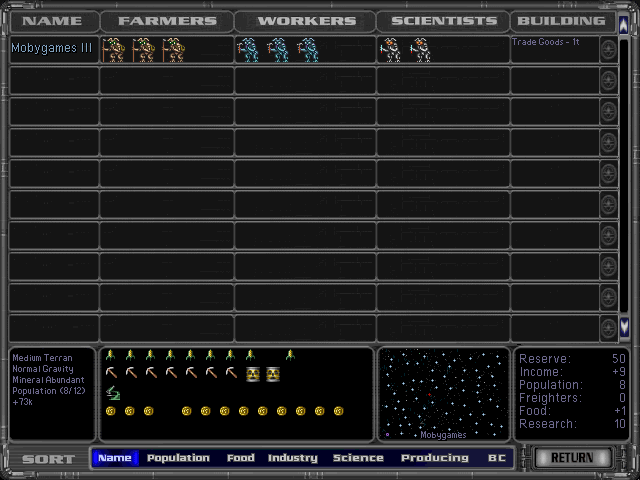
For all its tactical polish, the mid-to-late game phase reveals clear flaws in the management loop. Once your empire expands past fifteen or twenty star systems, managing individual planetary queues becomes a massive administrative headache. Unlike the original game's simple slider controls, every single colony demands manual attention for its building queues, worker assignments, and terraforming projects.
The galactic threats can also throw unpredictable wrenching wrenches into a solid run. Interdimensional Antaran raiders appear from random wormholes to target your richest worlds, often ignoring closer AI rivals entirely. If the random number generator decides to launch a heavy Antaran fleet strike while three neighboring alien AI empires form a surprise alliance against you, a winning campaign can collapse in a couple of brutal turns.
Multiplayer was another area that hit hard friction at release. Attempting to play this classic MicroProse Software, Inc. publication over a modem connection or hotseat mode frequently resulted in system crashes. The developers even built in a cheeky anti-cheat mechanism: if you hold Alt on the starmap screen and type "moola" for credits or "einstein" for instantly unlocked technology, the game broadcasts a public warning message to every human opponent in the match letting them know you are cheating.
SimTex, Inc. was closed down by MicroProse shortly after shipping the game, despite winning the Origins Award for Best Fantasy or Science Fiction Computer Game of 1996. Every space-based strategy / tactics game released since still gets measured against what SimTex built here.
To succeed across a full campaign, you need to master several core mechanics:
- Balancing food, industry, and scientific research output across every newly settled planet.
- Designing specialized ship classes tailored to counter your immediate neighbor's weapon loadouts.
- Securing diplomatic non-aggression treaties or voting leverage on the Galactic Council.
- Building dimensional portals to invade the Antaran homeworld directly for an instant victory.
How to play Master of Orion II: Battle at Antares online today
You can play Master of Orion II: Battle at Antares free in your browser right now, with zero installation needed. When launch boots up, select a medium-sized galaxy with three opponents to keep the early turn speed brisk, pick a custom race, and put your first research points into basic planetary automated factories.
The crisp VGA visual interface and Laura Barratt's synth soundtrack hold up clean and sharp on a modern display. Skip the stock alien templates on your first run, build a custom species focused on production and scientific growth, and see how fast you can conquer Orion before the dimensional raiders arrive.
How Master of Orion II: Battle at Antares is played — the keys the game listens to, grouped by what they do.
- Interface
- Right click — Open summary explanation
Highlighted keys are mapped — hover or tap one to see what it does.
Players' controls
Touch and gamepad controls
The on-screen keyboard and gamepad mapping the browser player uses on a phone, a tablet or a controller, as opposed to the real keys above. $PRO members make their own in the player and share them here; anyone can pick one to play with.
Make your own touch controlsPRO
- 1Open the editorSign in below, then pick what to make. The game starts with the editor open over it.
- 2Place your keysAdd keys and drag them where your thumbs rest, or map a controller's buttons. Test plays the game with them; Save keeps them, and you play with them from then on.
- 3Share themShare them right after saving in the game, or name and share them here. Players vote, and the best become this game's controls for everyone.
Go PROSee how it worksSign in+20 XP for sharing · +50 XP if yours become the game's own
- The game's own controlsKeyboardGamepadWhat every player starts with.In use
4 screenshots
From the archive
No gameplay video yet
No gameplay video for Master of Orion II: Battle at Antares yet. Sign in to add one.
No reviews yet
Tell the community what you think of Master of Orion II: Battle at Antares. Reviews are public and tied to your username.
No archived manuals for Master of Orion II: Battle at Antares yet
No manuals archived for this title yet. Sign in to upload the first scan.
Cheat codes, console commands and memory pokes for Master of Orion II: Battle at Antares — each one verified and attributed.
Sign in to submitNo cheats yet for this title
Know a working cheat, poke or trainer? Add it with the button above. Moderators check every entry before it goes live.
No archived soundtrack for Master of Orion II: Battle at Antares yet
No soundtrack archived for this title yet. Sign in to upload the first rip.
No save states for Master of Orion II: Battle at Antares yet
No save states for this title yet. Sign in to share one.
Discussions
Sign in to post- Threads0
- Total posts0
- Online now6
Community · Master of Orion II: Battle at Antares
Who's contributing, and what's new
- Reviews0
- Threads0
- Uploadsapproved0
- Contributors0
Recent activity
Nothing here yet
Reviews, discussion threads and approved uploads appear here as members add them.