When Mortal Kombat arrived on PC displays in 1994, standard IBM-compatibles suddenly housed the same blood-soaked, digitized arcade violence that was keeping parents awake at night.
Porting a high-profile coin-op title to home PCs used to mean stripped-down graphics, missing animation frames, and tinny sound. Developer Probe Software Ltd. avoided that trap by taking advantage of how Midway built the original game. Because the arcade cabinet ran on C code, programmers Mark Roll and Gary Liddon could translate the core logic over to MS-DOS almost line for line.
Published by Acclaim Entertainment, Inc., the PC version captured the real digitized actors, complete special move sets, and dramatic character scaling. Audio conversion fell to Allister Brimble, who crafted sound profiles for Roland MT-32, Sound Blaster, and AdLib cards. Cranking up a Sound Blaster card gave players the full weight of Goro's heavy footsteps and Shang Tsung's booming announcements.
Crucially, PC owners received the completely uncensored arcade game. While Nintendo famously scrubbed the blood and altered the finishing moves on the Super NES, this DOS release kept every drop of red gore intact right out of the box.
Strip away the controversy and you find a strict, deliberate action title built on positioning and timing. You pick one of seven fighters: Liu Kang, Sonya Blade, Kano, Johnny Cage, Sub-Zero, Scorpion, or Raiden. Every match is a best-of-three duel across arenas like The Courtyard, The Palace Gates, and The Pit.
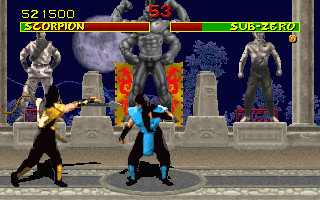
The single-player ladder tests your patience immediately. You fight through the six other characters, overcome a mirror match against yourself, and survive three brutal double-character endurance rounds. Between certain fights, the game throws in "Test Your Might" mini-games where you mash buttons to break blocks of wood, stone, or diamond.
Clear those endurance runs and you meet Goro, the four-armed Shokan sub-boss who can crush half your health bar in two hits. Beat Goro, and shape-shifting sorcerer Shang Tsung sits waiting at the top of the tower. He morphs into any fighter in the game at will, forcing you to adjust your strategy every few seconds.
Playing the 1994 release on a standard setup reveals its most frustrating flaw: the default keyboard controls. Executing sweeping quarter-circle special moves or multi-button Fatality sequences on standard arrow keys feels clunky. Without a four-button PC gamepad or a dedicated joystick, pulling off Sub-Zero's head-rip requires genuine finger gymnastics.
Modern emulation brings its own quirk with CPU cycles. If your DOS environment runs unchecked, the game timer ticks down at triple speed, turning strategic duels into frantic button-mashing panics.
Secret hunters still love poking around in the configuration screens. Booting up the setup menu, pressing F10, and typing DIP while holding Shift opens a secret menu. This toggles blood options, Fatality switches, and CPU finisher behaviors directly.
If you drop to the bottom of The Pit stage under strict conditions, you can even fight the hidden green ninja, Reptile. He combines the movement speeds and special attacks of both Sub-Zero and Scorpion into one terrifying opponent.
Even with its stiff keyboard inputs and punishing boss fights, this conversion proved what a 1990s PC conversion could actually pull off. The digitized sprites hold up visually, the audio hits hard, and the core combat retains its brutal arcade feel. Anyone who grew up on early DOS fighting games should fire it up again for an evening.
You can play Mortal Kombat online free in your browser right now with nothing to install. Jump straight into the tournament, test your reflexes against Goro, and land a bloody Fatality on Shang Tsung without digging up old setup disks.
When Mortal Kombat arrived on PC displays in 1994, standard IBM-compatibles suddenly housed the same blood-soaked, digitized arcade violence that was keeping parents awake at night.
Porting a high-profile coin-op title to home PCs used to mean stripped-down graphics, missing animation frames, and tinny sound. Developer Probe Software Ltd. avoided that trap by taking advantage of how Midway built the original game. Because the arcade cabinet ran on C code, programmers Mark Roll and Gary Liddon could translate the core logic over to MS-DOS almost line for line.
Published by Acclaim Entertainment, Inc., the PC version captured the real digitized actors, complete special move sets, and dramatic character scaling. Audio conversion fell to Allister Brimble, who crafted sound profiles for Roland MT-32, Sound Blaster, and AdLib cards. Cranking up a Sound Blaster card gave players the full weight of Goro's heavy footsteps and Shang Tsung's booming announcements.
Crucially, PC owners received the completely uncensored arcade game. While Nintendo famously scrubbed the blood and altered the finishing moves on the Super NES, this DOS release kept every drop of red gore intact right out of the box.
Strip away the controversy and you find a strict, deliberate action title built on positioning and timing. You pick one of seven fighters: Liu Kang, Sonya Blade, Kano, Johnny Cage, Sub-Zero, Scorpion, or Raiden. Every match is a best-of-three duel across arenas like The Courtyard, The Palace Gates, and The Pit.
The single-player ladder tests your patience immediately. You fight through the six other characters, overcome a mirror match against yourself, and survive three brutal double-character endurance rounds. Between certain fights, the game throws in "Test Your Might" mini-games where you mash buttons to break blocks of wood, stone, or diamond.
Clear those endurance runs and you meet Goro, the four-armed Shokan sub-boss who can crush half your health bar in two hits. Beat Goro, and shape-shifting sorcerer Shang Tsung sits waiting at the top of the tower. He morphs into any fighter in the game at will, forcing you to adjust your strategy every few seconds.
Playing the 1994 release on a standard setup reveals its most frustrating flaw: the default keyboard controls. Executing sweeping quarter-circle special moves or multi-button Fatality sequences on standard arrow keys feels clunky. Without a four-button PC gamepad or a dedicated joystick, pulling off Sub-Zero's head-rip requires genuine finger gymnastics.
Modern emulation brings its own quirk with CPU cycles. If your DOS environment runs unchecked, the game timer ticks down at triple speed, turning strategic duels into frantic button-mashing panics.
Secret hunters still love poking around in the configuration screens. Booting up the setup menu, pressing F10, and typing DIP while holding Shift opens a secret menu. This toggles blood options, Fatality switches, and CPU finisher behaviors directly.
If you drop to the bottom of The Pit stage under strict conditions, you can even fight the hidden green ninja, Reptile. He combines the movement speeds and special attacks of both Sub-Zero and Scorpion into one terrifying opponent.
Even with its stiff keyboard inputs and punishing boss fights, this conversion proved what a 1990s PC conversion could actually pull off. The digitized sprites hold up visually, the audio hits hard, and the core combat retains its brutal arcade feel. Anyone who grew up on early DOS fighting games should fire it up again for an evening.
You can play Mortal Kombat online free in your browser right now with nothing to install. Jump straight into the tournament, test your reflexes against Goro, and land a bloody Fatality on Shang Tsung without digging up old setup disks.
How Mortal Kombat is played — the keys the game listens to, grouped by what they do.
Highlighted keys are mapped — hover or tap one to see what it does.
Sources place the MS-DOS release of Mortal Kombat in 1993 rather than 1994. Controls are redefinable in the game options.
The on-screen keyboard and gamepad mapping the browser player uses on a phone, a tablet or a controller, as opposed to the real keys above. $PRO members make their own in the player and share them here; anyone can pick one to play with.
Cheat codes, console commands and memory pokes for Mortal Kombat — each one verified and attributed.
Sign in to submitHow Mortal Kombat is played — the keys the game listens to, grouped by what they do.
Highlighted keys are mapped — hover or tap one to see what it does.
Sources place the MS-DOS release of Mortal Kombat in 1993 rather than 1994. Controls are redefinable in the game options.
The on-screen keyboard and gamepad mapping the browser player uses on a phone, a tablet or a controller, as opposed to the real keys above. $PRO members make their own in the player and share them here; anyone can pick one to play with.
Cheat codes, console commands and memory pokes for Mortal Kombat — each one verified and attributed.
Sign in to submit