

When Mortal Kombat II landed on MS-DOS, it brought the full arcade roster, digitised blood splashes, and stage Fatalities straight to home monitors that had never seen anything quite so brutal.
The arcades came home in 1994 without losing the blood
The moment you step onto the dirt in Outworld, the rhythm of fight design hits immediately. Ed Boon and John Tobias trimmed the awkward delays from the first title, giving every punch and sweep a snap that feels sharp under your fingers. High kicks land with heavy weight, roundhouses clear space, and executing a crisp bicycle kick with Liu Kang or dropping a shadow kick with Johnny Cage rewards precise direction taps. Earthrealm fighters head into Shao Kahn's tournament with five distinct difficulty settings, but even on lower tiers, the computer opponents waste no time punishing missed special moves.
The pixelated fighters are built from digitised photographs of real actors, giving Kitana, Jax, Baraka, and Kung Lao an athletic, grounded motion on screen. Watching Mileena drop through the floor to teleport behind you or Reptile melt into invisibility keeps you constantly watching opponent animations. The action takes place across arenas like the Acid Pool, the Ceiling Spikes area, and the Abyss, where winning two rounds out of three is only the halfway mark of a match.
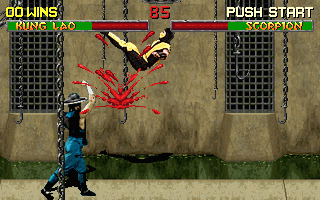
Ending a match is where the game turns into a cultural lightning rod. Once the announcer barks the famous command, you have a brief window to punch in a tight button sequence. Beyond classic character Fatalities and environment-specific death traps, this sequel introduced lighter humiliations like Babalities, which transform defeated rivals into crying infants, and Friendships, where your warrior offers a gift instead of taking a life.
Why fighting Shao Kahn in Mortal Kombat II broke so many keyboards
Single-player progression follows a climbing ladder of opponents that eventually leads to sub-boss Kintaro and the emperor Shao Kahn himself. While playing against a friend sitting beside you delivers balanced, competitive fun, the solo arcade ladder cheats shamelessly. High-level computer enemies read your controller inputs frame by frame, countering special attacks before the animation even starts on screen.
To get past late-ladder fights, players often relied on repetitive AI exploits rather than clean martial arts execution. Jumping backward and throwing high fireballs or catching the computer on predictable uppercut loops became standard survival tactics. Computer Gaming World noted in 1995 that the multiplayer mode was a whole lot of fun when fighting a friend, but the late-game boss encounters tested anyone's patience.
- Liu Kang: Strong space control with high fireballs, low fireballs, and the bicycle kick.
- Sub-Zero: Freezes enemies in place to open up free uppercuts and high-damage combos.
- Scorpion: Pulls opponents across the screen with his spear for immediate punishment.
- Baraka: Uses blade swipes and spark projectiles to dominate close-range trades.
- Jax: Devastates up close with ground quakes and multi-hit grapple slams.
The difficulty curve turns into a vertical wall once Kintaro steps into the arena. The four-armed giant absorbs normal strikes with minimal flinching and can crush half your health bar in two quick grabs. Defeating him only earns you a match against Shao Kahn, who taunts continuously while throwing shoulder charges and heavy energy spears that ignore standard guard timings.
Hardware setups made or ruined the PC port
The Midway Games arcade original was translated to home computers by a programming team including Ed Boon and Brian O'Shaughnessy, released under Acclaim Entertainment. On action games fans' rigs in 1994, audio hardware dictated whether you heard Dan Forden's full musical score and punchy voice lines or quiet, muffled thuds. The manual listed explicit setup options for Sound Blaster, Sound Blaster AWE32, Gravis Ultrasound, Roland SCC-1, and Roland LAPC-1 cards.
If your autoexec and config files lacked the proper DMA and IRQ values for a Sound Blaster board, the atmosphere evaporated. Today, running the Mortal Kombat II MS-DOS game under modern software emulation presents its own technical traps. Without capping CPU cycles, the match timer ticks down in seconds and characters move so fast that pulling off a special move becomes impossible.
When configured properly with accurate cycle limits, the DOS port delivers a high frame rate and a sharp visual conversion. Side by side with console versions of the same era, the PC conversion preserved crisp graphics resolution and fast animation recovery times. I always preferred playing with two keyboard users crammed over one board, trading space on the arrow keys and numpad.
Secrets, senators, and the birth of video game ratings
This release is packed with hidden features that reward curious players. Secret unplayable fighters like Jade, Smoke, and Noob Saibot jump out to challenge you if you fulfill obscure battle conditions, such as winning rounds using only low kicks on specific backgrounds. On the PC screen, typing the secret character string AICULEDSSUL during the startup copyright display opens a hidden developer menu filled with dipswitch toggles and fight options.
The graphic nature of these finishing moves made headlines far beyond gaming magazines. Explicit gore in the series became a central focal point during US Senate hearings on electronic media violence, hosted by senators Joe Lieberman and Herbert Kohl. That political pressure forced the interactive entertainment industry to establish the ESRB rating system, permanently changing how boxes were labeled on store shelves.
While some regional gaming publications issued low scores to bundled releases due to technical hardware hurdles, standalone reviews recognized how faithfully the conversion captured the arcade cabinet's speed. The sheer density of special moves and secret inputs kept players grinding away in practice rounds for months.
You can play Mortal Kombat II online right now
Decades after its original computer release, it still plays like a brutal, aggressive fighting game. The single-player bosses are notoriously cheap, but the deep roster, responsive movement, and secret-heavy design make it rewarding to revisit with a second player.
You can play Mortal Kombat II online, free in your browser, with nothing to install and no setup required. Launch the game, pick Liu Kang or Sub-Zero, and practice your timing on frozen uppercuts and stage Fatalities right away.