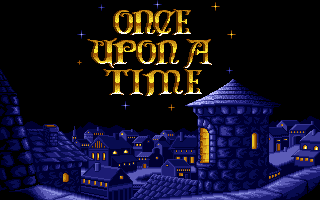
Once Upon A Time: Little Red Riding Hood
Playing Once Upon A Time: Little Red Riding Hood lets you choose whether to carry cake to Grandmother or hunt forest animals as the big bad Wolf in Coktel Vision's 1991 storybook adventure.
Turning standard fairy tales into dual-perspective DOS software
Adapting traditional folklore for early PCs presented a specific mechanical challenge in 1991. Simply turning pages on a computer screen felt static, yet full narrative action games required more memory and design complexity than most educational titles used. Coktel Vision solved this by splitting the narrative of Once Upon A Time: Little Red Riding Hood down the middle, letting you pick your character before setting foot in the woods.
Choosing your path alters every goal and screen logic you encounter. Playing as Little Red Riding Hood puts you on a rescue and delivery run across flipped forest screens, while selecting the Wolf transforms the game into a predatory scavenger hunt. That simple choice gives this action game a completely different dynamic depending on which side of the tale you want to experience.
Playing both sides of Once Upon A Time: Little Red Riding Hood
The core loop jumps across three distinct gameplay modes for each character. First-person screens handle object collection and puzzle mechanics, side-scrolling arcade sequences handle forest traversal, and direct first-person showdowns resolve the main conflict.
- As Little Red Riding Hood: You collect items to bring cake to Grandmother or locate houses for lost animals in first-person view, cross the side-view forest catching butterflies or collecting nuts while dodging wasps, and strike the Wolf with a stick during direct encounters.
- As the Wolf: You gather hunting gear or flush animals from their burrows in first-person view, navigate the side-scrolling forest catching birds and squirrels to eat while avoiding a rival Raven, and swipe at Little Red Riding Hood with your claws.
This layout forces you to pivot constantly between slow inventory checks and immediate twitch reactions. Catching butterflies or snatching squirrels in the side-scrolling mode requires precise timing, especially when airborne hazards like wasps or the Raven cut across your jump arcs.
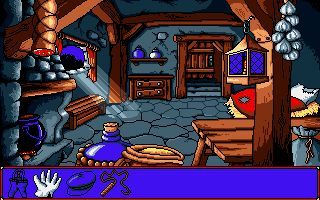
The Coktel Vision engine behind the storybook screens
Underneath the illustrated graphics, the game runs on Coktel Vision's proprietary Gob engine. Project leader François Nedelec directed the production, while Catherine Lucas designed the dual scenarios. The visual look came from artists Kaki Chapoullié and Pascal Pautrot, who crafted flip-screen layouts that look like classic European picture book pages.
Composer Frédéric Motte, known in the tracker community as elMobo, provided the soundtrack. On standard PC Speakers, the sound effects offer basic, sharp clicks, but running the audio through an AdLib or Roland MT-32 sound card gives the forest sequences distinct musical backing. Like many releases from Coktel Vision in 1991, the retail package included physical copy protection that forced players to check answers against the printed manual or a bundled code wheel before starting a run.
Switching between perspectives creates real mechanical friction
The abrupt shift from point-and-click item gathering to twitch arcade movement is where most runs break down. The side-view forest scenes do not offer smooth, forgiving controls. If you misjudge a jump while dodging a wasp as Little Red Riding Hood, you lose momentum instantly, forcing tedious restarts across the forest path.
The final first-person showdowns can also feel erratic. Striking with the stick or slashing with claws relies on rapid point-and-click positioning, which easily leads to missed swings if your cursor drifts. Choosing between three difficulty levels helps mitigate the steep jumps in hazard speed, and finishing the campaign unlocks five predefined starting checkpoints for quick replays.
Play Once Upon A Time: Little Red Riding Hood online right now
If you want to try the Once Upon A Time: Little Red Riding Hood MS-DOS game without digging out old disks or entering manual lookup codes, you can start right away. The main attraction is taking control of the Wolf to chase down wildlife and dodge the annoying Raven in the side-scrolling sequences.
You can play Once Upon A Time: Little Red Riding Hood online free in your browser right here, with nothing to install and no setup. Pick your character on the main menu, choose your difficulty, and see if you can make it through the woods to Grandmother's house intact.