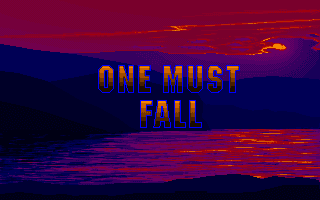
Before it evolved into a giant-robot arena fighter, One Must Fall started life in 1993 as a bare-bones MS-DOS prototype featuring two identical digitized karate fighters on a single screen.
Two human fighters on one DOS screen
Built for MS-DOS machines with VGA graphics cards, the game demands 500k of conventional memory alongside 540k of XMS memory to run. If you had a Sound Blaster or Sound Blaster Pro configured on port 220, every landed blow delivered a sharp digitised crunch alongside basic internal speaker chirps. PC developers were desperate to replicate the quarter-eating success of arcade hits like Street Fighter II, yet hardware limits forced massive compromises.
On screen, two digitised human sprites stand in a static arena. The graphics rely on captured actor frames, looking much like early Mortal Kombat digitisation layered over the minimalist presentation of Karate Champ. You and a second player control the exact same character model, down to the matching trousers and identical martial arts stance. There is no character selection menu, no world map, and no narrative backdrop. You step straight into the arena to trade blows.
Despite the visual symmetry, the control scheme offers a surprisingly varied offensive kit for a early PC fighter. Both players have access to direct punches and kicks, but the real meat lies in the special commands:
- High punches and low sweep kicks for basic mid-range spacing
- Fireballs thrown horizontally to force early defensive reactions
- Instant teleports that let a fighter vanish and reappear behind an opponent
- Shadow punches and shadow kicks that launch your fighter across the screen in a fast blur
Movement feels punchy, even if the collision detection occasionally acts up during rapid teleports. Landing a jumpkick into a sweep kick feels satisfying, but because both fighters possess the exact same counter-tools, matches quickly devolve into high-speed mind games of teleport traps and fireball trades.
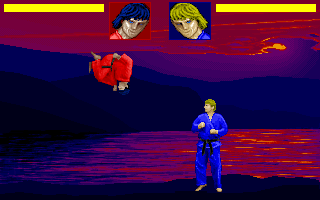
The severe limits of a 1993 freeware test
The immediate problem with this 1993 release is that you cannot play it alone. Developers Rob Elam and Ryan Elam built no computer-controlled opponent for this build. If you boot the software without a friend sitting next to you at the keyboard, player two simply stands motionless while you pummel a helpless target. There is no tournament ladder, no career mode, and no difficulty setting to tweak.
This missing single-player component turned away plenty of early dial-up users who pulled the archive off local bulletin boards. Expecting a full tournament experience, players instead found a raw technical engine test. Controlling two characters on a single keyboard was notoriously uncomfortable, often causing key-jamming bugs when both players tried to input special move commands at the exact same time.
The repetitive roster presented another barrier. Because both fighters use the exact same sprite and move list, matches lack the asymmetry that makes competitive fighting games work. Once you learn the range on the shadow kick and the timing for teleporting past fireballs, you have seen everything the game mechanics have to offer. The total package takes less than ten minutes to fully explore.
How Rob and Ryan Elam turned a raw engine into a real idea
Brothers Rob Elam and Ryan Elam published this prototype through Diversions Entertainment as a freeware release. It was distributed across BBS networks and included in various shareware CD-ROM compilations during the early nineties. The goal was simple: test whether an MS-DOS PC could handle fast-paced fighting game inputs and smooth sprite animation before committing to a full commercial release.
Feedback from the public test proved crucial. Players enjoyed the quick combat rhythm and special move inputs, but unanimously criticized the mirror-match setup and lack of single-player content. Recognizing that human martial artists felt too derivative of existing arcade titles, the Elam brothers abandoned the sprite digitisation entirely. They scrapped the human fighters and retooled the underlying code into what eventually became the giant-robot fighter One Must Fall: 2097.
Looking back at this freeware prototype alongside other action games from 1993 highlights how rapidly PC fighting game design evolved. Where traditional fighting games focused on expanding character rosters, Diversions Entertainment used this small release to refine sprite handling and input response first. The low-resolution human sprites may feel rough today, but the core engine responsiveness laid the exact groundwork for their later success.
Fireballs and teleports hit differently when you play One Must Fall online
As a finished product, this initial proof-of-concept obviously falls short of a complete fighting game. The lack of a CPU opponent means it functions more like an interactive software sketch than a full release. Yet as a piece of DOS gaming history, it provides a clear look at a famous franchise before it found its true identity in massive steel robots.
If you enjoy exploring early software prototypes or want to see how famous series started, this build remains fascinating to test with a friend. The quick special moves, rapid teleports, and retro sound effects hold a raw, historic charm that takes only minutes to appreciate.
You can play One Must Fall free in your browser right now on this page. There is nothing to install and no complex DOS memory setup required, so you can jump straight into the arena, throw a few fireballs, and experience this 1993 MS-DOS game directly in your browser window.
How One Must Fall is played — the keys the game listens to, grouped by what they do.
- Movement
- Action
- Interface
Highlighted keys are mapped — hover or tap one to see what it does.
The game speed can be adjusted in the options menu via Esc, as it runs significantly faster on modern hardware than its original speed.
Players' controls
Touch and gamepad controls
The on-screen keyboard and gamepad mapping the browser player uses on a phone, a tablet or a controller, as opposed to the real keys above. $PRO members make their own in the player and share them here; anyone can pick one to play with.
Make your own touch controlsPRO
- 1Open the editorSign in below, then pick what to make. The game starts with the editor open over it.
- 2Place your keysAdd keys and drag them where your thumbs rest, or map a controller's buttons. Test plays the game with them; Save keeps them, and you play with them from then on.
- 3Share themShare them right after saving in the game, or name and share them here. Players vote, and the best become this game's controls for everyone.
Go PROSee how it worksSign in+20 XP for sharing · +50 XP if yours become the game's own
- The game's own controlsKeyboardGamepadWhat every player starts with.In use
2 screenshots
From the archive
No gameplay video yet
No gameplay video for One Must Fall yet. Sign in to add one.
No reviews yet
Tell the community what you think of One Must Fall. Reviews are public and tied to your username.
No archived manuals for One Must Fall yet
No manuals archived for this title yet. Sign in to upload the first scan.
Cheat codes, console commands and memory pokes for One Must Fall — each one verified and attributed.
Sign in to submitNo cheats yet for this title
Know a working cheat, poke or trainer? Add it with the button above. Moderators check every entry before it goes live.
No archived soundtrack for One Must Fall yet
No soundtrack archived for this title yet. Sign in to upload the first rip.
No save states for One Must Fall yet
No save states for this title yet. Sign in to share one.
Discussions
Sign in to post- Threads0
- Total posts0
- Online now6
Community · One Must Fall
Who's contributing, and what's new
- Reviews0
- Threads0
- Uploadsapproved0
- Contributors0
Recent activity