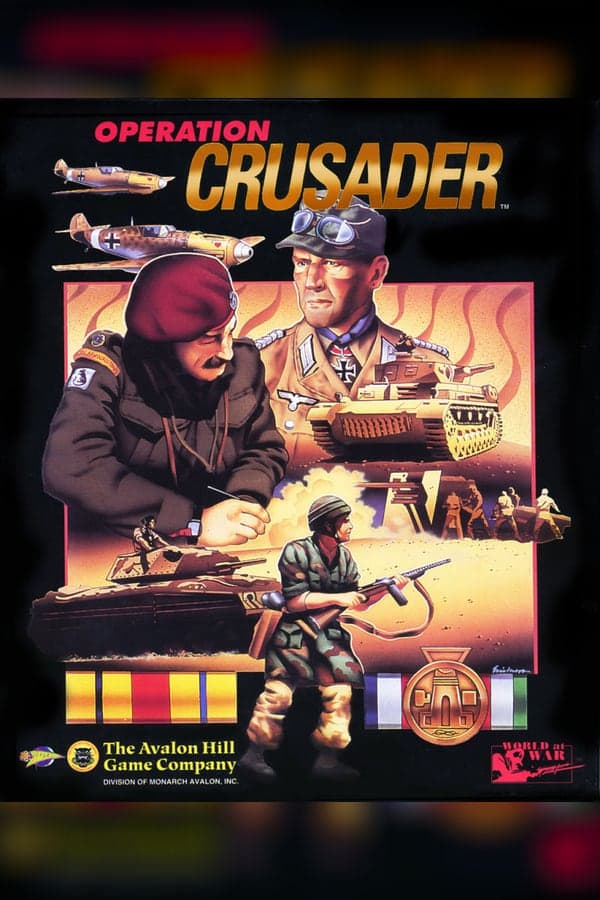
Operation Crusader
Checking…
In Operation Crusader, you take direct command of the 1941 North African desert campaign right down to individual engineering groups and night-fighting infantry.
Atomic Games built a sharper engine for Avalon Hill
By 1993, traditional board wargame sales were falling, and table publisher The Avalon Hill Game Company needed a clear digital strategy. Producer Jim Rose signed Atomic Games, founded by Keith Zabalaoui, Ed Rains, and Larry Merkel, to launch a new computer line. The result in 1994 was a massive simulation built on the foundation of their earlier V for Victory engine.
Instead of starting from scratch, the team retooled their existing codebase to handle desert mechanics. They expanded the fog-of-war rules and introduced much tighter controls for unit formations. It marked the start of Avalon Hill's World at War series, which later moved on to Stalingrad and Normandy.
The core setup places you in North Africa between November and December 1941. You can take either side, leading Erwin Rommel's forces or the Commonwealth Eighth Army backed by American supply shipments. The theater map is broad, but the tactical scope stays grounded in individual division orders.
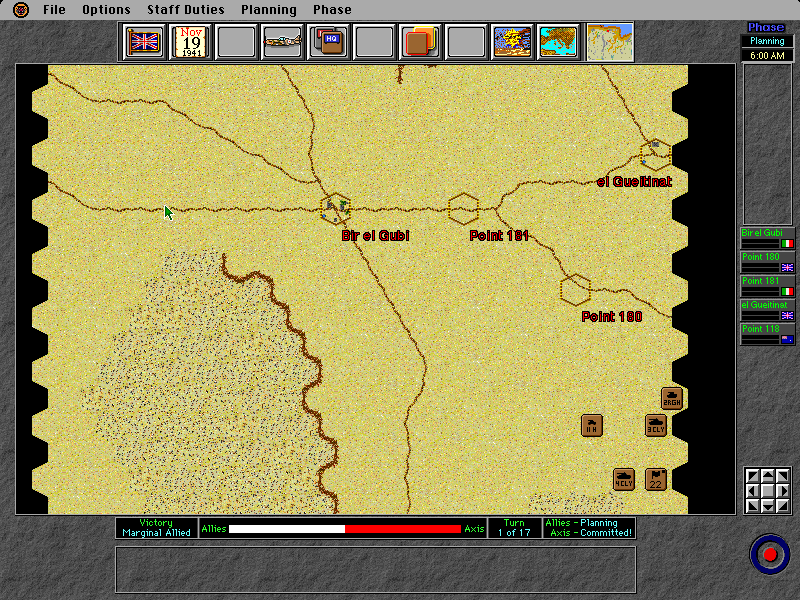
The decision loop in Operation Crusader
A good turn in this strategy and tactics title relies entirely on how carefully you plan your attack types. You do not just send a unit into a space and watch numbers crunch. You pick specific orders ranging from cautious low-intensity probes to high-risk all-out assaults.
A probing attack lets you test defense lines without committing your main forces to heavy casualties. If you misjudge enemy strength during an assault, your entire division can end up pinned down and low on fuel. You can also split formations to cover flank gaps or combine smaller detachments into heavy striking groups.
Every movement order must account for zone of control mechanics. Moving past enemy positions slows your momentum and risks cutting your own support paths. A bad turn usually starts with a greedy push that leaves an armors group stranded without infantry coverage.
Supply lines, Maori battalions, and interface pain
Desert combat in this game is fundamentally a logistics challenge. Tank divisions stop dead in the sand if gas supplies fail to reach them from coastal depots. You spend almost as much energy managing movement corridors as you do calculating armor penetration values.
Special traits make specific historical units feel distinct on the map. For example, the Maori battalion possesses dedicated night-combat abilities, making them ideal for surprise night operations. Utilizing these unique unit strengths at the right hour often turns a stubborn standoff around.
- Five focused single-battle scenarios for quick tactical engagements.
- One full theater campaign covering the complete winter 1941 timeline.
- A Random Variant toggle to shuffle unit setups and prevent repetitive openings.
- Play-by-email (PBEM) support for turn-based head-to-head matches against human opponents.
When you take on the AI, the computer keeps you honest, but play-by-email was where serious wargamers found real friction. Exchanging save files with a friend made multi-week matches tense, especially with hidden unit visibility turned on.
Where Operation Crusader hit the wall on 1994 hardware
When this original MS-DOS title shipped, it pushed mid-nineties personal computers straight to their limits. Period magazine reviewers explicitly warned that it was a memory-intensive program that demanded careful system configuration. It shipped with its own VESA driver for high-resolution SVGA graphics, which looked sharp but strained lower-end systems.
Sound card support included AdLib and Sound Blaster chips, though audio was easily the weakest part of the package. Reviewer coverage at GameBytes noted that the sound files were skippable and usually worth ditching to keep things moving. Fortunately, the printed manual was fantastic, packed with clear visual aids and thorough military reference material.
What plainly fails today is the sheer weight of the interface. Navigating nested menus to assign individual tasks to dozens of engineering groups becomes tiring during long turns. Yet the depth of simulation keeps grognards coming back to it decades later.
Play Operation Crusader online right now
If you want to experience a classic 1990s hex wargame without tracking down printed manuals or messing with system memory allocations, you can play Operation Crusader online right now. You can run the complete Operation Crusader MS-DOS game free in your browser directly on this page.
Load up the first desert scenario, set your attack force to a low-intensity probe, and see if you can crack the defensive line before your fuel supplies run dry.
Players' controls
Touch and gamepad controls
The on-screen keyboard and gamepad mapping the browser player uses on a phone, a tablet or a controller, as opposed to the real keys above. $PRO members make their own in the player and share them here; anyone can pick one to play with.
Make your own touch controlsPRO
- 1Open the editorSign in below, then pick what to make. The game starts with the editor open over it.
- 2Place your keysAdd keys and drag them where your thumbs rest, or map a controller's buttons. Test plays the game with them; Save keeps them, and you play with them from then on.
- 3Share themShare them right after saving in the game, or name and share them here. Players vote, and the best become this game's controls for everyone.
Go PROSee how it worksSign in+20 XP for sharing · +50 XP if yours become the game's own
- The game's own controlsNone yet: played with a real keyboard only.In use
2 screenshots
From the archive
No gameplay video yet
No gameplay video for Operation Crusader yet. Sign in to add one.
No reviews yet
Tell the community what you think of Operation Crusader. Reviews are public and tied to your username.
No archived manuals for Operation Crusader yet
No manuals archived for this title yet. Sign in to upload the first scan.
Cheat codes, console commands and memory pokes for Operation Crusader — each one verified and attributed.
Sign in to submitNo cheats yet for this title
Know a working cheat, poke or trainer? Add it with the button above. Moderators check every entry before it goes live.
No archived soundtrack for Operation Crusader yet
No soundtrack archived for this title yet. Sign in to upload the first rip.
No save states for Operation Crusader yet
No save states for this title yet. Sign in to share one.
Discussions
Sign in to post- Threads0
- Total posts0
- Online now6
Community · Operation Crusader
Who's contributing, and what's new
- Reviews0
- Threads0
- Uploadsapproved0
- Contributors0
Recent activity
Nothing here yet
Reviews, discussion threads and approved uploads appear here as members add them.