
Screenshot1mo ago
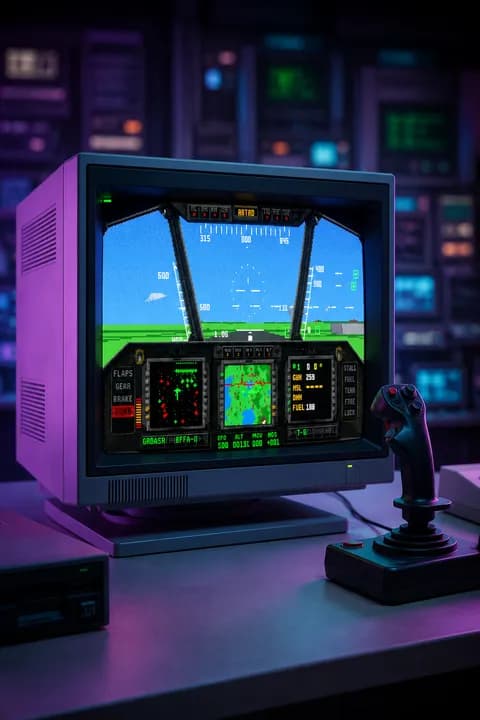
Owl Fly II
Seven video systems, from Hercules mono to VGA, and every one of them flies. Two squadrons fight an attrition war over a procedural island; you arrive as a spectator above it and press ENTER to take a jet. This is new code written in the idiom of the era, not a re-release of anything: pure 8086 assembly, one source file of about thirty thousand commented lines, assembled with flat assembler, no linker and no library. It is a DOS program - not specifically MS-DOS. It wants DOS and a video card and does not care whose.
RUNNING IT
Everything in this archive is what runs. Nothing needs building or installing.
IN DOSBOX
mount c <the folder holding this file>
c:
OWLFLY3
Tested with DOSBox 0.74-3, and with DOSBox compiled to WebAssembly (js-dos 8.3.20). DOSBOX.CONF in this archive holds the settings it was tested at; the one that matters is cycles=30000. Below that the frame rate suffers, and far above it the game runs faster than it was tuned for. In DOSBox you can also press Ctrl-F12 a few times instead.
No emulator is included here, deliberately. DOSBox is GPL software with its own distribution terms, and you will have your own build of it.
ON REAL HARDWARE
Copy every file out of this archive into one directory and run OWLFLY3. An 8086 will do. A Sound Blaster is not required, but it is what the sound was written for.
THE FIRST SCREEN
The game opens on SELECT VIDEO SYSTEM. Pick what the machine actually has - a mode the hardware lacks is marked as missing and will not appear by magic.
- HERCULES 720x348 mono the 6845 programmed by hand, dithered by density, with its own drawn cockpit
- CGA 320x200 palette 1, cyan/magenta/white. H swaps the hardware palette in flight
- EGA 320x200x16 runs on any EGA, the 64K card included
- EGA 640x350x16 EGA's best; wants a 128K card and an EGA monitor
- MCGA 320x200x256 the mode 13h path
- VGA 320x200x256 the game as born
- VGA 640x480x16 the crispest geometry of all
The renderer never changes. Every mode converts the same finished 320x200x256 frame, and the cockpit on the retro cards is its own drawn artwork rather than a per-pixel conversion of the VGA one.
CONTROLS
FLIGHT
- Arrows pitch and roll
- Q / E rudder left / right also Z, numpad 7 / 9, or top-row 1 / 3
- W / S throttle up / down also = / - , or numpad + / -
- Shift+W throttle to full
- Shift+S throttle to idle
- A afterburner (hold)
- F flaps
- L landing gear
- B airbrake
COMBAT
- ENTER lock the target under the sight
- Backspace launch a missile
- O master mode, air-to-air / air-to-ground
- SPACE back into the sky after being shot down
VIEWS
- F2 cockpit view
- F3 chase camera
- F4 orbit the locked target
- F5 missile camera, arm / disarm
- F6 / F7 look left / right, ninety degrees also Ctrl + left / right
- M right MFD mode
- N day / night
SYSTEMS
- G ground comms, VHF-FM - the army net
- U air comms, UHF - the squadron net
- I IFF transponder
- T TACAN
- P autopilot
- R emissions, transmit / receive
- J ECM
- Y noise jammer
- V sound: everything / effects only / silence
OTHER
- TAB or F8 change seats: the jet, or the Shilka on the ground
- Alt-Q quit
TWO PLAYERS
A shared sky runs over IPX, which DOSBox tunnels over UDP. One machine hosts with DOSBox's own "ipxnet startserver"; the other joins with "ipxnet connect <host address>". Then both run OWLFLY3 as usual.
The repository has NETHOST.BAT and NETJOIN.BAT, which do exactly that and nothing clever.
WHAT IS IN THIS ARCHIVE
- OWLFLY3.EXE the game
- *.DAT artwork, palettes, fonts, sound bank and the city
- ENGINE.RAW the turbine sample
- DOSBOX.CONF the settings it was tested at
- README.TXT this file
- LICENSE.TXT MIT
- FILE_ID.DIZ the short description, for archives that want one
- WEB\ the same game packaged for js-dos, if you host games in a browser. It contains no emulator.
LICENCE AND SOURCE
MIT. Copyright (c) 2026 Denys Kirin. See LICENSE.TXT.
Every byte in this archive is the author's own work. Nothing third-party is redistributed here.
Source, build instructions and the architecture notes:
https://github.com/KirinDenis/wire-city-2
The game in a browser, and the fuller instructions:
https://kirindenis.github.io/wire-city-2/owlfly3.html
The whole workshop - four games, thirteen teaching programs and the lessons that go with them:
https://kirindenis.github.io/wire-city-2/