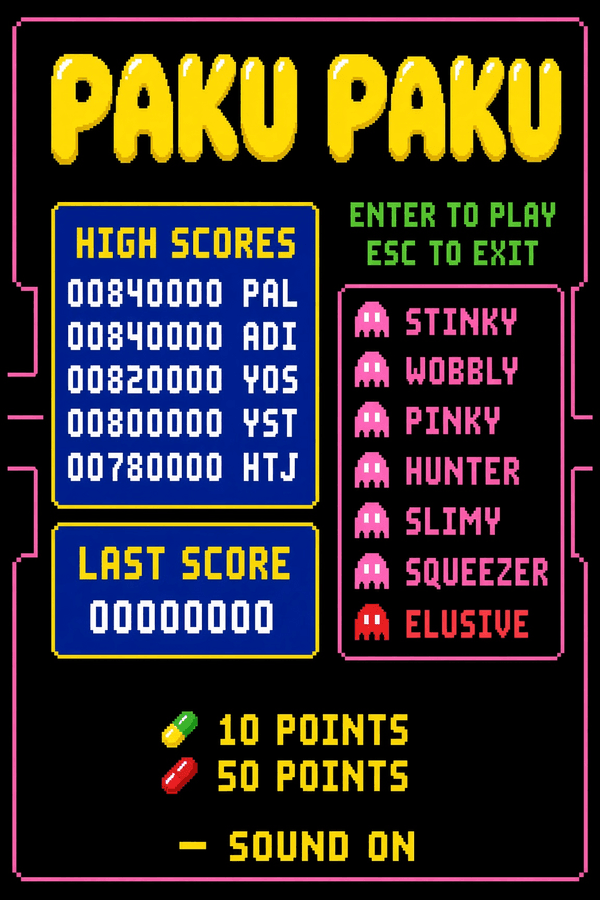
Jason M. Knight created Paku Paku to prove that an 8088 PC could deliver a sharp arcade maze chase using an obscure CGA display trick.
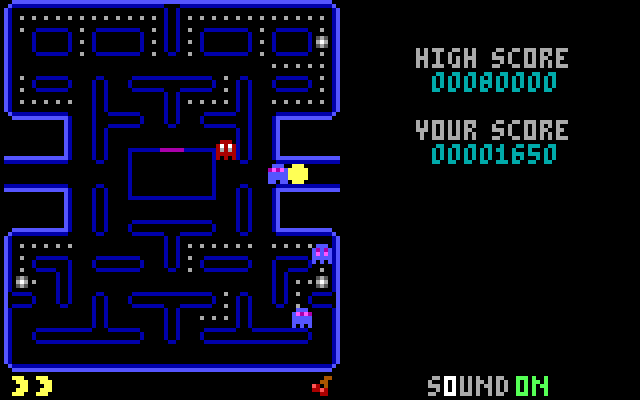
When you drop into Paku Paku, you immediately notice how quick the movement feels. You guide a yellow creature around a maze, gobbling dots while four ghosts hunt you down. It matches the arcade cabinet right down to the target behaviors of the ghost crew.
The four ghosts do not just wander around at random. The red ghost pursues you directly, closing the distance whenever it can. The magenta ghost tries to position itself in front of your movement vector to set up ambushes. The cyan ghost bases its decisions on your distance relative to the red ghost, while the brown ghost follows a much sillier wandering pattern that often saves your life when trapped in a corner.
Eating one of the larger power pellets turns all four pursuers dark blue. They immediately attempt to flee, allowing you to munch them for escalating point bonuses. Fruit items pop up near the center of the screen for brief periods, giving you a chance to pad your high score if you dare to venture into the open middle corridors.
The technical structure behind this action title is where hardware nerds start taking notes. Developed by Jason M. Knight for the Retrochallenge winter warm-up in 2011, the Paku Paku MS-DOS game runs on vintage hardware as modest as a 4.77 MHz IBM 8088 processor with 128KB of RAM.
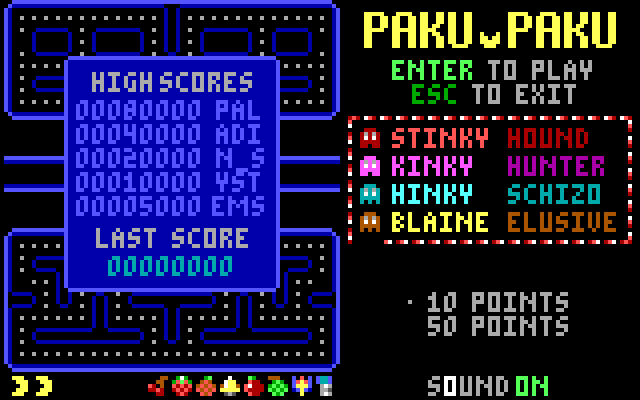
Instead of relying on standard bitmap modes, the developer hacked the standard 80x25 CGA text mode. By tweaking hardware registers on the display card, the screen is forced to display 80x100 line segments. Combined with ASCII extended box-drawing half-block characters, the game effectively tricks the monitor into showing a 160x100 resolution display using 16 colors.
Because the lower effective grid resolution can make tight turns feel sticky, Knight coded a clever movement helper. The engine detects your directional inputs and gives your character a one-pixel boost when turning around corners. The community came to call this the "boot in the patoot" mechanism, and it keeps cornering crisp despite the chunky pixel grid.
The sound routines in Paku Paku are just as crafted as the visual engine. Knight wrote the code using a hybrid mix of Turbo Pascal 7 and raw 8086 Assembly. The entire executable sits at roughly 66 kilobytes in memory, with executable instructions taking up only about half of that space.
Audio hardware support is wide-ranging across early IBM PC standards. The game features sound routines tailored for the standard internal PC speaker, Tandy 3-voice sound chips, the Creative Music System (CMS), and Yamaha OPL FM synthesis cards such as the AdLib and Sound Blaster. Hearing authentic arcade sound effects chiming out of a basic PC speaker is surprisingly satisfying.
Early releases were not completely bug-free. Version 1.5 suffered from intermittent system freezes when initializing Creative Music System audio drivers, though version 1.6 quickly resolved the issue. Knight released the project as cardware, asking happy players to mail him a physical postcard while placing the complete Pascal and assembly source code into the public domain.
Clearing every dot on the board triggers a stage reset, refreshing the maze layout and ramping up the global game speed. The acceleration curve strikes a healthy balance. It never feels unmanageable in early stages, but it forces snappy reaction times once you push deep into a session.
The principal hurdle you face during long runs comes down to spatial awareness. The wide half-block pixels mean the gap between your character and an incoming ghost looks small long before collision occurs. Learning the exact hitbox boundaries takes a few attempts, particularly when trying to squeeze past the cyan ghost in narrow hallways.
If you want a quick session that feels right without touching modern remakes, this homebrew release nails the rhythm. The controls respond instantly to key presses, and the audio engine brings early DOS sound chips to life. It is a tight, impressive piece of tiny-footprint assembly coding.
You can play Paku Paku online right now, right here in your web browser. There is no installation required and no need to hunt down low-level CGA register settings or memory managers. The movement response is tight, the ghost AI behaves just as it should, and the OPL sound synthesis translates directly to modern audio outputs.
Whether you want to test your maze-running line execution or inspect how far clever assembly programming can stretch basic text modes, Paku Paku free in your browser is ready for your next quick break.
Jason M. Knight created Paku Paku to prove that an 8088 PC could deliver a sharp arcade maze chase using an obscure CGA display trick.
When you drop into Paku Paku, you immediately notice how quick the movement feels. You guide a yellow creature around a maze, gobbling dots while four ghosts hunt you down. It matches the arcade cabinet right down to the target behaviors of the ghost crew.
The four ghosts do not just wander around at random. The red ghost pursues you directly, closing the distance whenever it can. The magenta ghost tries to position itself in front of your movement vector to set up ambushes. The cyan ghost bases its decisions on your distance relative to the red ghost, while the brown ghost follows a much sillier wandering pattern that often saves your life when trapped in a corner.
Eating one of the larger power pellets turns all four pursuers dark blue. They immediately attempt to flee, allowing you to munch them for escalating point bonuses. Fruit items pop up near the center of the screen for brief periods, giving you a chance to pad your high score if you dare to venture into the open middle corridors.

The technical structure behind this action title is where hardware nerds start taking notes. Developed by Jason M. Knight for the Retrochallenge winter warm-up in 2011, the Paku Paku MS-DOS game runs on vintage hardware as modest as a 4.77 MHz IBM 8088 processor with 128KB of RAM.
Instead of relying on standard bitmap modes, the developer hacked the standard 80x25 CGA text mode. By tweaking hardware registers on the display card, the screen is forced to display 80x100 line segments. Combined with ASCII extended box-drawing half-block characters, the game effectively tricks the monitor into showing a 160x100 resolution display using 16 colors.
Because the lower effective grid resolution can make tight turns feel sticky, Knight coded a clever movement helper. The engine detects your directional inputs and gives your character a one-pixel boost when turning around corners. The community came to call this the "boot in the patoot" mechanism, and it keeps cornering crisp despite the chunky pixel grid.
The sound routines in Paku Paku are just as crafted as the visual engine. Knight wrote the code using a hybrid mix of Turbo Pascal 7 and raw 8086 Assembly. The entire executable sits at roughly 66 kilobytes in memory, with executable instructions taking up only about half of that space.
Audio hardware support is wide-ranging across early IBM PC standards. The game features sound routines tailored for the standard internal PC speaker, Tandy 3-voice sound chips, the Creative Music System (CMS), and Yamaha OPL FM synthesis cards such as the AdLib and Sound Blaster. Hearing authentic arcade sound effects chiming out of a basic PC speaker is surprisingly satisfying.
Early releases were not completely bug-free. Version 1.5 suffered from intermittent system freezes when initializing Creative Music System audio drivers, though version 1.6 quickly resolved the issue. Knight released the project as cardware, asking happy players to mail him a physical postcard while placing the complete Pascal and assembly source code into the public domain.

Clearing every dot on the board triggers a stage reset, refreshing the maze layout and ramping up the global game speed. The acceleration curve strikes a healthy balance. It never feels unmanageable in early stages, but it forces snappy reaction times once you push deep into a session.
The principal hurdle you face during long runs comes down to spatial awareness. The wide half-block pixels mean the gap between your character and an incoming ghost looks small long before collision occurs. Learning the exact hitbox boundaries takes a few attempts, particularly when trying to squeeze past the cyan ghost in narrow hallways.
If you want a quick session that feels right without touching modern remakes, this homebrew release nails the rhythm. The controls respond instantly to key presses, and the audio engine brings early DOS sound chips to life. It is a tight, impressive piece of tiny-footprint assembly coding.
You can play Paku Paku online right now, right here in your web browser. There is no installation required and no need to hunt down low-level CGA register settings or memory managers. The movement response is tight, the ghost AI behaves just as it should, and the OPL sound synthesis translates directly to modern audio outputs.
Whether you want to test your maze-running line execution or inspect how far clever assembly programming can stretch basic text modes, Paku Paku free in your browser is ready for your next quick break.
How Paku Paku is played — the keys the game listens to, grouped by what they do.
Highlighted keys are mapped — hover or tap one to see what it does.
Joystick support requires launching the executable with the /joy command line option.
The on-screen keyboard and gamepad mapping the browser player uses on a phone, a tablet or a controller, as opposed to the real keys above. $PRO members make their own in the player and share them here; anyone can pick one to play with.
Cheat codes, console commands and memory pokes for Paku Paku — each one verified and attributed.
Sign in to submitHow Paku Paku is played — the keys the game listens to, grouped by what they do.
Highlighted keys are mapped — hover or tap one to see what it does.
Joystick support requires launching the executable with the /joy command line option.
The on-screen keyboard and gamepad mapping the browser player uses on a phone, a tablet or a controller, as opposed to the real keys above. $PRO members make their own in the player and share them here; anyone can pick one to play with.
Cheat codes, console commands and memory pokes for Paku Paku — each one verified and attributed.
Sign in to submit