
Perils of Treasure Mountain
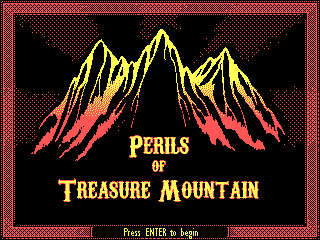
Perils of Treasure Mountain strips action-adventure mechanics down to block-by-block movement and a classic four-color palette, sending you into desert paths to recover stolen explosives.
Bandit raids and single-tile steps set the tempo quickly
You start stranded in the wilderness after a band of local outlaws ransacks your camp. They took your weapons and stole the dynamite meant to clear the entrance of a collapsed, resource-rich mine. Without those explosives, your expedition ends before it starts, leaving you to push forward into hostile territory with bare hands and no margin for error.
The control scheme keeps things basic. You move block-by-block using the arrow keys, holding Space to strike in the direction you face, while numeric keys switch through your collected inventory items. Because movement locks strictly to the grid, positional awareness matters far more than fast reflexes. Steering your hero through narrow passages requires calculating every step before you make it.
That tile-by-tile cadence gives combat an unforgiving, almost turn-based quality despite happening in real time. Stepping directly onto an enemy space guarantees taking damage, so you have to bait hostile targets toward open ground where you can turn and attack before they close the distance. It is an intentional design choice that rewards careful planning over mindless button mashing.
Perils of Treasure Mountain cheats on its 1980s display tech
Built by developer Eigen Lenk as an entry for CGA Jam in 2017, the game captures the aesthetic of early PC monitors while using modern coding tools under the hood. The visual presentation relies on the recognizable cyan, magenta, black, and white palette of IBM's Color Graphics Adapter standard. The crisp sprites and high-contrast environments ensure that every rock, pathway, and enemy remains clearly readable on screen.
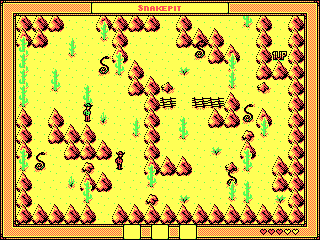
Purists who test this action game on period hardware will quickly catch the illusion. The game was constructed in C++ using the Allegro programming library, which handles graphics blitting, input, and MIDI playback. Because Allegro relies on VGA resolution modes, the software actually renders at 320x240 pixels in an 8-bit color mode that only simulates a CGA palette rather than running in true native 320x200 CGA. Trying to run this Perils of Treasure Mountain MS-DOS game on a vintage 8088 processor like a Book8088 will crash; the engine strictly requires a 386 processor or better to function.
Audio duties fall to synthesized AdLib sound, utilizing MIDI tracks to drive the background music. The chirpy FM synth output matches the retro presentation, giving every environment a sharp, metallic audio identity that fits right alongside mid-1990s shareware releases. It provides an authentic atmosphere without overwhelming the minimalist action on screen.
Arid Canyon forces careful spacing against deadly wildlife
The core structure of the game divides exploration across hazardous regional zones filled with aggressive threats. In the early stretch known as Arid Canyon, the main danger comes not from armed bandits, but from native snakes coiled along key choke points. Navigating these dry gulches demands absolute precision, as one wrong step into an occupied tile drains your health instantly.
Defeating these creatures requires mastering attack range and timing:
- Observe the movement patterns of snakes guarding narrow canyon passes.
- Lure enemies into open tiles where you have room to maneuver.
- Line up your hero, hold Space to strike, and retreat before they counterattack.
- Retrieve dropped gear to expand your options against heavily armed outlaws.
That spatial crunch is where many players run into a wall. The snake near the center of the Arid Canyon screen is a notorious early barrier, frequently stopping anyone who tries to rush past it without calculating weapon reach. Because health is limited and gear must be recovered step by step, clearing these bottlenecks requires deliberate patience rather than aggressive pushing.
Short jam projects work best when mechanics stay crisp
Because the title was produced under strict game jam time limits, the original plans for a massive world map and expanded item progression had to be scaled back. You will not find elaborate multi-stage boss encounters, complex dialog trees, or hidden bonus levels here. What remains is a lean, focused survival crawl centered entirely on positional combat and map traversal.
The brevity works to its advantage. Rather than padding out the runtime with repetitive backtracking or artificial mazes, the experience delivers a tight challenge that can be understood in minutes and tackled in a single sitting. It delivers honest, straightforward arcade exploration without trying to pretend to be a full-scale commercial epic.
If you enjoy classic top-down action titles that prioritize grid tactics over raw speed, this small indie project easily fills an evening. The tight movement rules and crisp visual layout hold up cleanly, offering a solid challenge for anyone who appreciates retro PC engineering.
Reclaim your stolen dynamite right in your browser
You can play Perils of Treasure Mountain online directly on this page without searching for old hardware configs or disk images. You can launch Perils of Treasure Mountain free in your browser right now with no setup required. As soon as the game loads, tap the arrow keys to get a feel for the grid movement, keep your distance from the first snake in Arid Canyon, and work your way toward recovering that stolen dynamite.