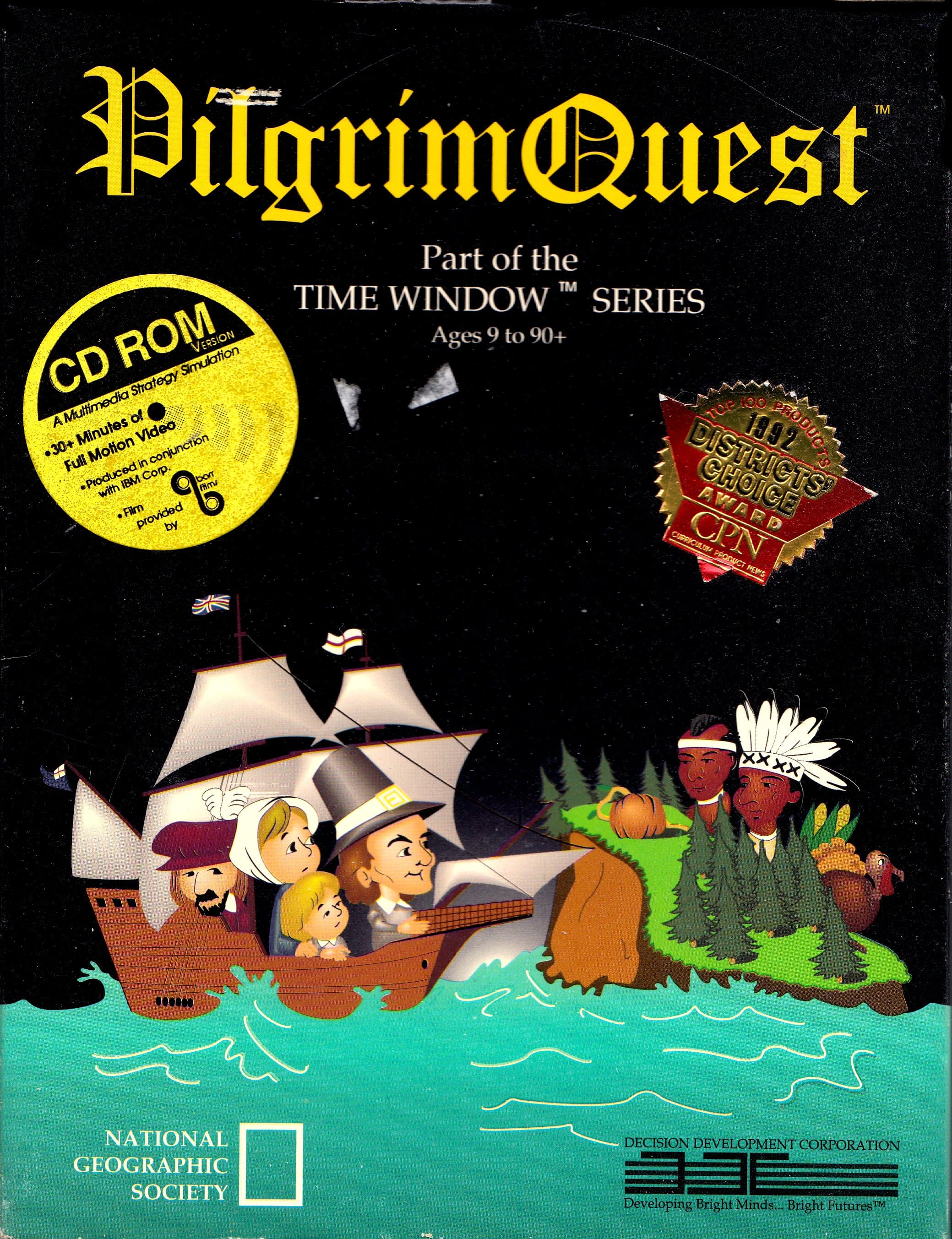
Long before modern survival simulators turned management into a chore, Pilgrim Quest forced elementary school kids to clear high-seas ship leaks and negotiate fur trades just to keep a 17th-century colony from collapsing.
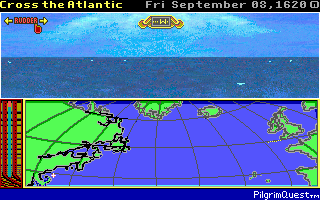
Most strategy games from this era let you stroll into the main simulation loop right away, but Decision Development Corp. makes you earn landfall. Before your settlers can chop down a single tree in Plymouth, you have to guide the Mayflower across a treacherous ocean screen. High waves batter the ship, water rises in the hold, and you are forced to rapidly mash your directional arrow keys to bail out the leaks before your journey ends at the bottom of the Atlantic. It is an abrupt, arcade-style wall, and you will likely need a few tries just to land on the coast safely.
Once you reach safe harbor and pick a spot for the colony, Pilgrim Quest shifts into its primary view. The layout gives you top-down strategy maps for broad planning, side-view perspectives for specific tasks, and first-person views during trade and exploration. You are immediately put in charge of assigning daily chores to the surviving passengers:
Jumping straight from high-level management into hands-on arcade action gives the early game a chaotic, erratic rhythm.
Surviving the wilderness requires more than basic manual labor; you have to establish relationships with the local Native American tribes. The trade interface lets you barter essential goods like food, furs, and beer to build goodwill and secure food supplies during desperate seasons. If you choose to steal resources or resort to open hostility, the game quickly turns into a brutal military struggle that an unprepared settlement will rarely survive.
Because the game leans heavily into its role as an educational game, the simulation logic expects you to pursue practical historical solutions rather than aggressive expansion. Yet the puzzle elements behind successful trade deals leave little room for error. If you mismanage your inventory and run out of bartering items early, your people will fall ill and work efficiency plunges to zero.
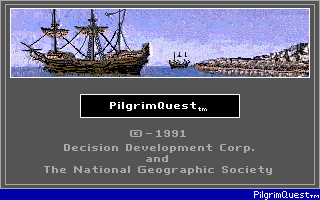
Looking at the 1991 landscape, Pilgrim Quest sat alongside other resource-heavy simulation titles of the DOS era, but its hybrid structure set it apart. It never delivers a hundred-hour campaign; in fact, once you figure out the resource ratios and master the oceanic bailing minigame, the experience is quite short and relatively easy to beat. The flaw isn't that the game is too complex, but that once you decode the optimum assignment routine, the danger evaporates.
The PC speaker clicks and crude Sound Blaster bleeps give the action-arcade sequences a distinct early-nineties weight. Decision Development Corp. originally built it for school computer labs, and while it spawned a Windows sequel years later, that strange mix of genres still makes for an interesting run.
If you spent your computer lab sessions failing to cross the ocean, you can tackle the challenge again right now. The original Pilgrim Quest MS-DOS game keeps all its sharp turns, from sudden ship leaks at sea to delicate fur bartering sessions. It works as a neat, bite-sized strategy test that doesn't waste your time.
You can play Pilgrim Quest free in your browser right here on this page with nothing to install and no setup required. Jump straight into the Mayflower's captain seat, get your arrow keys ready to bail out the ocean, and see if you can establish a self-sufficient colony on your very first run.
Long before modern survival simulators turned management into a chore, Pilgrim Quest forced elementary school kids to clear high-seas ship leaks and negotiate fur trades just to keep a 17th-century colony from collapsing.
Most strategy games from this era let you stroll into the main simulation loop right away, but Decision Development Corp. makes you earn landfall. Before your settlers can chop down a single tree in Plymouth, you have to guide the Mayflower across a treacherous ocean screen. High waves batter the ship, water rises in the hold, and you are forced to rapidly mash your directional arrow keys to bail out the leaks before your journey ends at the bottom of the Atlantic. It is an abrupt, arcade-style wall, and you will likely need a few tries just to land on the coast safely.
Once you reach safe harbor and pick a spot for the colony, Pilgrim Quest shifts into its primary view. The layout gives you top-down strategy maps for broad planning, side-view perspectives for specific tasks, and first-person views during trade and exploration. You are immediately put in charge of assigning daily chores to the surviving passengers:
Jumping straight from high-level management into hands-on arcade action gives the early game a chaotic, erratic rhythm.

Surviving the wilderness requires more than basic manual labor; you have to establish relationships with the local Native American tribes. The trade interface lets you barter essential goods like food, furs, and beer to build goodwill and secure food supplies during desperate seasons. If you choose to steal resources or resort to open hostility, the game quickly turns into a brutal military struggle that an unprepared settlement will rarely survive.
Because the game leans heavily into its role as an educational game, the simulation logic expects you to pursue practical historical solutions rather than aggressive expansion. Yet the puzzle elements behind successful trade deals leave little room for error. If you mismanage your inventory and run out of bartering items early, your people will fall ill and work efficiency plunges to zero.

Looking at the 1991 landscape, Pilgrim Quest sat alongside other resource-heavy simulation titles of the DOS era, but its hybrid structure set it apart. It never delivers a hundred-hour campaign; in fact, once you figure out the resource ratios and master the oceanic bailing minigame, the experience is quite short and relatively easy to beat. The flaw isn't that the game is too complex, but that once you decode the optimum assignment routine, the danger evaporates.
The PC speaker clicks and crude Sound Blaster bleeps give the action-arcade sequences a distinct early-nineties weight. Decision Development Corp. originally built it for school computer labs, and while it spawned a Windows sequel years later, that strange mix of genres still makes for an interesting run.
If you spent your computer lab sessions failing to cross the ocean, you can tackle the challenge again right now. The original Pilgrim Quest MS-DOS game keeps all its sharp turns, from sudden ship leaks at sea to delicate fur bartering sessions. It works as a neat, bite-sized strategy test that doesn't waste your time.
You can play Pilgrim Quest free in your browser right here on this page with nothing to install and no setup required. Jump straight into the Mayflower's captain seat, get your arrow keys ready to bail out the ocean, and see if you can establish a self-sufficient colony on your very first run.
How Pilgrim Quest is played — the keys the game listens to, grouped by what they do.
Highlighted keys are mapped — hover or tap one to see what it does.
Control information is limited; up and down arrow keys are used to bail water when prompted.
The on-screen keyboard and gamepad mapping the browser player uses on a phone, a tablet or a controller, as opposed to the real keys above. $PRO members make their own in the player and share them here; anyone can pick one to play with.
Cheat codes, console commands and memory pokes for Pilgrim Quest — each one verified and attributed.
Sign in to submitHow Pilgrim Quest is played — the keys the game listens to, grouped by what they do.
Highlighted keys are mapped — hover or tap one to see what it does.
Control information is limited; up and down arrow keys are used to bail water when prompted.
The on-screen keyboard and gamepad mapping the browser player uses on a phone, a tablet or a controller, as opposed to the real keys above. $PRO members make their own in the player and share them here; anyone can pick one to play with.
Cheat codes, console commands and memory pokes for Pilgrim Quest — each one verified and attributed.
Sign in to submit